
10 Things to Do in Naples on a 3-Day Stopover
Naples is a city of Greek street grids and Baroque chapels stacked above 2nd-century catacombs, with a live volcano across the bay and the pizza every other pizza imitates. The volcano is the thing to hold onto. Vesuvius is why the ruins down the coast are the best-preserved in the world, why the soil grows the tomatoes that go on the pizza, and why the city has spent two thousand years living beautifully in the shadow of a mountain that could turn on it — and most travelers sprint through all of it between the airport and a ferry. That's the mistake this list corrects.
If Naples is your stopover — the opening leg of a Southern Italy trip before Pompeii, the Amalfi Coast, or the push south to Puglia — give it the first three days rather than a lunch break. Landing here first is easier than it has ever been: since 2024, Delta, American, and United all fly to Naples nonstop from the US East Coast (Naples Airport official, 2026). Here are the ten things that argue the city's own case, with prices and transit for each.
1. Stand in front of the Veiled Christ at Cappella Sansevero

The Veiled Christ is a 1753 marble sculpture of Christ under a translucent veil, carved by Giuseppe Sanmartino from a single block of stone — the one thing in Naples nobody should skip.
You walk into a low, candle-warm room and there it is, a body laid out under a shroud so fine you can read the face through it. The veil is not a separate material laid over stone; it is the stone, and your eyes will keep refusing that fact. Naples being Naples, the marvel comes with a darker companion: down in the crypt sit two Anatomical Machines, eighteenth-century skeletons threaded with a simulated circulatory system, commissioned by a prince half the city believed was an alchemist. The room is tiny and sells out, so book online ahead (€8, closed Tuesdays — museocappellasansevero.it, 2026).
2. Walk Spaccanapoli end to end

Spaccanapoli is the kilometer-long, dead-straight street cut along the original Greek grid of Neapolis, founded 470 BC — and the fastest way to understand why Naples' historic center is a UNESCO World Heritage Site (UNESCO, 1995).
The name means "splits Naples," which it visibly does, slicing the old city in a line you can stand at one end of and lose to vanishing point. Walk it slowly and the centuries stack up around you: Baroque churches, presepe (nativity-scene) workshops where a craftsman paints a thumb-sized shepherd, street-food counters, and present-tense Neapolitan life all layered over the ancient grid — Europe's largest historic center, roughly 1,021 hectares of it. Go on a weekday before 11 a.m.; by midday in season it's shoulder to shoulder. It costs nothing, and it's the city's spine — items 1, 8, and half your meals sit on or just off it.
3. See MANN before you see the ruins

The Naples National Archaeological Museum (MANN) holds the originals from Pompeii and Herculaneum — the mosaics, frescoes, and bronzes pulled from the ash and moved here for safekeeping — plus the Farnese collection of classical sculpture (€20 — museoarcheologiconapoli.it, 2026).
Most visitors do the ruins first and the museum never, and they have it backwards. Spend two or three hours here first and the empty rooms down the coast turn legible — you stand in a stripped Pompeii house and already know the mosaic that was prised off its floor and the bronze that stood in its garden. The Farnese Hercules and Farnese Bull command the sculpture floor; the Alexander Mosaic is under restoration as of 2026 but viewable through observation points. Closed Tuesdays; book online in summer. Metro Line 1 to Museo, then three minutes on foot.
4. Make the ruins call: Pompeii or Herculaneum

Both cities died in the same 79 AD eruption of the volcano across the bay, both sit on the same commuter line, and the honest rule is one per day — Herculaneum for most travelers, Pompeii for sheer scale.
This is the excursion the whole stopover is built around, so choose for what each place does to you, not for the name you recognize. Herculaneum was a seaside town for the wealthy, sealed under superheated mud rather than ash, and the mud kept what ash burned away: second-story roofs, carbonized wooden beams and furniture, a baby's wooden crib, doorframes still in their walls. You walk streets that feel paused rather than ruined, in a town that draws a fraction of Pompeii's crowds. Pompeii answers with the opposite argument — 66 hectares of it, the Forum, the Amphitheater, the plaster casts of people caught where they fell, a whole city you can get lost in. Herculaneum takes 1.5–3 hours (€15; Circumvesuviana to Ercolano Scavi, €2.10, ~15 minutes); Pompeii eats a full day (€18–22 — pompeiisites.org, 2026; Circumvesuviana €3.20, ~35–40 minutes, or the calmer €6 Campania Express, mid-March to mid-October). Whichever you pick, take the first morning train and watch your pockets on the Circumvesuviana.
5. Get lost in the Quartieri Spagnoli

The Quartieri Spagnoli is the tight 16th-century grid west of Via Toledo where Naples' self-image lives — ground-floor kitchens turned trattorias, laundry strung overhead, the Maradona shrine, and the city's densest street food.
Turn off the main drag and the streets narrow to a few arm-spans, scooters threading through, a grandmother lowering a basket on a rope from a third-floor window. The Diego Maradona mural on Via Emanuele de Deo became a pilgrimage site after the footballer's death in 2020 — Naples worshipped the Argentine who won them their only league titles, and the cult around him here has no equivalent anywhere else in European sport. At the quarter's edge, the Pignasecca market is a working food market at local prices, a fishmonger calling out the morning's catch over crates of fish, produce, and fried things handed over in twists of paper. The neighborhood was rough for decades; it's now fine in daylight with ordinary city sense, and it kept the texture the postcard districts polished away. Come hungry, at lunch.
6. Take the catacombs tour in Rione Sanità

The Catacombe di San Gennaro are two underground levels of 2nd-century burial galleries lined with early Christian and Byzantine art, walked with guides from La Paranza, a neighborhood youth cooperative that funds local social programs (€9 — catacombedinapoli.it, 2026).
That is what makes this the most distinctly Neapolitan thing on the list: ancient, alive, and run by the young people of the quarter it belongs to, who turned a half-forgotten cemetery into work and pride for the streets above it. The surrounding Rione Sanità spent decades written off and is now in genuine revival; Time Out named it among the world's coolest neighborhoods, the only Italian entry (Time Out Naples, 2026). Stay for the double-ramp staircase at Palazzo dello Spagnolo, three minutes away, and pizza at Concettina ai Tre Santi if it's mealtime.
7. Eat pizza three different ways

Neapolitan pizza at the source — 900°F wood-fired ovens, San Marzano tomatoes from Vesuvius's soil, puffed cornicione (the blistered rim) — is materially different from the Neapolitan-style pizza anywhere else, served in three registers for €8–15.
This is the dish the city gave the world, and it has the receipts: the margherita was supposedly built here for a visiting queen, tomato, mozzarella, and basil laid out to flag the Italian tricolor, and Naples has been arguing about the perfect version ever since. Taste the argument. Sorbillo on Via dei Tribunali is the famous one — tourist-heavy, always queued, still excellent, so go at 12:30 or 7 p.m. sharp. 50 Kalò in Mergellina is the technician's pick, the one local pizza writers rank first (Time Out Naples, 2026). And Da Attilio on Via Pignasecca is the family room, Attilio Bachetti often at the oven himself, sliding the peel in and out with no queue and no Instagram presence, just the thing itself. Eat at least two of the three and disagree with somebody.
8. Eat standing up: sfogliatella, pizza fritta, cuoppo

Naples street food is its own canon, eaten on your feet for €2–8: the sfogliatella (a flaky shell-shaped pastry filled with ricotta), pizza fritta (a deep-fried half-moon of stuffed dough), and the cuoppo (a cone of fried seafood).
For sfogliatella, the chaotic, correct choice is Attanasio near Naples Centrale — order the riccia, the layered, fan-shaped version that shatters when you bite it and doesn't survive export, and eat it warm enough to fog the paper. For pizza fritta, Esterina Sorbillo's takeaway window on Via dei Tribunali is the canonical stop; a full one is lunch on its own. For the cuoppo, Il Cuoppo on Spaccanapoli does the reliable cone of zucchini flowers, anchovy fritters, and small fried fish (eatingeurope.com, 2026). Morning for the pastry, midday for the fried things, and napkins either way.
9. Ride the funicular to Castel Sant'Elmo and the Certosa
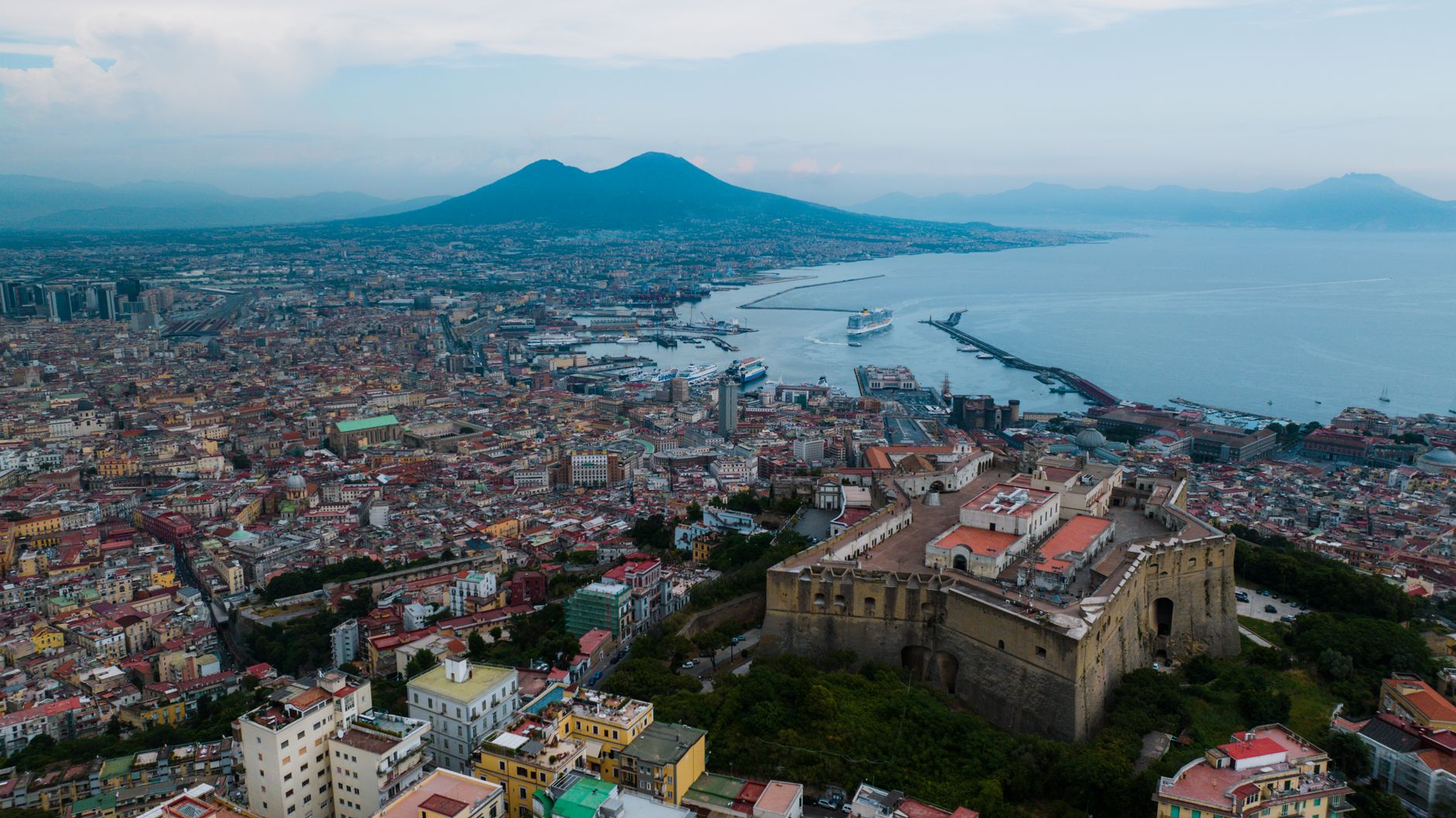
A €1.10 funicular ride lifts you through Naples' residential layers to Vomero hill, where Castel Sant'Elmo's ramparts hold the best 360° view in the city and the Certosa di San Martino sits next door, routinely and unjustly skipped.
The 14th-century fortress is the viewpoint (€5), and from the top the whole argument of the trip lays itself out below you: the grid of Spaccanapoli, the dome-studded historic center, the bay, and Vesuvius squatting at the far edge of it. The Carthusian monastery beside it is the quiet surprise — Cosimo Fanzago's sculpted Baroque cloister and the most important presepe collection anywhere (€6 — Lonely Planet, 2026). The funicular itself, included in any standard ANM transit ticket, is half the pleasure: a creaking vertical commute through the everyday city, packed at rush hour with people going home. Time it for late afternoon and you get the warm light over the bay on the ride down.
10. Walk the waterfront to Castel dell'Ovo

Castel dell'Ovo — the Castle of the Egg — is Naples' oldest fortress, set on a tiny island off the Lungomare, free to climb, and the natural last hour of any Naples day: ramparts, sea air, Vesuvius across the bay.
Start at Piazza del Plebiscito, the vast Bourbon square between the Royal Palace and the colonnaded basilica, then walk the fifteen minutes down to the water as the city loosens into evening. The castle's name comes from a legend that the poet Virgil hid a magic egg in its foundations — when the egg breaks, the story goes, the castle and the city fall with it, which is about as Neapolitan a way to end the day as exists. The Borgo Marinaro marina below has seafood restaurants that are scenic rather than cheap; for the view alone, the ramparts cost nothing (free, Mon–Sat 9 a.m.–7:30 p.m., Sun to 2 p.m. — visitnaples.eu, 2026).
Practical notes
Three days in Naples runs on a handful of practical facts — one transit card, one cover-charge custom, one honest safety briefing — plus the reminder that the city is the opening act of the south, not a layover to survive.
Get around on UnicoCampania tickets: €1.10 covers 90 minutes across metro, buses, and all four funiculars, and the €4.50 day pass pays for itself by ride three. At restaurants, the coperto — a per-person cover charge for bread and the table — is legal and standard at €1–3; it's printed on the menu, not a tourist trap (enjoyitaly.travel, 2026). On safety, once and then never again: Naples ranks below Rome, Milan, and Florence for general crime (wantedinrome.com, 2025). The specific cautions are pickpockets on the Circumvesuviana, motorbike bag-snatchers — keep your bag zipped and on the building side of the pavement — and unlicensed taxis. Official cabs are white; ask for the fixed rate.
And when the three days are up, you're already standing where the rest of Southern Italy begins: Pompeii and Sorrento on the commuter line, the Amalfi Coast by ferry via Salerno, Puglia by rail, Sicily by overnight ferry from the port. That's the stopover argument in one sentence — Naples isn't on the way to the south; it is the south, starting the moment you land.
Planning Naples? Two more guides worth a look: 5 days across Naples and Campania and Naples vs Rome as your gateway.
Frequently asked questions
Is Naples worth visiting — is it safe?
Yes on both counts. Naples ranks below Rome, Milan, and Florence for general crime (wantedinrome.com, 2025); the reputation is roughly twenty years out of date. The real risks are ordinary ones — pickpockets on the Circumvesuviana train, motorbike bag-snatching on open streets — and standard city vigilance covers them. What you get in return is Italy's deepest food culture and its largest historic center.
How many days do I need in Naples?
Two to three days covers the city well: the historic center and Cappella Sansevero, the archaeological museum, one neighborhood afternoon, and serious eating. Add a day per excursion — Pompeii or Herculaneum, or the Amalfi Coast — rather than compressing them. Naples rewards a real stay more than a rushed transit between train and ferry.
How do I get from Naples airport to the city center?
The Alibus shuttle runs from Capodichino to Piazza Garibaldi (Naples Centrale) in about 15 minutes for €5, every 20 minutes on weekdays (ANM, 2026). Official white taxis charge a fixed rate of around €23 to the center — ask for the tariffa fissa, the posted fixed fare. There's no direct metro line from the airport.
What's the best pizza in Naples — does it matter where I go?
It matters. Sorbillo on Via dei Tribunali is the famous one and deserves its queue; 50 Kalò in Mergellina is the technical benchmark many local pizza writers rank first; Da Attilio in the Quartieri Spagnoli is the family-run room Neapolitan pizza makers themselves name (Time Out Naples, 2026). Budget €8–15 and go at opening to skip the lines.
What's the difference between Pompeii and Herculaneum — which should I visit?
Pompeii is the famous one — vast, iconic, almost shadeless. Herculaneum was buried in volcanic mud rather than ash, so roofs, beams, and mosaics survived intact; it takes 1.5–3 hours and draws a fraction of the crowds. For most travelers with one day, Herculaneum is the better experience. Pick one — doing both in a day flattens both.
When is the best time to visit Naples?
April–June and September–October: temperatures of 18–24°C, manageable crowds, and accommodation running 25–35% cheaper than peak summer (naplesinsider.com, 2026). July and August are hot, crowded, and shadeless at the ruins, and many family-run restaurants close for two to three weeks in August for the traditional owner's holiday.