
3 days in Amsterdam: a Western Europe rail starter
Amsterdam is a city that earned its shape. In the 17th century, merchants funding the Dutch East India Company built four concentric semicircles of canals — the Grachtengordel (canal ring), a UNESCO World Heritage Site since 2010 — and lined them with narrow brick houses that lean toward each other at improbable angles because the waterways were the roads. The wealth that financed those facades also commissioned Rembrandt, funded Vermeer, and produced more paintings in 70 years than anywhere else in recorded history. You are looking at what a trading empire looked like when it spent its money on art.
It's also the opening leg of a Western Europe trip — and 3 days in Amsterdam is enough to make the case. Amsterdam Centraal puts Brussels under 2 hours away by Eurostar, Paris at 3 hours 20 minutes, and London at 4 hours 17 minutes — no domestic connector flight, no backtracking. For flexible travelers who want to move through Western Europe rather than in and out of a single city, flying into Amsterdam Schiphol and leaving by train is how the trip makes sense: you land in a city worth three days on its own, then step onto a high-speed rail corridor that connects three of Europe's major capitals. From Schiphol, recent low fares have come in around $248–$258 one-way from North America (Treverra search data, Sept–Oct 2026 windows), with typical advance fares in the $300–$450 range — competitive, though not dramatically cheaper than Paris or London in every window. The gateway case here is connectivity, not price arbitrage.
Why Amsterdam as a gateway
Amsterdam Centraal is one of Western Europe's best-positioned rail hubs: Eurostar trains run directly to Brussels-Midi, Paris Gare du Nord, and London St Pancras from city center — no transfer, no domestic connector flight.
The trip shape this enables: fly into Schiphol, spend three days in Amsterdam, then book a Eurostar east to Brussels (under 2 hours, from ~$34 one-way advance) or southwest to Paris (3h20, from ~$41 one-way advance) or northwest to London (4h17, from ~$69–$70 one-way advance) (Eurostar.com; Rail Europe, 2026; Trainline, 2026). If your trip ends somewhere other than Amsterdam, an open-jaw ticket — flying into one city and home from another, so you never retrace the same ground — works cleanly on this corridor. The alternative is entering via Paris or London and doing Amsterdam as an extra domestic leg; that's fine, but it adds a flight or a longer train ride at the start of a trip that would otherwise move in a single direction.
Amsterdam is a weaker fit if your entire itinerary is France, Spain, or Italy — Paris CDG or Madrid MAD often prices more attractively for those corridors, and the rail geometry points the wrong way. This is for travelers whose Western Europe trip crosses the northern arc: Belgium, the Netherlands, Germany, and at least one of France or the UK.
Day 1: The Jordaan and Anne Frank House
Day 1 stays inside the canal ring: the Jordaan on foot, the Anne Frank House in the afternoon — a pairing that sits in the same Golden Age city, three centuries apart in what that city made possible.

Start at Amsterdam Centraal to get your bearings — the Damrak approach south toward Dam Square gives you the city's civic architecture in one corridor — then walk thirty to forty minutes west into the Jordaan, or catch Tram 13 or 17 from Centraal. The neighborhood is dense with the domestic architecture of Golden Age wealth: narrow canal houses built by spice traders and VOC shareholders, their facades leaning forward over the water because the hoisting beams at the top were designed to winch cargo up to the upper floors, and because the plot taxes were levied by frontage width, not depth. The Jordaan was built to be functional; it became beautiful by accumulation.
At the Leliegracht/Prinsengracht intersection, the Westerkerk tower frames a sightline of canal, drawbridge, and leaning facades that local photographers still use as a reference point. The tower is the tallest in Amsterdam — 85 metres — and Rembrandt is buried somewhere in the church below, though the exact grave was never recorded (Westerkerk.nl). You can climb the tower for a wide view of the canal ring; it is worth the twenty minutes if you time it before the midday queue.
The afternoon belongs to the Anne Frank House at Prinsengracht 263. What the museum holds is not a reproduction or a re-creation — it is the actual concealed annexe where Anne Frank, her family, and four others hid for twenty-five months during the Nazi occupation, entered through a hinged bookcase disguised as a stationery shelf. The diary was written here. The rooms are preserved rather than restored; the pencil marks on the wall where Anne tracked her height during the hiding years are still visible. The physical experience of the cramped annexe closes the gap between the document and the place in a way that reading the diary alone cannot.
After the Anne Frank House, the bruin cafés — traditional Dutch brown-paneled pubs — in the surrounding streets are the natural place to decompress. The interior lighting in a bruin café is brown because the walls and ceiling have been stained by a century or more of pipe smoke; they are not staged to look old.
Quick reference — Day 1
- Jordaan walk: 30–45 min from Amsterdam Centraal on foot; Tram 13/17 from Centraal cuts it to 10 min. Free to wander.
- Westerkerk tower: €12.50; limited availability; book ahead at Westerkerk.nl. Tower closes in winter; check schedule.
- Anne Frank House: €16.50 adults / €7 ages 10–17 / €1 under age 10. Tickets released every Tuesday at 10am Amsterdam time (CET), for visits exactly 6 weeks ahead. In peak season (March–October) they sell out within hours of that Tuesday release. No walk-up tickets. No official resellers. Set an alarm for Tuesday 10am CET and book at AnneFrank.org (2026).
- Bruin cafés in the Jordaan: €4–€6 per beer. No reservation needed; dense independent options along Prinsengracht and the surrounding side streets.
- Evening: dinner in the Jordaan or along Prinsengracht; independent restaurants along the canal streets are a short walk from the Anne Frank House.
Day 2: Museumplein, De Pijp, and the Albert Cuyp Market
Day 2 moves south from the canal ring to Museumplein and the De Pijp neighborhood — two museum visits that share a public square and two kilometers apart from each other, with the Albert Cuyp Market filling the afternoon with the city's oldest outdoor trading tradition.
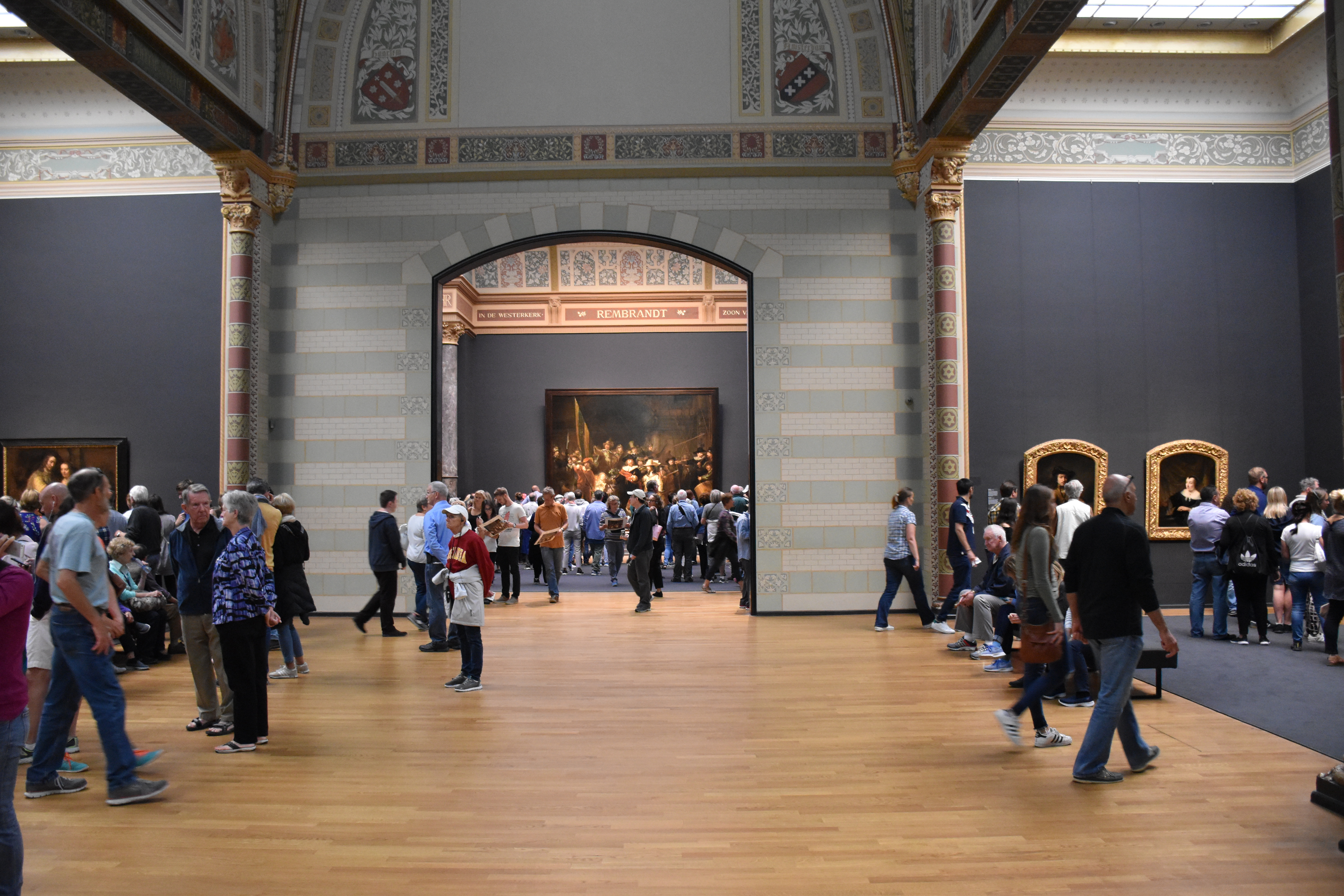
Open the day at the Rijksmuseum at 9am, when the halls are quietest. The building was designed in the 1870s with a specific organizing principle: the Gallery of Honour corridor — a long vaulted hall of Golden Age masterpieces — was built to culminate in a single painting. That painting is Rembrandt van Rijn's The Night Watch, a militia portrait measuring 363 by 437 centimetres, and the building's entire spatial sequence leads the visitor toward it. By the time you reach it at the end of the corridor, you have passed thirty years of Dutch Golden Age output — Vermeers, Steens, Hals' early group work — and arrived at the painting that required a dedicated hall to contain it. The Dutch Republic of roughly 1588 to 1672 produced an estimated 5 million paintings in 70 years, more than any comparable period anywhere in history; the Rijksmuseum is where the distillation of that output lives.
Ten minutes on foot from the Rijksmuseum, across the wide open square of Museumplein, is the Van Gogh Museum. Two hundred paintings and five hundred drawings trace Van Gogh's full arc: the dark Nuenen work of the Dutch period, the brightness break of Paris, the fever-pitch output of Arles and Saint-Rémy. The progression through the building is chronological; by the last rooms you understand the Dutch countryside of his early years as the origin of everything that followed.
The afternoon goes to De Pijp, a 19th-century residential grid ten minutes' walk from Museumplein. The neighborhood's main artery is the Albert Cuyp Market, which has run along Albert Cuypstraat since 1905 — 260 stalls stretching nearly a kilometre, six days a week. The market is where you eat two things Amsterdam does specifically: a hot stroopwafel pressed to order at stand 144 (€2.50, the two crisp waffle rounds with syrup melting between them bearing no resemblance to the packaged version), and raw herring with onion and a pickle spear at the fish stand near Sweelinckstraat. The herring comes non-sliced — you hold it by the tail and eat downward — and has been served this way at this market since 1916. The fish-and-onion combination was already documented in Dutch still-life paintings before the market existed; at the Albert Cuyp stand, you are eating a tradition rather than a snack.
Quick reference — Day 2
- Rijksmuseum: €25 adults; free under 18. Open daily 9am–5pm; closed April 27 and December 25. Online timed entry only — no walk-up sales. Tuesdays and Wednesdays quietest; arrive at 9am or after 3pm to avoid midday crowds (Rijksmuseum.nl, 2026). The Dutch Golden Age produced an estimated 5 million paintings in 70 years — more than any comparable period in history (DailyArt Magazine, 2024).
- Van Gogh Museum: €25 adults; free under 18. Open daily 9am–6pm (Fridays to 9pm). Book 2–4 weeks ahead; sells out in peak season (VanGoghMuseum.nl, 2026).
- Albert Cuyp Market: Free entry. Monday–Saturday 9am–5pm; closed Sundays. Arrive before 10am for the freshest picks (IAmsterdam.com, 2026). Raw herring at the fish stand near Sweelinckstraat has been served this way since 1916 (Adam and Eve Food Tours, 2026).
- Museumplein: Free public square between the Rijksmuseum and the Van Gogh Museum; a useful 2-minute buffer between the two visits. Free summer outdoor concerts at the Vondelpark Openluchttheater nearby (June–August).
Day 3: Amsterdam Noord and Haarlem
Day 3 crosses the IJ River to the post-industrial north side of the city, then catches a train west to Haarlem — a half-day in a Dutch provincial town that gives you the genealogy of everything you saw at the Rijksmuseum on Day 2.
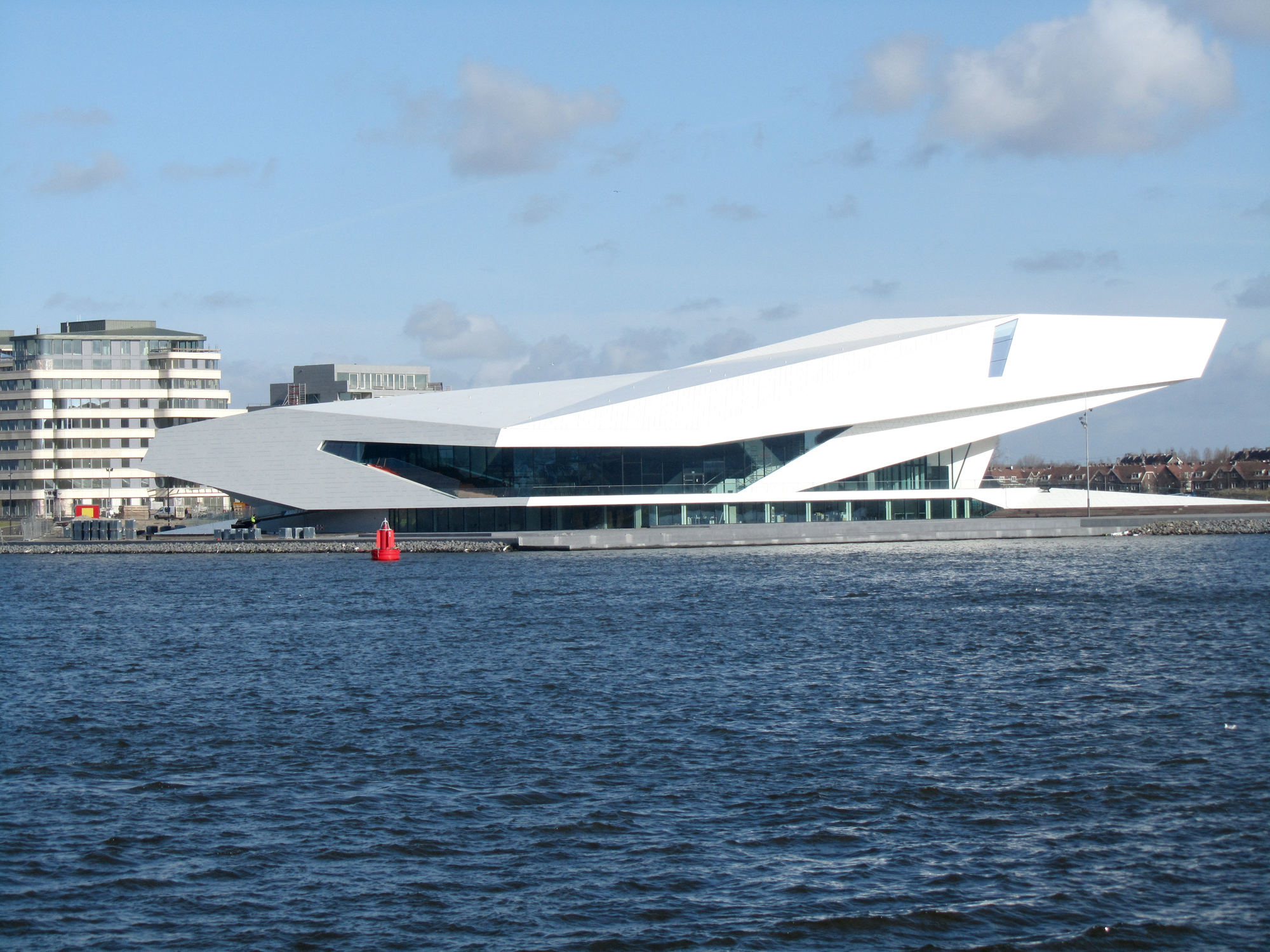
The free IJ ferry departs from the dock directly behind Amsterdam Centraal 24 hours a day, seven days a week. The crossing takes five minutes, bikes are welcome, and there is no ticket to buy — no OVpay tap, no queue, nothing. The ferry delivers you to Amsterdam Noord — a former Royal Dutch Shell research campus and shipyard landscape now populated by industrial-scale street murals, the EYE Film Institute in a 2012 cantilevered concrete building that leans over the IJ waterfront, container-bar beach clubs, and the NDSM Wharf at the far north end of the district where quarterly flea markets and film screenings run inside a warehouse large enough to hold an aircraft carrier. The contrast with the canal ring is the point. The Golden Age Amsterdam you spent two days inside was built on capital accumulation; this Amsterdam was built on labour, and then abandoned when the labour moved elsewhere, and then reclaimed by the people who needed cheap space.
From Amsterdam Centraal, a train departs for Haarlem every fifteen minutes; the ride takes twenty minutes and the one-way fare is around €4.50. Haarlem is what most Dutch cities looked like before tourism reoriented them toward visitors: a canal ring of its own, smaller and less visited than Amsterdam's, a market square with a functioning Monday market, and the Frans Hals Museum holding the definitive collection of Golden Age civic guard group portraits. This matters to the Amsterdam itinerary because of what Hals' work is: the artistic format that produced The Night Watch. Hals was painting citizen-militia groups in Haarlem in the 1620s and 1630s while Rembrandt was still a young painter from Leiden learning the format; the Rijksmuseum's organizing masterpiece is, among other things, the endpoint of a tradition that began in this building. The museum runs at a fraction of Amsterdam's visitor volume. You can stand in front of the paintings.
The Grote Kerk on the market square is worth thirty minutes: a 15th-century Gothic nave and the Müller organ that the young Mozart played during a family tour in 1766 (the organ is still played at regular recitals). The church makes no spectacle of the Mozart connection; there is a small plaque. Half a day in Haarlem is enough for the museum, the Grote Kerk, and lunch near the market square; return to Amsterdam Centraal in the afternoon and you are positioned for the evening Eurostar.
If you would rather stay in the canal ring on Day 3, the Rembrandt House Museum (Jodenbreestraat) offers a different angle on the Golden Age. Where the Rijksmuseum presents the product — the masterpieces in a grand hall — the Rembrandthuis presents the workshop: the canal house where Rembrandt lived and worked from 1639 to 1658, restored to period state, with his print-making equipment and the collection of shells, antler horns, and Flemish paintings he accumulated compulsively before going bankrupt in 1656 because he could not stop spending on exactly this collection. For a half-day complement, an electric small-boat canal cruise with operators like Pure Boats or KINboat accesses the narrower waterways — Brouwersgracht, Reguliersgracht, the Jordaan canals — that the large tour vessels cannot enter.
Quick reference — Day 3
- IJ ferry to Amsterdam Noord: Free; 24/7; departs behind Amsterdam Centraal. Buiksloterweg and NDSM are the two most useful stops. Bikes welcome.
- EYE Film Institute: Admission varies by screening (~€11–€14). Exterior and waterfront terrace are free to walk.
- A'DAM Tower lookout: €17.50 adults (A'DAM Tower, 2026). Optional — the exterior view from the IJ is free.
- Train to Haarlem: Every 15 minutes from Amsterdam Centraal. ~€4.50 one-way, 20 minutes (Trainline, 2026).
- Frans Hals Museum (Haarlem): Check current admission at franshalsmuseum.nl. Allow 1.5–2 hours.
- Grote Kerk (Haarlem): Small admission; check current hours at grotekerk.nl.
- Rembrandt House Museum (secondary option): €23.50 adults (off-peak 4–6pm: €19.50); ages 25 and under €15. Open daily 10am–6pm; closed April 27 and December 25. Book a start time online at Rembrandthuis.nl (2026).
- Small electric boat canal cruise (secondary option): €25–€50/hour with operators including Pure Boats and KINboat. Book ahead in peak season (April–September).
Onward to Brussels, Paris, or London
Amsterdam Centraal is the gateway payoff: from here, three of Western Europe's major cities are reachable by Eurostar without a single additional flight, and the rail leg works in any direction the rest of your trip needs to go.
All three Eurostar routes depart from Amsterdam Centraal directly — no transfer to a separate rail hub. Passport control and a security check happen at the Amsterdam departure end, so arrive at least 30 minutes before your train. The Eurostar operates under UK and Schengen border protocols on the London route; bring your passport regardless of destination. Dynamic fares rise sharply as departure approaches, so booking several weeks ahead — especially for Paris and London — is how it works.
Brussels in under 2 hours (from ~$34 one-way advance) is the natural first stop on a multi-city Belgium leg: the Grand-Place, Flemish Gothic churches, and a beer tradition that looks nothing like the Amsterdam craft scene. Paris in 3 hours 20 minutes (from ~$41 one-way advance) needs no argument. London in 4 hours 17 minutes (from ~$69–$70 one-way advance) completes the northern arc (Eurostar.com; Rail Europe, 2026; Trainline, 2026). For travelers whose flight home departs from Paris CDG or London Heathrow rather than Schiphol, this is where the open-jaw routing closes: you flew into Amsterdam and you fly home from a different city, without retracing a single kilometre.
Cologne is also an option for a Germany leg, served by ICE and IC trains from Amsterdam Centraal in 2h33 to 3h44 — a natural connection point toward Frankfurt, Munich, or the night train corridor into Switzerland and Italy.
Book your Eurostar leg at the same time you book your transatlantic flight: advance fares are meaningfully cheaper, and the most popular Paris and London departures on Friday and Sunday afternoons sell out weeks ahead in peak season.
Practical notes
Amsterdam is a straightforward city to navigate for first-time visitors, with good English coverage across the tourism sector and a public transit system that now accepts contactless bank cards on every route — but several logistics require advance attention, particularly for the museums.
Getting around. The GVB — Amsterdam's public transport operator, running trams, metro, buses, and the free IJ ferry — uses OVpay, which lets you tap in and out with a contactless bank card or phone on all routes. Daily cap: €10.50. A single tram ride runs roughly €1.50–€3 depending on distance. GVB day passes (1 day €10, 2 days €16, 3 days €21.50) are available if you prefer a flat fee (GVB, 2026). The IJ ferry to Amsterdam Noord has no tap — it is simply free.
From Schiphol to the city. A direct train from Schiphol's rail station (directly below the terminal) to Amsterdam Centraal runs every 10 to 15 minutes, taking 16 to 18 minutes. A second-class ticket costs €6.20. Taxis to the center run €40–€55; Uber and Bolt operate from the airport. Avoid unmarked taxis at Centraal — the scam risk is documented and the official taxi queue is clearly signed.
Museum bookings. The Rijksmuseum, Van Gogh Museum, and Anne Frank House all require online booking with timed entry; none sell walk-up tickets. The Anne Frank House is the most constrained: tickets release every Tuesday at 10am CET for visits exactly 6 weeks ahead, and in peak season (March–October) they sell out within hours. Book before you leave home, and book the Anne Frank House specifically on the Tuesday that falls six weeks before your planned visit date. The Van Gogh Museum sells out days to weeks ahead in season; book 2–4 weeks in advance. The Rijksmuseum is easier to book but still requires an online timed slot.
Money and tipping. The Netherlands uses the euro. Card payment is near-universal and many venues are card-only (the Rijksmuseum is cashless). Tipping is not expected the way it is in North America: 5–10% for a full restaurant meal, rounding up for café drinks. Most payment terminals offer a tip option when you tap — decide in advance and the tap is fast (DutchReview, 2026).
Language. Dutch is the official language. English is near-universally spoken in Amsterdam's hospitality and tourism sectors; you will not need Dutch for any part of this itinerary.
Holland vs. the Netherlands. Holland refers only to two of the Netherlands' twelve provinces — North Holland and South Holland. Amsterdam is in North Holland. The country is the Netherlands; "Holland" as a synonym for the Netherlands is a common Anglophone shorthand that Dutch people notice. Not trip-ruining, but worth knowing.
WorldPride 2026. WorldPride 2026 runs July 25 through August 8 — the highest-demand pricing window of 2026 for Amsterdam hotels, with all museums and most restaurants requiring advance reservations further out than usual. The Canal Parade is August 1. Avoid if you are seeking lower prices and smaller crowds; prioritize if the event draws you (IAmsterdam.com, 2026).
An afternoon worth adding. If any afternoon has an unscheduled hour or two, consider Brouwerij 't IJ in eastern Amsterdam. In 1985, a Dutch musician named Kaspar Peterson — frustrated by Amsterdam's limited beer culture — converted a 19th-century public bathhouse directly adjoining the De Gooyer windmill (the tallest post-mill in the Netherlands) into a working organic brewery. There are now twelve standard beers and three seasonal releases, all organic, and the outdoor terrace sits on the IJ waterfront with the windmill directly overhead. The tasting room is open daily 2pm–8pm; it is located about fifteen minutes by tram or bike from Centrum, which is enough distance to mean the clientele is mostly local (Brouwerijhetij.nl; IAmsterdam.com, 2026).
Safety. Amsterdam is among the safer European capitals for violent crime. Pickpocket risk is real at Centraal Station, Dam Square, the Albert Cuyp Market, and on Trams 2 and 5; keep phones and wallets in front pockets and bags zipped and worn across the chest in busy areas. Real Dutch police do not ask to inspect your wallet — if someone presents themselves as police and asks for cash, refuse and walk away.
ETIAS. US travelers may need ETIAS (the EU's Electronic Travel Information and Authorisation System) pre-authorization before entering the Netherlands — check travel.state.gov before departure. When ETIAS launches, the fee is expected to be €20 per application, valid for three years or until your passport expires, whichever comes first. ETIAS is not yet operational as of June 2026; the launch is expected in Q4 2026 but has been delayed before.
Frequently asked questions
Is 3 days enough for Amsterdam?
Three days in Amsterdam is enough to cover the Jordaan and Anne Frank House on Day 1, Museumplein and De Pijp on Day 2, and Amsterdam Noord plus a half-day in Haarlem on Day 3. That third day is also the natural pivot point to board a Eurostar from Amsterdam Centraal toward Brussels, Paris, or London — the trip you came to start.
How do I get from Amsterdam to Paris by train?
The Eurostar runs direct from Amsterdam Centraal to Paris Gare du Nord in 3 hours 20 minutes, with 10 trains daily. Book on Eurostar.com or Trainline; advance fares start around $41 one-way. You go through passport and security at Amsterdam Centraal before boarding — allow 30 minutes. Cheaper tickets sell out weeks ahead in peak season.
Can I book the Anne Frank House without planning ahead?
No. The Anne Frank House releases tickets every Tuesday at 10am Amsterdam time, for visits exactly 6 weeks ahead. During peak season (March through October) they sell out within hours of that release. There are no walk-up tickets and no official resellers. Set an alarm for Tuesday 10am CET — that is the only reliable way to get in. Book at AnneFrank.org.
When is the best time to visit Amsterdam to avoid crowds?
September and October offer post-peak crowds and lower hotel rates while keeping the weather mild. April and May are beautiful but busy, with Keukenhof tulip gardens open for a limited window. WorldPride 2026 runs July 25 through August 8 — the highest-demand pricing window of the year for Amsterdam hotels and museums, so plan around it or for it.
How do I get from Schiphol Airport to Amsterdam city center?
A direct train runs from the rail station directly under Schiphol's terminal to Amsterdam Centraal every 10 to 15 minutes. The ride takes 16 to 18 minutes; a second-class ticket costs €6.20 without an OV-chipkaart. OVpay — tapping your contactless bank card or phone — works on all city trams, buses, and metros once you're in Amsterdam, so most short-stay visitors have no reason to buy a separate transit card.
What is the OV-chipkaart, and do I still need one in 2026?
The OV-chipkaart is the Netherlands' legacy transit card. As of 2026, OVpay has replaced it for most visitors: tap your contactless bank card or phone to board GVB trams, metros, and buses, and tap out on exit. A daily spend cap of €10.50 applies. You only need an OV-chipkaart if your bank card doesn't support contactless payment, which is rare for North American travelers with Visa or Mastercard.
Do I need to speak Dutch in Amsterdam?
No. English is near-universally spoken in Amsterdam's hospitality and tourism sectors — restaurants, museums, transit staff, hotels, and market stalls all operate comfortably in English. Amsterdam is one of the most international cities in Europe; less than half of its residents are Dutch-born. You will not need Dutch for any part of a standard 3-day visit, though a word of greeting in Dutch is always appreciated.
Can I do a day trip to Haarlem from Amsterdam?
Haarlem is 20 minutes from Amsterdam Centraal by train, with departures every 15 minutes and a one-way fare of around €4.50. The Frans Hals Museum alone makes the trip worth it — Hals' 17th-century civic guard portraits are the direct ancestor of the Rijksmuseum's Night Watch, and the city runs at a fraction of Amsterdam's visitor volume. A half-day from Amsterdam comfortably covers the museum and the market square.