
3 Days in Brussels: The Rail-Hub Gateway to Western Europe
Brussels is the best-positioned starting point for a multi-city Western Europe trip — a capital of gilded guildhalls, Art Nouveau town houses, and beer brewed nowhere else, set down at the exact point where the high-speed lines of four countries cross. Stand on the concourse at Brussels-Midi and you can read the departure board like a map of the continent: Paris, Amsterdam, London, and Cologne, each one closer than the far edge of a big city's own suburbs. That is the real reason Brussels works as the opening leg of a bigger trip rather than a place you squeeze into a layover — you fly in once, and then the trains take you everywhere.
It helps that the city you've landed in is worth the days before you board. Three days here gets you the Grand Place at first light when the square is yours, the Saint-Gilles streets where Art Nouveau was invented, a glass of lambic poured a few blocks from the open vats where the wild yeast still finds it, and a medieval Flemish city an hour away for the price of a sandwich — and then the rail crossroads carries you on to the next capital faster than most cities get you from the airport to your hotel.
Why Brussels as a gateway
Brussels earns the gateway role on position, not airfare: a quick train from the airport straight into the centre, and Paris, Amsterdam, London, and Cologne each under two hours away on direct high-speed rail from a single station.
Start with the honest part. Paris and Amsterdam are mega-hubs with denser nonstop competition from North America, and they frequently price lower than Brussels on the transatlantic leg. If the absolute cheapest flight to Europe is your only goal, Charles de Gaulle or Schiphol often wins outright. Brussels wins on what happens after you land — and what happens is that the whole map opens up from one place you can walk into off the plane.
The transfer is the first advantage. The train station sits directly beneath the terminal at Brussels Airport (Zaventem), so there's no hour-long express into town, no airport upsell — you ride the escalator down from arrivals and step onto a platform. By the time travelers landing at the bigger hubs are still queueing for a regional train, you're already watching the city go by.
The rail ring is the second, bigger advantage. From Brussels-Midi, direct trains reach Paris, Amsterdam, London, and Cologne — no other Western European entry point puts four major capitals inside a two-hour ring this cleanly. It even supports a fly-in-once, train-everywhere loop: Brussels to Ghent or Bruges, up to Amsterdam, down to Paris, and home from there, without a second flight anywhere in the trip. The departure board does the work a connecting airport would, minus the security line and the airfare.
This is a trip for flexible travelers booking three to eight weeks out who want several cities, not one. If you only want Paris, or you're booking inside two weeks, a nonstop to the mega-hub is usually the better call.
Quick reference — the gateway numbers
- Transatlantic fares: BRU round-trips from New York around $348, recent lows near $230 on flexible off-peak dates — solid, but CDG/AMS often price lower (momondo / KAYAK, June 2026).
- Airport train: directly beneath the terminal at Brussels Airport (Zaventem); ~17–20 min to Brussels-Central, departures roughly every 10 min (Brussels Airport, June 2026).
- Onward rail from Brussels-Midi: Paris ~1h22 from €29; Amsterdam ~1h52 from €25–€34; London ~1h52 from around $42; Cologne ~1h50 from €12–€22 (Eurostar / Trainline / Rail Europe / Omio, June 2026).
Day 1: Arrival and the icons at the right hours
Day 1 lands you, drops the bags, and covers central Brussels' icons at the hours they're actually worth seeing — the Grand Place at first light or after dark, the Galeries off-peak, and the city's surrealist streak in the afternoon.
Time the Grand Place deliberately. The square — ringed by ornate Baroque and Gothic guildhalls, the Town Hall, and the King's House — is genuinely the city's showpiece, and by midday it's wall-to-wall tour groups. Come just after sunrise and you'll have it to yourself: gold light climbing the gilded facades, a street-sweeper working the empty cobbles, the smell of the first waffle iron warming up somewhere off the corner. Or come after dark for the illuminations. If you land midday, save it for tonight and start elsewhere.
One rule while you're in the neighborhood: don't eat on the square or on Rue des Bouchers, the restaurant strip just north of it. Touts, laminated menus, inflated bills — it's the textbook tourist trap, and better food is a ten-minute walk away in any direction.
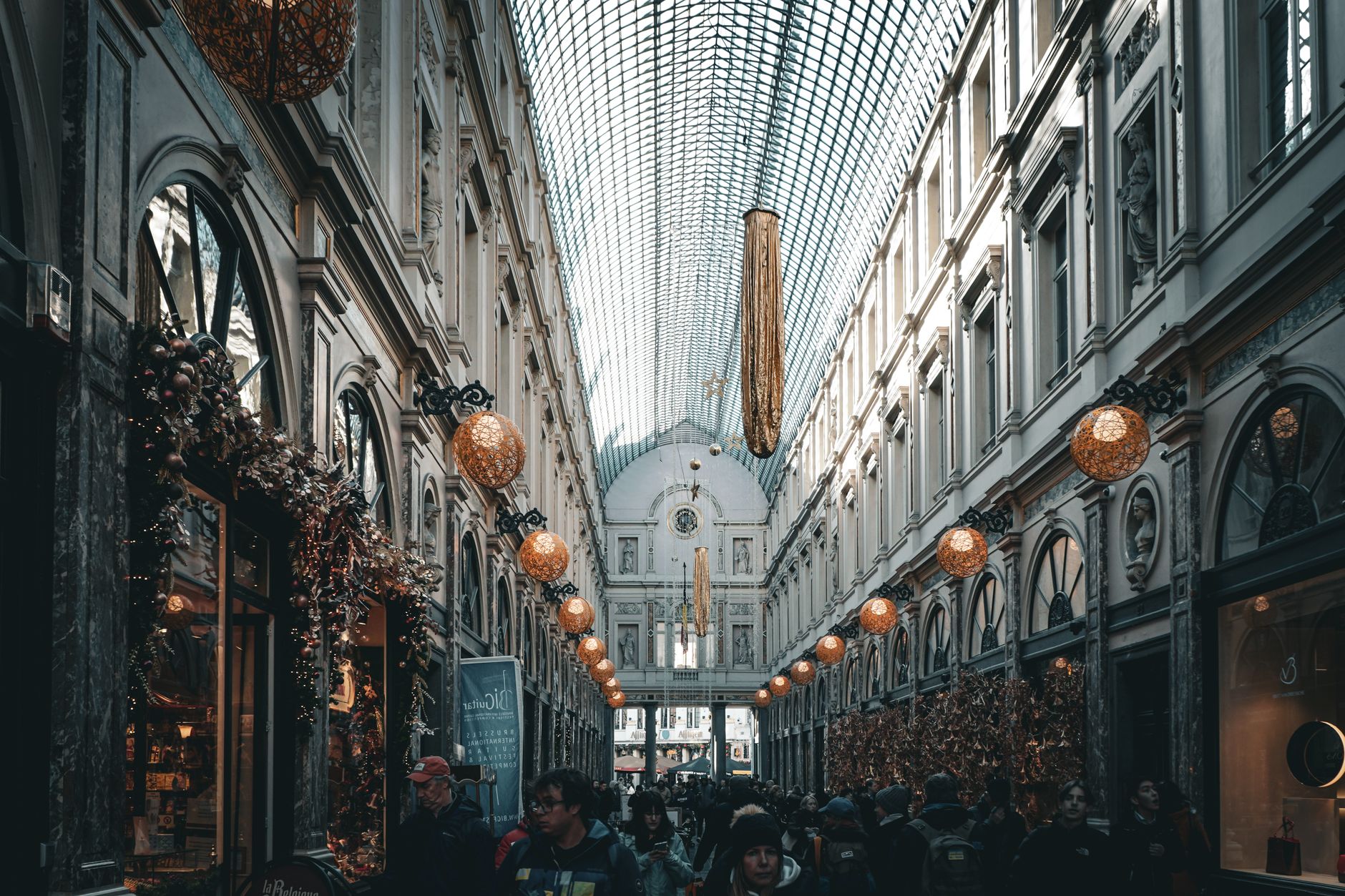
Galeries Royales Saint-Hubert, two minutes from the square, is an 1847 glass-roofed shopping arcade — one of Europe's oldest covered galleries — lined with chocolatiers and cafés. Walk it off-peak; the midday crush is real. For chocolate, hold out for the Sablon, the upper town's twin squares, where the city's top chocolatiers share the streets with antique dealers and a weekend antiques market, minus the arcade scrum.
Manneken Pis is on the way and takes two minutes: a tiny bronze statue behind a barrier on a small, crowded corner. Some travelers find it charmingly absurd; plenty of others rank it among Europe's most overrated stops. See it, smile at the costume of the day — the city keeps it a wardrobe of hundreds and dresses it for everything from saints' days to football wins — and keep walking.
Spend the afternoon uphill at the Magritte Museum on the Mont des Arts. Surrealism runs deep here — this is the city that put a pipe in a frame and wrote underneath it that it was not a pipe — and this is Belgium's strongest single-artist museum, set inside one of Europe's better museum clusters. Step back out onto the Mont des Arts terrace afterward for the classic panorama down over the lower town.
For dinner, eat the national street food properly. Frites come from a real friterie (a dedicated frites stand — fritkot in Dutch), and the Belgian method is the point: the potatoes are fried once to cook them through, rested, then dropped a second time in hotter fat until the outside shatters and the inside stays soft — double-fried, served in a paper cone with a sauce you point at. Friterie de la Chapelle is the central pick. Then order your first lambic at Moeder Lambic Fontainas, which curates Belgian beer the way a good wine bar curates its list — a low-key introduction to the sour, funky, barrel-aged tradition you'll trace to its source tomorrow.
Quick reference
- Airport train: ~17–20 min to Brussels-Central, every ~10 min, ~05:00–midnight; budget ~€11 one-way incl. airport supplement (SNCB / Brussels Airport, June 2026).
- Grand Place: free, open 24h, UNESCO-listed since 1998. Go at sunrise or after dark; skip the square-front restaurants and Rue des Bouchers.
- Galeries Royales Saint-Hubert: free to walk through; off-peak hours best.
- Manneken Pis: free; the statue is 61 cm; two minutes.
- Magritte Museum: ~€12–€16 entry, allow 1.5–2h (Royal Museums of Fine Arts, June 2026). Metro: Gare Centrale / Parc.
- Friterie de la Chapelle: €3–€5; cash often preferred at stands.
- Moeder Lambic Fontainas: walk-in, no booking.

Day 2: The Brussels locals keep
Day 2 leaves the postcard centre for the neighborhoods where Brussels actually lives: the Marolles flea market in the morning, lambic at its source before lunch, Art Nouveau in Saint-Gilles, and dinner across town in Ixelles.
Start in the Marolles, the historically working-class district below the Palais de Justice, where the daily flea market on Place du Jeu de Balle runs from dawn until early afternoon — brocante (secondhand and antique bric-a-brac) stalls, old brasseries, and a market that still belongs to the people who live here. Go early, while the stalls are full and a vendor is still willing to haggle over a chipped enamel sign with one hand and his coffee in the other.
Late morning, make your way to Cantillon in Anderlecht, a family brewery working since 1900 and the authentic home of the lambic tradition. This is the part of Brussels worth crossing town for. Lambic isn't brewed so much as it's caught: the hot wort is pumped up to a shallow open vat in the roof, called a coolship, and left overnight to the air, so the wild yeasts and bacteria that drift through this particular corner of the Senne valley — and nowhere else — settle into it and start the fermentation. Gueuze is a blend of young and old lambics, refermented in the bottle like champagne; kriek is lambic steeped on sour cherries until it turns the colour of garnet. That a beer can only be made here, from the air over Brussels, is a large part of why Belgian beer culture sits on UNESCO's intangible-heritage list. The tourist-packed Delirium Café holds a Guinness record for the sheer number of beers on its menu, and it's a fun night out — but Cantillon is the real story.
In the afternoon, cross into Saint-Gilles for the city's most under-marketed asset. Brussels is the birthplace of architectural Art Nouveau, and the Horta Museum — Victor Horta's own house and studio at 23–25 Rue Américaine — holds the movement's most extraordinary interiors: mosaics, stained glass, and a famous stairwell where the daylight seems to pour down the ironwork like water. Horta's four town houses are UNESCO-listed, and his Tassel House of 1893 is widely cited as the first true Art Nouveau building anywhere. The other three are private, so admire the facades on a free self-guided walk through Saint-Gilles — a compact district that locals describe as feeling like a village inside the city (Visit Brussels).
Finish in Ixelles. Place Flagey, anchored by the curved Art Deco "paquebot" (ocean-liner) building and a popular weekend food market, and the Ixelles ponds beside it are where the city unwinds on a warm evening; Café Belga on the square is the classic hangout, its terrace packed the moment the sun comes out. For dinner, walk into Matongé, Brussels' Congolese quarter, for the best African food in the city. And if you pass a waffle stand along the way, buy one plain and eat it standing up, the sugar still crackling — that's how Brussels actually eats them, not buried in cream at a sit-down café.
Quick reference
- Place du Jeu de Balle flea market: daily, dawn–~14:00 (later on weekends); free. Metro: Louise / Porte de Hal.
- Cantillon: tour + tasting ~€10–€12; book ahead (Cantillon, June 2026). Cash useful.
- Horta Museum: ~€12 entry; the Saint-Gilles Art Nouveau facade walk is free; Horta's four town houses UNESCO-listed since 2000 (Horta Museum, June 2026).
- Waffle from a street stand: plain, €3–€4 — the local way; skip the €12 cream-piled café version.
- Ixelles / Place Flagey: ~15 min from the centre by tram; Flagey food market on weekends.
- Matongé dinner or Café Belga: walk-in friendly.
Day 3: The Flemish day trip — Ghent or Bruges
Day 3 is the day trip that justifies basing in Brussels: a medieval Flemish city 30 to 60 minutes up the line for the price of a couple of coffees, no booking, no plan — buy a ticket, board, and let the rail hub do what it's good at.
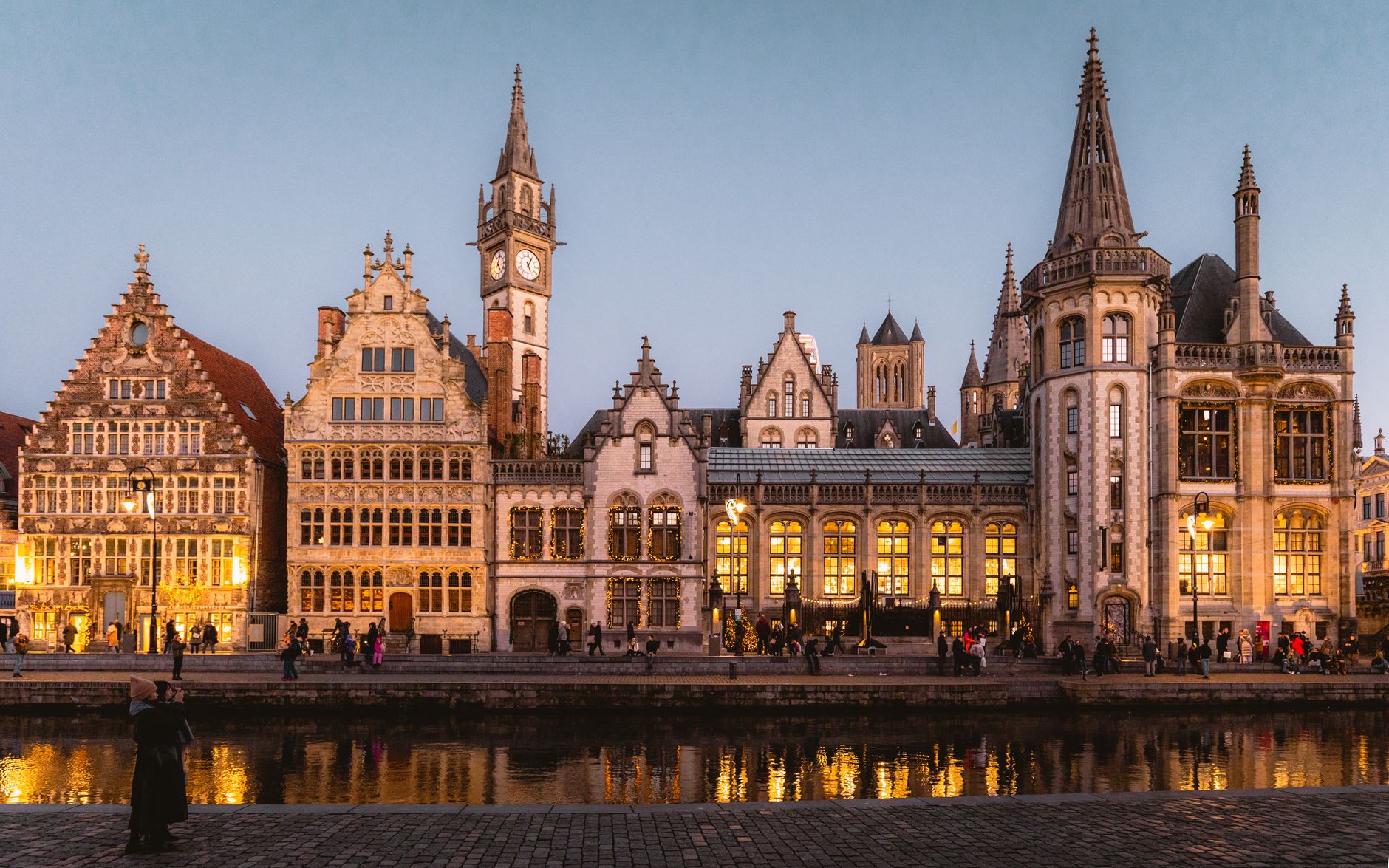
Ghent is the pick if you choose one. It pairs the medieval beauty — the gabled merchants' houses along the Graslei and Korenlei waterfront, the towers, the canals catching the late light — with a living university city around it: real bars, real residents, students cycling home past 800-year-old guildhalls. Bruges is the more famous and more postcard-perfect option, the preserved "Venice of the North," and correspondingly more touristed; lovelier on a photograph, busier underfoot.
The logistics could not be simpler, which is the whole point of using Brussels as your base. Trains to both run frequently all day and need no advance booking — buy a point-to-point one-way ticket and board. The two cities sit close enough together that an ambitious long day can combine them: Ghent in the morning, Bruges in the afternoon, back to Brussels for dinner. Antwerp is the alternative day trip, for fashion, diamonds, and Baroque painting.
Back in Brussels by evening, take ten minutes to confirm tomorrow's train out — the gateway's whole promise is the easy onward leg, and it rewards a booked seat. And if you somehow have a fourth morning, the Atomium, the 102-metre stainless-steel model of an iron crystal built for Expo 58, is a short Metro ride north to Heysel, paired naturally with the Mini-Europe miniature park next door. Fair warning: the exterior is the photograph, and opinions genuinely split on whether the interior justifies the ticket.
Quick reference
- Brussels–Ghent: ~30–40 min, under €10 one-way, very frequent, no booking (SNCB, June 2026).
- Brussels–Bruges: ~1h, under €10 one-way, very frequent, no booking (SNCB, June 2026).
- Ghent–Bruges: ~30 min apart — combinable in one long day.
- Antwerp alternative: ~40–50 min from Brussels.
- Atomium (fourth morning only): ~€16; Mini-Europe ~€14.30; Metro Line 6 to Heysel (Atomium, June 2026).
Onward to Paris, Amsterdam, or London
When you leave Brussels, you leave by rail: this is the section the whole trip has been pointing at, where you pick a direction off the Brussels-Midi departure board and a single high-speed train carries you into the heart of the next capital before a flight would have finished boarding.
Paris is the headline — a little over an hour to Gare du Nord, with a train leaving roughly every half-hour from early morning to mid-evening, so you barely need a plan beyond showing up. Amsterdam is a direct run too; slower, cheaper InterCity trains cover the same route if you'd rather keep walk-up flexibility. Cologne is the budget surprise and the pivot point — it drops you straight into Germany, with Frankfurt, Düsseldorf, or a loop back up to Amsterdam all opening from there.
London is the one leg that needs an extra step. The Eurostar runs under the Channel to St Pancras, but since 25 February 2026 US travelers need a UK ETA — an electronic travel authorisation — before boarding, and passengers without one are turned away at the border (Eurostar / UK Government, 2026). It's a quick online application, separate from Europe's ETIAS system, and the passport check happens right there at Midi before departure, so give that leg extra time.
Three booking rules cover all four directions. First, book the onward train when you book the flight — the cheapest fares sell out around Fridays, Sundays, and holidays. Second, arrive at Midi well before any international departure (longest for London) for the security and passport flow. Third, Belgian rail runs reduced timetables on national strike days, and the Belgian–Dutch corridor sees periodic engineering work — check belgiantrain.be and eurostar.com a day or two before you depend on a specific train.
Quick reference — onward by rail from Brussels-Midi
- Paris: ~1h22 to Gare du Nord, ~22–23 trains/day, advance fares from €29 (Eurostar / Trainline, June 2026).
- Amsterdam: ~1h52 direct, from €25–€34; cheaper InterCity trains cover the same route (Trainline / Rail Europe, June 2026).
- Cologne: ~1h50, advance fares from €12 on Deutsche Bahn up to ~€22 on Eurostar (Omio / Trainline, June 2026).
- London: ~1h52 to St Pancras, from around $42 (Rail Europe, June 2026); UK ETA required (£20, valid two years), arrive ~90 min early.
- Booking buffer: 30–45 min before any international departure (90 for London).
Practical notes
Brussels is an easy city to operate — compact, bilingual, English-friendly — but a few specifics save real friction if you know them going in: how Midi station works, what the signage means in two languages, when to carry cash, and which paperwork to sort before you fly.
Brussels-Midi, honestly. Brussels is broadly a safe city, but petty theft concentrates at the three main stations, above all Brussels-Midi — which happens to be the terminus every onward leg departs from. Pickpockets and bag-snatchers work the concourse and the surrounding streets, especially after dark. Keep bags zipped and in front of you, and don't linger in the area. If you ever arrive at Midi with luggage and no onward train, hop a local train two minutes to Brussels-Central and skip the Midi surrounds entirely. And don't base your stay there — sleep around Sainte-Catherine, the Sablon, or Saint-Gilles, and treat Midi purely as a transit point.
Two languages on every sign. Brussels is officially bilingual French and Dutch, and every station and street name appears in both: Brussels-Midi is also Brussel-Zuid, Gare Centrale is Centraal Station, and the transport operator signs as both STIB and MIVB. Knowing that one fact prevents most navigation confusion. English works fine in tourist settings, and a "bonjour" or "goedendag" both land well — just don't treat Brussels as basically French; it misreads the place.
Money and tipping. Service is legally included in restaurant and taxi prices, so tipping is not expected — locals leave €1–€2 in cash for genuinely good table service and round taxi fares up to the euro (Wise / Rick Steves, 2026). Cash still rules at frites stands, markets, small bakeries, and Cantillon, so pull some out on arrival (budget €50–€100).
Getting around. The centre is compact and walkable, though hilly between the lower town and the upper town around the Sablon. STIB/MIVB runs metro, tram, and bus on one integrated ticket that transfers freely within the Brussels zone, and its app works in English. Uber and Bolt operate citywide.
Paperwork. US passport holders enter visa-free under the Schengen 90-days-in-180 rule, with a passport valid at least three months beyond departure (US State Department, 2026). Europe's ETIAS travel authorization (€20, valid three years, free for under-18s and over-70s) is expected to launch in late 2026 — check the official site, travel-europe.europa.eu/etias, before your trip rather than relying on a date (EU official, checked June 2026). If London is on your route, the UK ETA (£20) is a separate requirement that's already live.
When to go. May and September are the consensus picks — mild weather and thinner crowds (U.S. News Travel / GetYourGuide, 2026). The Grand Place hosts its flower carpet in mid-August on alternating years and a major Christmas market in December; beer travelers should aim for Belgian Beer Weekend in early September. Winters are grey and damp — bring a real waterproof.
Planning Brussels? Two more guides worth a look: four countries within two hours by train and why fly into Brussels.
Frequently asked questions
How many days do you need in Brussels?
Three days is the right first visit: two full days in the city — the historic core at the right hours, then the Marolles, Saint-Gilles, and Ixelles — plus a day trip to Ghent or Bruges. One-day itineraries consistently undersell Brussels; travelers report that even three days barely scratches the surface of the museums. If you're starting a rail trip across Western Europe, three days fits naturally before the onward leg.
How do I get from Brussels Airport to the city centre?
Take the train. The station sits directly beneath the terminal, and direct trains reach Brussels-Central in about 17–20 minutes, departing roughly every 10 minutes from about 5 a.m. to midnight. Budget around €11 one-way including the mandatory airport supplement (SNCB / Brussels Airport, June 2026). It's one of the shortest airport-to-centre transfers of any major European capital — no bus, no transfer, no metro connection needed.
How do I get from Brussels to Paris by train, and how much does it cost?
Direct Eurostar trains run from Brussels-Midi to Paris Gare du Nord in about 1h22, with roughly 22–23 departures a day from about 6:43 a.m. to 9:16 p.m. Advance fares start from €29 (Eurostar / Trainline, June 2026); walk-up fares run higher, and the cheapest tickets sell out around Fridays, Sundays, and French holidays. Book when you book your flight, and arrive 30–45 minutes early for security.
Can I do a day trip to Bruges or Ghent from Brussels?
Yes — easily. Ghent is 30–40 minutes from Brussels and Bruges about an hour, with frequent trains under €10 each way and no advance booking needed (SNCB, June 2026); buy a point-to-point ticket and board. The two cities are about 30 minutes apart, so a long day can combine them. Ghent is the better pick for most travelers: the same medieval beauty as Bruges, inside a living university city.
Is Brussels worth visiting?
Yes — its reputation undersells it. Brussels is the birthplace of architectural Art Nouveau, home to a beer tradition UNESCO recognizes as intangible cultural heritage, and a genuinely surreal, walkable, food-obsessed capital. The trick is to give it more than a layover: do the icons at the right hours, then spend real time in Saint-Gilles, Ixelles, and the Marolles, where the city actually lives.
Is Brussels-Midi station safe?
Brussels is broadly a safe city, but petty theft concentrates at its three main stations, and Brussels-Midi — the Eurostar terminus — is the worst of them. Watch your bags on the concourse, don't linger in the surrounding streets after dark, and if you arrive with luggage, hop a local train two minutes to Brussels-Central. Treat Midi as a transit point, not a base: stay around Sainte-Catherine, the Sablon, or Saint-Gilles instead.
What's the difference between a Brussels waffle and a Liège waffle?
The "Belgian waffle" sold in North America doesn't exist in Belgium. There are two distinct waffles: the Brussels waffle — light, rectangular, and crisp, made from a liquid batter — and the Liège waffle, denser and studded with caramelized pearl sugar. Locals don't eat them buried in whipped cream at €12 sit-down cafés; they buy one plain from a street stand for €3–€4 and eat it walking.