
3 Days in Paris: Arrive Smarter Through Orly
Paris reveals itself from the south first — the grey-zinc rooftops, the bends of the Seine, the gold dome of Les Invalides — and if you fly in through Orly instead of Charles de Gaulle, that's roughly the order you'll meet it in. Orly is the city's smaller, southern airport, and treating it as your way in lines the whole trip up along the river: you land closer to the centre, ride one automated metro line about 25 minutes to the islands where the city began, pass the museum built inside an old riverside railway station, and end on the same southbound tracks that carried Parisians toward the Mediterranean for generations — ready to carry you the moment the city is done with you.
This isn't a claim that Paris is a bargain; it's the most expensive-feeling city in France. But the airport you choose is one of the few real levers a value-minded traveller has, and most people never pull it. Here's a three-day plan that uses Orly as the front door, times the famous sights so you actually enjoy them, spends the second day where Parisians spend theirs, and ends pointing south.
Why come in through Orly
Orly is Paris's second airport, about 13 kilometres south of the centre, and since 2024 it sits at the end of Metro Line 14 — a direct, driverless ride to Châtelet in roughly 25 minutes. That's the case for it in one sentence: closer than Charles de Gaulle, and simpler to reach. CDG sits 25 km northeast and, for all its size, usually means a transfer or a longer haul into town.
Two things make Orly more interesting in 2026 than it was a few years ago. First, it got closer in practice, not just on the map — the Line 14 extension turned a clunky shuttle-plus-train trip into one seat, so you step off your flight and onto a train that doesn't stop until the heart of the city. Second, the airline mix shifted: Air France pulled its flights up to Charles de Gaulle this spring and handed most of its old Orly routes to its low-cost arm, Transavia. Orly is now where the cheap European and domestic seats concentrate, alongside easyJet and Vueling — the southern airport quietly became the budget one.
There's even a low-cost door across the Atlantic. French Bee flies New York (Newark) and San Francisco straight into Orly, the rare transatlantic carrier that skips CDG entirely. The trade-off is real and worth naming: most US long-haul still lands at Charles de Gaulle, which has far more route choice, so Orly suits you when your flight actually serves it. When it does, it's the better front door — smaller and calmer than CDG, with passport control and baggage that tend to move faster, which off a red-eye is the difference between making lunch in the city and losing the morning to a queue.
Quick reference — the Orly case
- Location: ~13 km south of the centre (CDG ~25 km northeast).
- Into town: Metro Line 14 direct to Châtelet, ~25 min; single ticket €10.30 (includes airport surcharge) or free on an all-zone Navigo.
- Airline mix: Air France moved all flights to CDG as of 29 March 2026; most former Orly routes went to Transavia (One Mile at a Time, 2026). Low-cost European/domestic concentrates here.
- Transatlantic: French Bee from Newark and San Francisco, one-way from ~$233 (French Bee, April 2026); round-trip economy from US East Coast hubs has recently run ~$450–$550 off-season to $900+ at peak (aggregator averages, early–mid 2026).
Day 1: Land at Orly, ease into the islands
Day one is deliberately light — you've likely just crossed an ocean — and it sticks to the walkable historic core so jet lag never has to fight a metro map. Ride Line 14 in from Orly, drop your bag, and let the first afternoon be the Seine, the islands, and a slow dinner.
Start where the city started, on the Île de la Cité, the boat-shaped island in the middle of the river where Paris has stood for two thousand years. Notre-Dame reopened in December 2024 after the 2019 fire, its stone scrubbed back to a pale gold most living Parisians had never seen; the free, timed entry is worth booking ahead, but even if you skip the interior queue, the square and the river curling around it are the best opening the city gives you. A few steps away, Sainte-Chapelle is the one most first-timers walk past — and shouldn't. Louis IX raised it in the 1240s as a jewel-box to hold what he believed was Christ's Crown of Thorns, and its upper chapel is walled almost entirely in 13th-century stained glass; step in on a bright afternoon and the light comes through fifteen windows of deep blue and blood red until the stone seems to dissolve. It's the better ticket than the cathedral next door.
From the islands, cross into Le Marais, the medieval-grid district in the 3rd and 4th where the streets reward aimless walking more than any single sight. Aim for Place des Vosges, the oldest planned square in the city (1612), a perfect red-brick rectangle of arcades where children kick footballs under the same vaults Cardinal Richelieu once strolled, and step into the free Maison de Victor Hugo on its corner, the apartment where he wrote much of Les Misérables. Then detour down Rue des Rosiers, the old Jewish quarter's main lane, and join the line at a falafel counter that has fed the neighbourhood for decades — pita still warm, the cabbage and tahini spilling as you eat it walking. If your first day lands on a Sunday, when much of Paris shutters, the Marais is the quarter that stays open, which makes it the right place to spend a low-energy first afternoon. For dinner provisions or a graze, walk up to Rue des Martyrs in the 9th, a sloping market street of bakeries, fromageries, and chocolatiers that quietly does the job the Champs-Élysées only pretends to.

Quick reference
- Notre-Dame: Free interior, timed entry — reserve online. Square and quais open 24h.
- Sainte-Chapelle: ~€13, book a timed slot. Closed some midday hours — check before going.
- Le Marais: Free to wander. The reliable Sunday-open quarter. Metro: Saint-Paul.
- Place des Vosges / Maison de Victor Hugo: Square free; museum free.
- Rue des Martyrs: Shops mostly closed Sunday afternoon and Monday. Metro: Notre-Dame-de-Lorette.
Day 2: The Paris locals actually use
Day two trades the monument checklist for the city Parisians live in — one great museum in the morning, then the canal-and-Belleville side of town, and a skyline view that isn't a two-hour queue. It's the day that turns a first trip into a second-trip kind of day.
Lead with the Musée d'Orsay over the Louvre, and there's a reason that fits the trip: the d'Orsay is a railway station. Built as the Gare d'Orsay at the turn of the last century for a World's Fair, it sent trains south toward Orléans until its platforms grew too short for modern carriages, and rather than tear the great glassed-iron hall down, Paris hung the country's Impressionists inside it — Monet, Renoir, Van Gogh, Degas, beneath a vaulted ceiling and the enormous gilded station clock you can still stand behind and look out through. The Louvre is the largest, busiest museum on earth and, on a short trip, the more skippable of the two; if you must go, book a timed slot for its Wednesday or Friday late opening and take it in small doses. The d'Orsay is the more rewarding half-day for most people, and far less crushing. Then walk north to the Canal Saint-Martin in the 10th, where the city gathers along the water in the early evening for the apéro — the unhurried pre-dinner drink and snack that is less a meal than a daily right — bottles open on the iron footbridges, instead of crowding the Seine; stop at Du Pain et des Idées, one of the most loved bakeries in the quarter, for an escargot pastry uncoiled like its namesake.
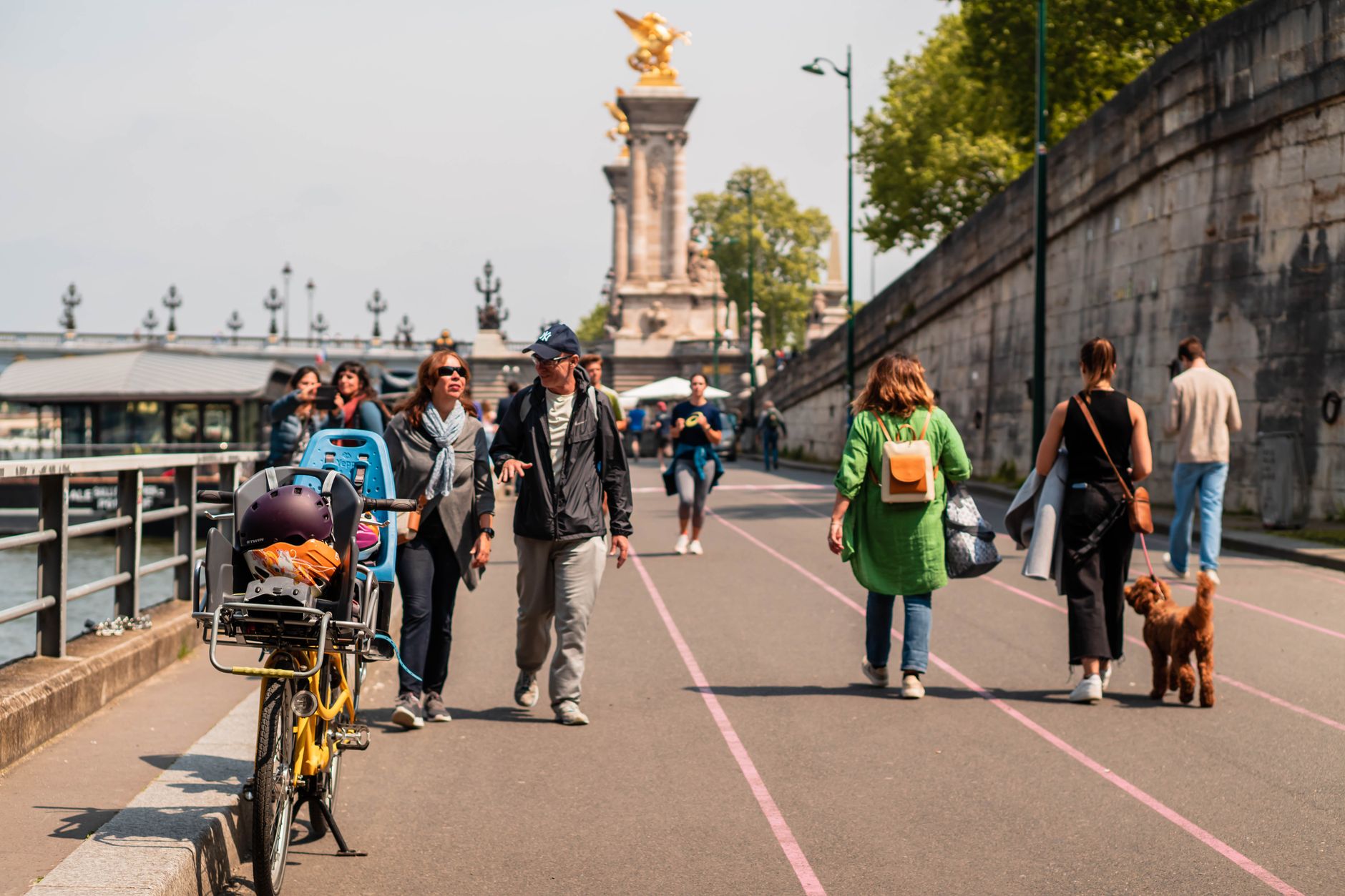
From there it's a short hop to Belleville, the hilly, multicultural northeast that is some of the best-value eating in Paris — Chinese family restaurants steaming dumplings in the window, North African bakeries, natural-wine bars, and the boulevard market on Tuesday and Friday mornings where a grandmother will press a slice of mango into your hand to prove it's ripe. Climb to the Parc de Belleville terrace for a wide, largely tourist-free look back over the whole city laid out below. Save sunset for a view with the Eiffel Tower in it rather than from it: the Montparnasse Tower terrace gives a 360° panorama, usually with a fraction of the Eiffel queue, and Trocadéro across the Seine remains the free photo spot. If you've got an hour to spare earlier, the Promenade Plantée — the elevated planted walk above the 12th that inspired New York's High Line — is a calm, local leg-stretch.
Quick reference
- Musée d'Orsay: ~€16; late opening Thursdays. Closed Mondays.
- Louvre (if you go): ~€22, timed entry; Wed/Fri late nights to ~9:45 p.m. Closed Tuesdays.
- Canal Saint-Martin: Free. Best late afternoon/evening. Metro: Jacques Bonsergent.
- Belleville market: Tue & Fri mornings, Bd de Belleville. Parc de Belleville free.
- Montparnasse Tower: ~€20, open late. Trocadéro: free.
Day 3: A day trip, then point south
Day three goes one of two ways — out to a palace or up a hill — and then sets up the part of the trip Orly really pays off on: a cheap leg south. Pick the version that fits your energy and the season, and keep the afternoon loose for the onward connection.
The headline day trip is Versailles, and it earns the morning on what no museum in the city can give you: scale. This was Louis XIV's machine for making power visible — the Hall of Mirrors built to throw daylight back at the gardens, a park so vast the king moved through it by canal, fountains that still run to music on summer weekends as they did for the court three centuries ago. It's genuinely easy to do independently: the RER C runs from central Paris to Versailles-Château-Rive-Gauche, with the palace a ten-minute walk from the station. Book a timed palace slot and do the gardens early, before the coaches arrive. If a palace day feels like too much, spend the morning in Montmartre instead — go before about 9:30 a.m. to have the Sacré-Cœur steps and the quiet western lanes, the ones the painters actually lived on, before the crowds and the bracelet hustlers arrive — and pair it with the Musée Marmottan Monet in the 16th, a mansion holding the largest collection of Monet anywhere, including the Impression, Sunrise that gave the whole movement its name, and almost never crowded.
Then comes the gateway payoff. The same rail hub that bases you in Paris also sends you south, cheap, when you're ready to move on.

Quick reference
- Versailles: RER C to Versailles-Château-Rive-Gauche, ~€4–€5 each way. Palace ~€21, timed entry, closed Mondays.
- Giverny / Fontainebleau: quieter alternatives — Giverny from Gare Saint-Lazare (Apr–Oct only); Fontainebleau ~40 min from Gare de Lyon.
- Montmartre: Sacré-Cœur free; go before 9:30 a.m. Marmottan Monet: ~€14, closed Mondays.
Onward: the south of France
This is where coming in through Orly stops being a convenience and becomes a strategy: Paris is the hub of the French high-speed network, so the same city you've spent three days in is also a launchpad. Step out of Gare de Lyon and you're following a route Parisians have ridden toward the Mediterranean light for a century — only now you can be deep in the south by lunchtime, and the fares, booked ahead, stay genuinely cheap.
By rail, the TGV from Gare de Lyon reaches Lyon, France's great food city, where you eat in a bouchon over a pot of Beaujolais, in about two hours; Marseille, salt-aired and rough-edged on its old port, in about three and a half; and Bordeaux, wine country and oyster shacks, in around two hours from Gare Montparnasse. The point isn't only that they're close — it's that they're cheap if you plan: book ahead and the budget Ouigo trains start low, and the wall-fare you see for tomorrow isn't the price you'd pay with two weeks' notice. If you'd rather fly, Orly's low-cost base now does the same job from the air — frequent short hops down to Nice and the Riviera, to Marseille, and on to Toulouse, Biarritz, Montpellier, Perpignan and Toulon. As a rule, if you're already in the city, the train wins on door-to-door time; if you haven't left the airport, the Orly flight saves the trip back out.
Either way, the move is the same: Paris first, then south — and the cheap seats reward booking ahead, so lock the onward leg in when you book the trip.
Quick reference — onward
- By rail (Gare de Lyon / Montparnasse): Lyon ~2h, Marseille ~3h20, Bordeaux ~2h. Ouigo budget service from €19 one-way; SNCF expects 50M+ high-speed tickets under €30 in 2026 (SNCF / RailTech, 2026).
- By air from Orly: Transavia to Nice and Toulouse from ~€38 one-way, Marseille from ~€45 (Transavia / Air Service One, 2026); also Biarritz, Montpellier, Perpignan, Toulon.
- Rule of thumb: in the city → train; still at the airport → Orly flight.
Practical notes
A few practical habits smooth out a Paris trip built around an Orly arrival and an onward leg south — how you pay, how you move around the city, and how you stay a step ahead of pickpockets and seasonal closures. None of them are complicated, but they're the details that decide whether a day runs easily or stalls.
Money and tipping. Restaurant service is included by law — you'll see service compris (service included) on the bill, and staff earn a full wage, so tipping is optional and modest: round up, or leave around 5–10% in cash for service you genuinely liked. Cards work almost everywhere; keep some coins for bakeries, markets, and toilets.
Getting around. The metro and RER stitch the city together; use contactless on your phone or a Navigo card. If you're doing day trips to Versailles and the Orly run, an all-zone Navigo can pay for itself and covers the €10.30 Line 14 airport fare — worth knowing, because a standard metro ticket does not cover that Orly leg on its own.
Safety. Paris is safe for a big city; the real risk is pickpocketing, not violent crime. Watch the crowded spots — RER B, metro lines 1 and 6, Châtelet, the Eiffel lawns, and the Sacré-Cœur steps — and keep a bag zipped and in front of you. Skip the bracelet-tiers in Montmartre and the clipboard "petition" approaches, and use the official taxi rank or a ride app at Orly rather than a driver who waves you over.
Language and timing. Lead with bonjour before you switch to English and the city meets you more warmly — the "rude Parisian" reputation is mostly a reaction to travellers who skip the greeting. Many independent restaurants close for two to three weeks in August, and a lot of retail shuts on Sundays, so check before you build a day around a specific place. And don't schedule your onward flight or train for arrival day — give Paris a full day first, then move.
Planning Paris? Also worth reading: Orly vs Charles de Gaulle.
Frequently asked questions
Should I fly into Orly or Charles de Gaulle?
For a flexible traveler, Orly is often the better pick: it's about 13 km south of the centre versus CDG's 25 km, and Metro Line 14 runs there direct in roughly 25 minutes. CDG still has far more long-haul routes, so the honest answer depends on whether your flight even serves Orly — but when it does, Orly is closer and usually cheaper.
How do I get from Orly Airport into central Paris?
Metro Line 14 runs direct from the Aéroport d'Orly station to Châtelet in about 25 minutes — one automated train, no transfer. A single ticket is €10.30 (it includes the airport surcharge), or the ride is free if you hold a Navigo all-zone pass. OrlyVal plus RER B, the Orlybus, and a regulated flat-rate taxi (~40 minutes) are the other options.
Is 3 days enough for Paris?
Three days is enough to see the famous core and still reach the Paris locals use. Day one covers the Seine islands and the Marais, day two trades the Louvre for the Musée d'Orsay and the canal-and-Belleville side of the city, and day three fits a Versailles day trip or an early Montmartre before you point south.
When is the best time to visit Paris?
May and September are the sweet spot — mild weather, gardens in bloom or autumn light, manageable crowds, and hotel rates roughly 20–30% below the July–August peak (multiple 2026 seasonal guides). January and February are cheapest but cold; July and August are hottest, busiest, and the time of the longest queues at the Eiffel Tower and Louvre.
Where do locals actually eat in Paris?
Away from the monuments. Belleville's boulevard market and the Chinese, North African, and natural-wine spots around it are some of the best value in the city; the Canal Saint-Martin banks fill with Parisians for the early-evening apéro; and Rue des Martyrs in the 9th is a market street of bakeries, fromageries, and cafés that beats anything on the Champs-Élysées.
How do I avoid pickpockets and scams in Paris?
Paris is safe for a big city, but pickpocketing is the real risk. Keep a bag zipped and in front of you on the busy lines — RER B, metro 1 and 6, and Châtelet — and around the Eiffel lawns and the Sacré-Cœur steps. Skip the bracelet-tiers in Montmartre and the clipboard 'petitions,' and use the official taxi rank or a ride app at Orly.
Will I need an ETIAS to visit Paris in 2026?
Possibly, depending on timing. US passport holders still enter visa-free for up to 90 days, but ETIAS — a quick online authorisation with a small fee — is scheduled to start in late 2026. The exact date and fee have moved more than once, so check the official EU ETIAS site close to your trip rather than relying on a figure quoted months ahead.