
3 days in Porto: a perfect Portugal starter
Porto sits where the Douro meets the Atlantic, a city of azulejo-tiled houses cascading down to the river and centuries-old port cellars across the water in Vila Nova de Gaia. Follow that river for three days and you've seen the whole city: the bridge it bends around, the lodges that age their wine on its bank, the terraced valley it runs down from, and the fishing port where it finally reaches the sea. It's also the cheapest, calmest gateway into Portugal from North America — flights from US Tier-1 hubs run $100–$300 below Lisbon for the same dates, and the Alfa Pendular train reaches Lisbon in three hours for as little as €12 booked ahead.
For flexible travelers booking three to eight weeks out, Porto is where a Portugal trip should start: a city that earns three or four days on its own merits, and quietly sets up everything that comes after. By the time you board the train south on day four, you'll have stood under a station ceiling of twenty thousand painted tiles, climbed a Baroque bell tower lit up at night with no queue, and watched the sun set on the Douro from a bridge an associate of Eiffel designed.
Why Porto as a gateway
Porto earns its gateway role on three numbers: US-hub fares that run $100–$300 below Lisbon, an airport that clears passport control in twenty minutes to Lisbon's 60-to-90, and a three-hour onward train to Lisbon from €12. Together they make it the cheapest, calmest, lowest-friction door into Portugal from North America.
The fare advantage is the headline. KAYAK was showing Porto round-trips at $296 from Newark, $299 from Seattle, and $323 from JFK in May 2026, while comparable Lisbon fares from Washington Dulles tracked at $654 and up. The gap holds across booking tools — Skyscanner, Momondo, Google Flights — and across most US Tier-1 hubs. For a flexible traveler with three to eight weeks of lead time, Porto is consistently the better-priced door into the country.
The airport advantage is the one travelers underestimate. Francisco Sá Carneiro Airport (OPO) is Portugal's second-busiest, with 45 airlines flying to 162 destinations, yet it moves you through passport control with far less friction than Lisbon. Off a red-eye, walking gate-to-metro in under twenty minutes instead of standing in a 60-to-90-minute arrivals queue is the difference between reaching your room by lunch and losing the day.
The train is the third leg of the argument. The Alfa Pendular runs Porto to Lisbon in three hours, with up to eleven daily departures and promo fares from €12 booked five to sixty days out. The connection south isn't a logistics burden to dread — it's a scenic stretch of the trip itself, at coffee-shop prices.
Two boundaries to be honest about. The fare advantage compresses inside two weeks of departure, where Lisbon's wider direct-flight selection often wins on convenience. And the case assumes Portugal is the destination — for a Spain-heavy trip, Madrid or Lisbon is the better entry, since Porto's overland links to Spain are slower than they should be.
One more wrinkle worth knowing: TAP Air Portugal lets you add up to ten nights in Porto or Lisbon to any transatlantic itinerary at no extra airfare. It's marketed mostly to US–Brazil travelers, but it works identically for US–Europe, and most North Americans don't realize it exists. Book a TAP flight from a US hub onward to anywhere in Europe with Porto as the layover, and you have ten free nights in this trip built in.
Quick reference — the gateway numbers
- Fares: Porto round-trips $100–$300 below Lisbon from US Tier-1 hubs; sharpest 3–8 weeks out, narrows inside 2 weeks (KAYAK, May 2026).
- Airport: OPO clears passport control in ~20 min vs Lisbon's 60–90 at peak (slowtravelblog.com, 2024).
- Onward train: Alfa Pendular to Lisbon, ~3h, promo fares from €12 booked 5–60 days out.
Day 1: The central spine, slowed down
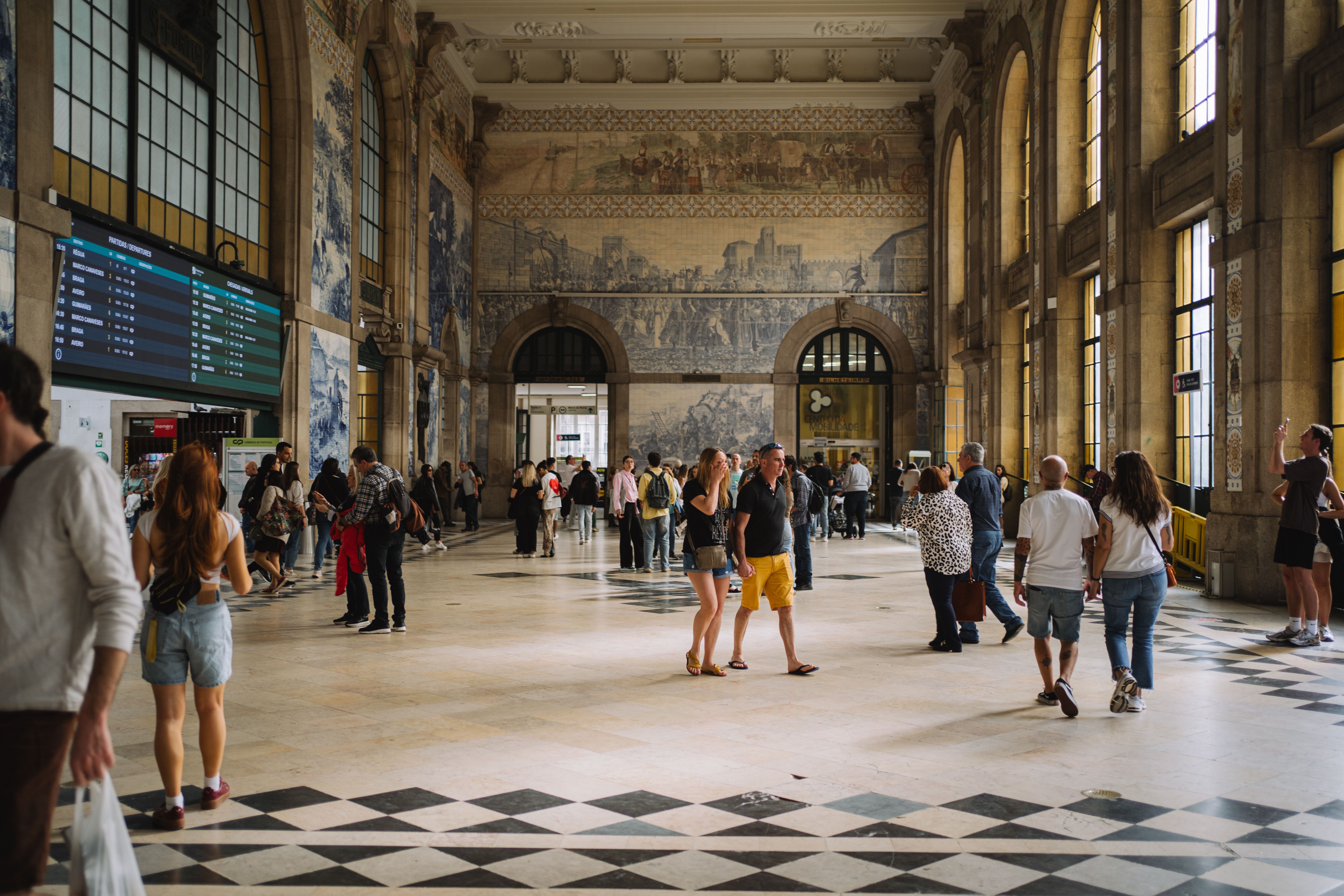
Day 1 walks Porto's central circuit — Ribeira, São Bento, Clérigos, Bolhão — but reorders it to dodge the daytime tour-group crush, using early-morning slots, late light, and one seasonal evening pass most guides miss. Done this way, you get the postcard Porto without the postcard crowds.
Start at São Bento Railway Station before 10 a.m. Step into the entrance hall and look up: more than 20,000 hand-painted azulejo tiles cover the walls, laid by Jorge Colaço between 1905 and 1916 into vast blue-and-white scenes of Portuguese history — battles, royal weddings, the harvest. It is one of the most extraordinary pieces of public art in Europe, and it is a working train hall you walk through for free. Come at opening; by midday the crowd makes it impossible to tilt your head back and take in the ceiling. Pair it with a coffee on Praça de Almeida Garrett just outside.
From São Bento, it's four minutes to Clérigos Tower, the 76-meter Baroque campanile Italian architect Nicolau Nasoni raised in the 1750s, 240 spiral steps to a 360-degree view. Most people climb at midday and queue thirty-plus minutes for a daytime photo. The move is the Night Pass: the city lit below you, the queue gone, the platform essentially yours. Daytime entry costs double for arguably the lesser view.
Late lunch should not be in Ribeira. Walk fifteen minutes uphill into Bonfim or Cedofeita, the two neighborhoods just outside the historic center where Porto's specialty-coffee, third-wave-brunch, and family-tasca scenes actually live. On Cedofeita's Rua de Miguel Bombarda, more than twenty contemporary galleries throw simultaneous opening nights every six weeks; the bartender who pours your wine will tell you which one is worth your hour. This is where Porto residents spend their own afternoons.
The afternoon belongs to Bolhão Market, reopened in 2022 after a long overhaul and — rare for a renovated market — still a place locals shop rather than a food-court clone. Browse the ground-floor stalls; the upper level has prepared food if lunch left you wanting more.
Close the day at Ribeira as the light goes, and let the river take over. Walk down to the quay and cross to Vila Nova de Gaia on the lower deck of the Dom Luís I Bridge — the pedestrian level near the water that most tourists skip — then loop back over the upper deck for the height. The bridge was finished in 1886 to a design by Téophile Seyrig, an associate at Eiffel's firm, not by Eiffel himself, whatever the guides repeat. The upper deck at golden hour is the image you came for. It earns the postcard.
Quick reference
- São Bento azulejos: Free, 24-hour access (working station). Best before 10 a.m.
- Clérigos Tower: €5 Night Pass (7–11 p.m. seasonal — summer, Easter, Christmas) or €10 day. 240 spiral steps. Closest metro: São Bento.
- Bonfim/Cedofeita lunch: 15–20 min walk from Aliados. Closest metro: Carolina Michaelis (Cedofeita); 24 de Agosto (Bonfim). Cedofeita galleries: Rua de Miguel Bombarda.
- Bolhão Market: Mon–Sat, 8 a.m.–8 p.m. Closed Sun. Free. Closest metro: Bolhão.
- Dom Luís Bridge sunset: Free. Walk lower deck across, return upper deck. Closest metro: São Bento or Jardim do Morro.
Day 2: Cross the river to the lodges, then locals' Porto
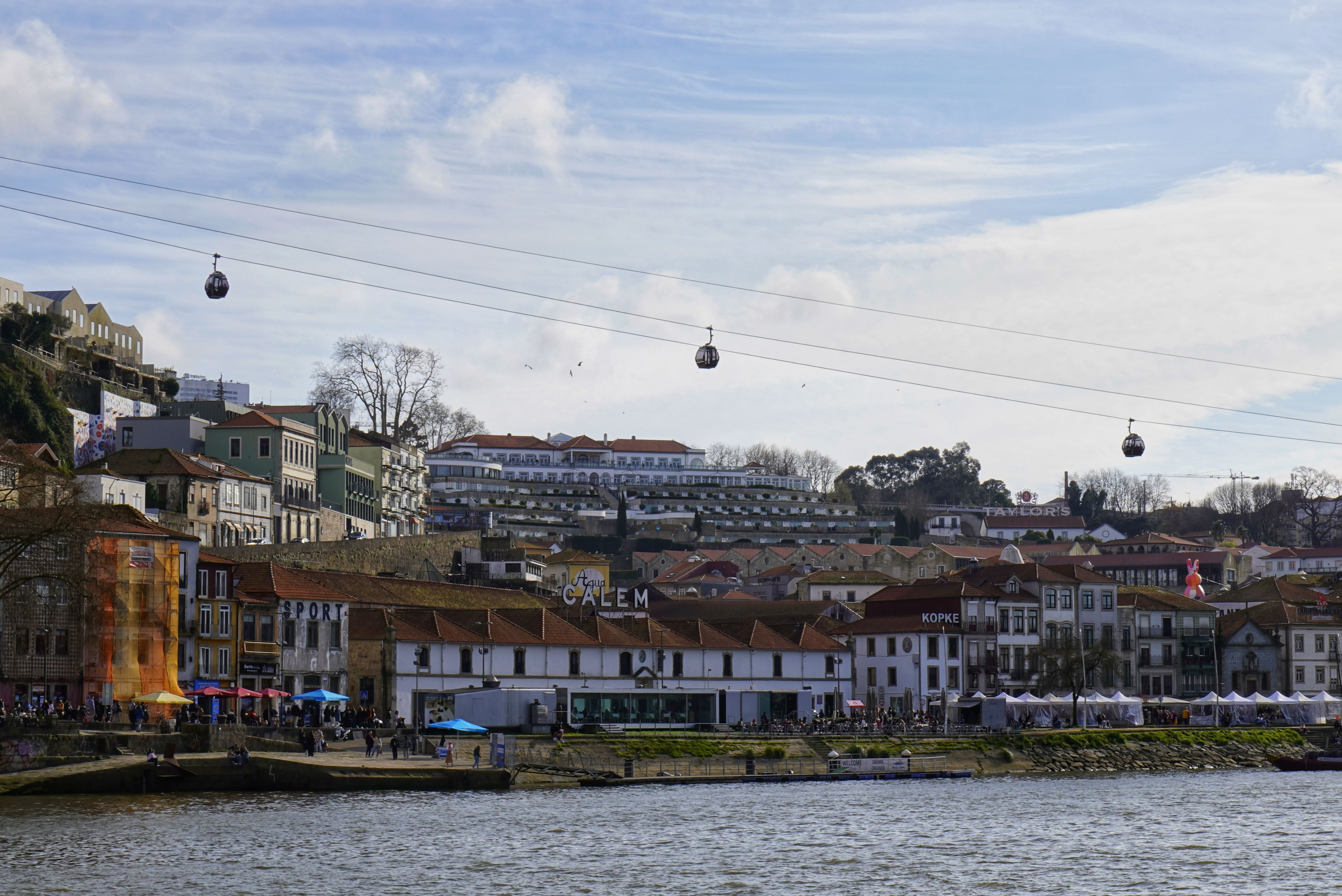
Day 2 crosses the river to the port lodges that gave the city its name and its wine, then climbs back into the flat, lived-in neighborhoods where Porto actually spends its own afternoons. It's a deliberate counter to Day 1's pace: a slower morning, a longer lunch, and an optional sunset run out to Foz where the Douro meets the sea.
Start across the water at the Vila Nova de Gaia port lodges, on the hillside where every major producer ages its barrels. There's a reason they all cluster here: a 17th-century decree requires that any wine classified as port mature in Gaia's cellars, and three centuries later this single walkable slope holds the highest concentration of port houses on earth. The wine is named for the city you're looking back at across the river.
The tourist mistake is three lodges in an afternoon, tasting the same styles on a loop. Pick one and go deep. Cockburn's draws Porto food writers for the most knowledgeable tour and the best tawny tasting; Graham's wins on the river view and a premium flight that reaches into 30- and 40-year-old tawnies; Taylor's suits anyone who'd rather move at their own pace with an audio guide. Skip Sandeman if you've already met it on a hundred Instagram posts — the caped guides are charming, the tour more theater than substance.
After the lodge, eat in Gaia along Avenida de Diogo Leite or back across the river, then climb into Bonfim or Cedofeita for the afternoon — both unusually flat for Porto, which is a mercy here. In Bonfim, the Fontaínhas viewpoint is the sunset spot the guides leave out; nearby, coffee at von&vonnie, cocktails at Terraplana. In Cedofeita, brunch at Zenith and hand-painted prints from Portuguese illustrators at Ó! Galeria.
If you've still got energy, ride Bus 500 from Aliados out to Foz do Douro for sunset — the seaside district six kilometers west where the river finally reaches the Atlantic, all promenade, beaches, a 16th-century fort, and the wrought-iron Foz Pergola. It's where wealthier Portuenses live and where the city walks on Sunday afternoons, and the 500 is quietly the most scenic public bus route in town. Tired by 5 p.m. on a three-day trip? Save it for next time.
One note on Livraria Lello, since every Porto list pushes it. The 1906 neo-Gothic bookshop is genuinely beautiful and almost impossible to enjoy: a €12–€16 ticket, a thirty-minute queue, and an interior so packed you can't actually browse. J.K. Rowling has said she never went in during her Porto years. If you must, book the 9 a.m. slot and arrive early; otherwise Café Majestic on Rua de Santa Catarina — where Rowling really did write — gives you the same Belle Époque room with a coffee instead of a crowd.
Quick reference
- Vila Nova de Gaia port lodges: €15–€60 depending on tasting tier; Graham's premium 30–40-year tawnies run €35–€60. Tours 30–90 min. Reserve ahead in summer. Walking distance from the Dom Luís lower deck (Instituto dos Vinhos do Douro e Porto, 2024; Taste Porto; Oh My Porto, March 2026).
- Bonfim/Cedofeita: Closest metro: Carolina Michaelis (Cedofeita); 24 de Agosto, Heroísmo, or Combatentes (Bonfim). Both flat.
- Bus 500 to Foz do Douro: From Aliados, 30–40 min, €2 with Andante card. Or Uber for €8–€10.
- Livraria Lello: €12–€16 entry, online booking required. R. das Carmelitas 144. Quietest at 9 a.m. weekdays in shoulder season.
Day 3: Up the Douro Valley, then Matosinhos for dinner

Day 3 follows the Douro to its source country and back — a morning train up to the terraced vineyards that make the wine you tasted in Gaia, then home in time for the meal the trip is secretly built around. The valley is non-negotiable; so is dinner where Porto residents actually eat fish. You can do both in a day.
This is the side trip that earns its place: the Douro Valley was the world's first officially demarcated wine region, mapped out in 1756, and a UNESCO World Heritage Site since 2001 — and the only way to understand the port in your glass is to see the schist terraces it grows on, stacked up the valley walls by hand. Catch the 08:20 or 09:20 train from Porto São Bento to Pinhão, the more atmospheric departure than Campanhã. The fare is fixed at €12.20 each way and can't sell out — buy it the morning of, and sit on the right going east, because the stretch past Régua is one of the most beautiful rail journeys in Europe.
Get off at Pinhão, not Régua. Walk the 2.5 km uphill to the Miradouro Casal de Loivos and the whole valley opens below you — vineyards dropping in terraces to the river, a quinta's name painted on a far slope. Several quintas sit within walking distance of the town — Quinta do Bomfim, Quinta do Noval, and Croft all pour — so pick one and linger rather than rushing three. Catch the 17:12 or 18:14 return, and bring water and snacks; there's no catering on board.
Skip the all-day Douro cruises out of Porto. Local writers are consistent on this: the food is mediocre and you spend the day on the boat instead of in the valley. The 50-minute Six Bridges cruise from Ribeira is a fine hour on another day, but a full-day cruise eats the day for far less than the train-and-walk gives back.
Back in the city by early evening, ride Metro Line A (Blue) from Trindade to Matosinhos Sul — about thirty minutes — to where the Douro's working waterfront still smells of charcoal smoke. Matosinhos is a fishing port, and Rua Heróis de França is a 400-meter run of forty-plus seafood places grilling the catch over outdoor coals. Tourists pay €30-plus for frozen fish in Ribeira; Porto residents take Line A out here and eat sardines, octopus, or whatever came in that morning, blistered over charcoal with sea salt and olive oil, for €15–€25 a head. Pull up to a paper-topped table, point at what looks freshest, and let the grill do the rest.
Salta o Muro (no bookings, always a line, worth it), Tito 2, Marisqueira de Matosinhos, and O Valentim are the names Porto food writers keep returning to. Most don't take reservations — arrive around 7 p.m. or expect to wait — and the fish is freshest at midday, so if your schedule allows, make this a non-departure-day lunch instead. This one meal does more for the trip than any single sight downtown.
Quick reference
- Porto São Bento → Pinhão: €12.20 each way, fixed price. 08:20 or 09:20 outbound; 17:12 or 18:14 return. Sit on the right going east. ~2h15 (Lonely Planet, April 2025).
- Miradouro Casal de Loivos: 2.5 km uphill walk from Pinhão town. Free.
- Quinta tastings: Quinta do Bomfim, Quinta do Noval, Croft — walking distance from Pinhão. Reserve ahead in summer.
- Matosinhos seafood: Metro Line A (Blue), Trindade to Matosinhos Sul. ~30 min, €2 with Andante. €15–€25 a head; lunch best for freshest fish (Oh My Porto, June 2025; Portoalities).
Onward to Lisbon
Day four is the whole point of the three days before it: you leave for Lisbon by rail, the gateway argument made good, on a three-hour train that costs less than lunch if you book it ahead. The Alfa Pendular runs Porto-Campanhã to Lisbon-Oriente or Santa Apolónia in roughly three hours, up to eleven times a day; standard 2nd class is €34, 1st class €48, and promo fares drop to €12 booked five to sixty days out.
Book ahead — the Alfa Pendular sells out in peak summer and the cheap fares go first. Leave from Campanhã, not São Bento (the long-distance trains depart Campanhã), arrive twenty minutes early, and you'll be in Lisbon for a late lunch.
Going further than Lisbon? The same line runs to Faro in just under six hours (€57.40), or to Coimbra in 1h 5m (~€18) if you want to break the trip at a UNESCO old town on the way down. Heading to Spain, skip the rails: there's no direct Porto–Madrid train and the route through Vigo runs eight hours, so fly — Ryanair, Iberia, easyJet, and Air Europa all run multiple daily Madrid flights for €30–€80 booked ahead. Same answer for Barcelona.
And the gateway keeps paying out past Portugal: fly into OPO cheap from a US hub, train to Lisbon for €12, then catch a €40 Ryanair hop onward to Barcelona, Paris, or Rome — a genuinely cheaper path than any direct US-to-Mediterranean ticket, stretched as far as you care to take it.
Quick reference — onward
- Porto → Lisbon: Alfa Pendular from Campanhã, ~3h, up to 11/day. 2nd class €34, 1st €48, promo from €12 booked 5–60 days out (Comboios de Portugal, 2026). Sells out in peak summer — book ahead.
- Beyond Lisbon by rail: Faro
6h (€57.40); Coimbra 1h 5m (€18). - To Spain: no direct Porto–Madrid train (Vigo route ~8h) — fly Madrid/Barcelona €30–€80 booked ahead.
Practical notes
Porto is a forgiving city for a first visit — small enough to walk, calm enough to enjoy — but a few local quirks and logistics save real friction if you know them going in. These are the details that don't fit cleanly into any single day but show up on every trip.
Tipping: not expected or required. Round up at cafés (€0.50–€1), 5–10% in cash at sit-down restaurants for service you genuinely enjoyed. No tip needed for taxis, bartenders, or hotel reception. Card terminals usually don't allow tips — keep small euro coins.
The couvert quirk: when bread, olives, or small cheese plates land on your table unasked, they aren't free. Wave them off with "não, obrigado/a" and they go back with no awkwardness — locals do it routinely. It's the surprise charge tourists most often complain about.
Money: central restaurants and shops take cards, but small tascas, market stalls, and family bakeries are still cash-first. Pull €100 from an ATM on day one and you'll rarely run dry.
Getting around: Porto is walkable in the center but steep — a "10-minute walk" on Google Maps can be a climb on slick cobbles. The Andante card (€0.60 rechargeable) covers metro, buses, trams, and urban trains. Uber and Bolt run here and usually beat taxis (€5–€8 between central neighborhoods).
Safety: violent crime is rare; petty theft is the real concern. Pickpockets work Tram 1, the metro at peak, the crowd inside São Bento, and the Ribeira waterfront at sunset. Standard precautions — bag in front, phone off the café table, wallet out of a back pocket. Avoid Bairro do Cerco and Bairro do Aleixo at night.
Visa context: US passport holders enter visa-free for up to 90 days within any 180-day period under Schengen rules. ETIAS (the EU travel authorization) is scheduled to launch in late 2026 with a six-month transitional period — by the time you read this it may be live, delayed, or in transition. Check the official EU ETIAS site closer to departure.
Best months: May–June and September–October are the consensus shoulder-season picks — daytime 20–25°C, plenty of sun, manageable crowds. June brings Festa de São João (June 23–24), Porto's biggest celebration. July–August are warmest and driest but most crowded. November–March is rainy and quiet, with winter discounts up to 50% off and weather that's hit-or-miss.
Buffer day: if you're catching the Alfa Pendular south, give yourself a full day in Porto before departure — the promo fares need booking ahead and the train sells out in peak season. Plan Matosinhos for a non-departure-day meal; it's a thirty-minute metro ride each way and the restaurants don't take reservations.
Frequently asked questions
Is 3 days enough for Porto?
Three days is enough to cover Porto thoroughly as a Portugal gateway — the central tourist circuit on Day 1, the locals' neighborhoods and port lodges on Day 2, the Douro Valley day trip on Day 3 — and leave for Lisbon on Day 4 with everything seen. If you have four nights, add Foz do Douro and a longer Douro Valley stop. Anything less than three nights forces you to skip either the Douro or Matosinhos, and both are non-negotiable.
How do I get from Porto to Lisbon — train or fly?
Take the train. The Alfa Pendular runs Porto-Campanhã to Lisbon in three hours, with up to eleven daily departures and promo fares from €12 booked ahead (Comboios de Portugal, 2026). Standard 2nd-class is €34; 1st class is €48. Flying takes longer once you factor in airport transit on both ends, costs more, and gives you nothing the train doesn't. The train is the right answer for almost every traveler.
Is Porto cheaper to fly into than Lisbon from the US?
Yes, consistently — Porto round-trips from US Tier-1 hubs run $100–$300 below Lisbon for the same dates (KAYAK, May 2026). The gap holds across booking tools and across most US East Coast and West Coast departures, with the exception of last-minute booking windows where Lisbon's wider direct-flight selection narrows the gap. The savings are sharpest when booking three to eight weeks out.
Can I do a day trip to the Douro Valley from Porto?
Yes, and it's the most rewarding day trip Porto offers. Catch the 08:20 or 09:20 train from Porto São Bento to Pinhão (2h15, €12.20 each way, fixed price). Sit on the right side going east for the river views. Walk to the Miradouro Casal de Loivos viewpoint, taste at one in-town quinta, and catch the 17:12 or 18:14 return. Skip the all-day boat cruises from Porto — they're consistently underwhelming.
When is the best time to visit Porto?
May–June and September–October are the consensus shoulder-season picks — daytime temperatures 20–25°C, manageable crowds, and accommodation prices below peak. June stands out for Festa de São João (June 23–24), Porto's biggest celebration with fireworks over the Douro and all-night street parties. July–August are warmest but most crowded. November–March is rainy but cheapest, with winter hotel discounts up to 50% off (Lonely Planet, 2026).