
5 Days in Buenos Aires and Argentina
Buenos Aires stands at the foot of a continent, a city of French-influenced facades and wide tree-canopied boulevards where the dinner tables fill after 9pm and the social tango halls don't warm up until midnight. It is also the dominant gateway into South America from North America — fares from Newark and Los Angeles run from $308–$319 one-way (recent lows, Treverra cache, Jul–Aug 2026) and EZE's connection network covers sixteen US origin airports, more than most North American travelers realize. That combination — a genuinely interesting city with a fare structure that makes the continent accessible — is what earns Buenos Aires its place as the opening leg of an Argentina trip.
Five days does more than you'd expect. Three city days cover the historic core, the cultural anchors, and one real evening at a milonga (the social tango gathering — not a dinner show; more on that below). Then a two-hour domestic flight from AEP opens the second act: Iguazú Falls, where 275 cascades drop eighty meters into a canyon the size of a city block and the sound hits you before the water does. The EZE fare pays off twice.
Why Buenos Aires as a Gateway
Buenos Aires is the best entry into Argentina for travelers planning more than a single city — three days in the capital, then a short domestic flight to one Argentine region, is the trip this post is built around.
The entry fares from North America are competitive: EWR→EZE from $308 one-way (recent low), LAX→EZE from $319 one-way, JFK→EZE from $465 one-way (Treverra search cache, Jul–Aug 2026 window; Argentine summer, December–February, typically runs higher). Aerolíneas Argentinas operates EZE as its international hub, which means your arrival comes with immediate domestic connectivity — Iguazú, Mendoza, Bariloche, Ushuaia, all within two hours by domestic flight from AEP.
The EZE/AEP distinction is the single most consequential practical fact in Buenos Aires travel and it's where the most confusion happens: EZE (Ministro Pistarini International) handles all intercontinental long-haul arrivals, 35 km southwest of the city center. AEP (Aeroparque Jorge Newbery) is the domestic and regional airport, close to Palermo, where every flight to Iguazú, Mendoza, and Bariloche departs. Getting between them takes 45–60 minutes by taxi. Plan accordingly: your first night in Buenos Aires should be after clearing EZE, your domestic onward flight leaves from AEP, and you want a minimum four-to-five hour buffer if you're doing any same-day connection.
A note on what Buenos Aires costs in 2026: it is not the 2022–2023 version. President Milei's government lifted currency restrictions in April 2025, the parallel "blue dollar" rate converged with the official rate, and the city is now priced at what it actually costs — around $50–60 per day on a budget, $100–120 per day mid-range, roughly 40–60% cheaper than major US or Western European cities. Genuinely good value. No longer the extreme-value outlier of the peak crisis years, and any post telling you otherwise is using outdated math.
One more practical note before the days start: when a card terminal asks whether to charge in ARS or USD, always choose ARS. Selecting USD triggers the merchant bank's conversion rate, which is consistently worse than the rate your card applies when charged in pesos.
Day 1: The Historic Spine

Day 1 moves south through four centuries of Argentine history — Plaza de Mayo, the Cathedral, San Telmo cobblestones — closing at a parrilla at the hour that feels late by North American clocks but is exactly right here.
Start at Plaza de Mayo, the square that has been the center of Argentine public life since 1580. The Casa Rosada (the executive mansion, known as the Pink House — the color dates to the nineteenth century) faces it to the east; the Metropolitan Cathedral anchors one side; the Cabildo (the colonial administrative building, now a small museum) closes another. The square is not a passive monument — the Madres de Plaza de Mayo still march here every Thursday at 3:30pm, carrying photographs of their children who disappeared during the 1976–1983 military dictatorship. If your Day 1 is a Thursday, that march is part of what the square is.
Walk south along Defensa Street into San Telmo, Buenos Aires' oldest neighborhood — a grid of cobblestones, nineteenth-century low-rises, antique shops, and the kind of bars where the walls have been the same color since before you were born. If Day 1 falls on a Sunday, the Feria de San Telmo (the Sunday street market along Defensa, running since 1970) takes over the neighborhood: 270 stalls of leather goods, antiques, handmade jewelry, and food vendors, with live street tango appearing mid-route. Arrive before 11am to beat the noon crowd.
La Boca can slot as a short morning add before Plaza de Mayo if you want the full historic south — the El Caminito alley of corrugated-iron facades painted in blues and yellows and reds reflects the port neighborhood's Italian immigrant history and is genuinely distinctive. But be direct about what it is: El Caminito is the strip; the restaurants immediately surrounding it are tourist-facing; the broader La Boca neighborhood warrants caution after dark. Visit for 1–2 hours, weekday morning for best light and fewer crowds, then head back north.
For dinner: a neighborhood parrilla (the Argentine wood-fire grill, the cooking method that defines Argentine beef) is the right move. El Desnivel in San Telmo and Parrilla Peña near Teatro Colón are the local choices — no English menus, no tourist pricing, the same cuts of entraña (skirt steak), bife de chorizo, and vacío (flank steak) done over hardwood. Argentine beef is grassfed, pampas-raised, and genuinely different from North American steaks in a way that's not hype. Eat at 9pm, which is early by local standards; the tables fill properly after 10.
Quick reference — Day 1
- Plaza de Mayo: Free access. Madres de Plaza de Mayo march: Thursdays 3:30pm — free and open to attend.
- Metropolitan Cathedral: Free entry. Open Mon–Fri 8am–6pm, Sat–Sun 9am–6pm.
- Cabildo museum: Hours vary; check turismo.buenosaires.gob.ar. Small entry fee.
- Casa Rosada: Free weekend tours via the official website.
- Feria de San Telmo (Sunday only): Every Sunday 10am–5pm along Defensa. Free. Cash preferred; many vendors offer 10–20% discounts for cash.
- El Caminito / La Boca: No admission fee. Daytime only. Budget 1–2 hours plus taxi (~$10 USD round-trip from San Telmo). Best on a weekday morning.
- El Desnivel (parrilla, San Telmo): Defensa 855. Full asado with wine ~$20–40 USD per person. Tip 10% in cash pesos.
- Parrilla Peña (Centro, near Teatro Colón): Rodríguez Peña 682. Similar price band.
Day 2: Recoleta, Teatro Colón, and the Real Milonga

Day 2 takes the longer view: the cemetery where Argentina's nineteenth century is written in marble, an opera house rated among the finest acoustics in the world, and an evening milonga where tango is a social practice, not a show.
Recoleta Cemetery (Cementerio de la Recoleta) is a city within the city — a grid of mausoleum corridors as elaborate as any street in Buenos Aires, lined with neoclassical vaults, wrought-iron gates, and stained-glass chapels housing the remains of Argentine presidents, generals, and aristocratic families. Eva Perón's tomb is in the Duarte family mausoleum in Section 12 and draws its own pilgrimage; the cemetery rewards wandering well beyond it. The architecture and inscriptions are dense with the political history of a country that has spent two centuries arguing with itself about what it is.
El Ateneo Grand Splendid is ten minutes north by foot: a working bookstore built inside a 1919 theater, the stage now a café, original painted ceiling and balconies intact. It appears on every "most beautiful bookstore" list on the internet and it earns the placement. Visit on a weekday morning before the photography crowd arrives and it remains a functioning place rather than a tourist event.
The afternoon belongs to Teatro Colón. The opera house opened in May 1908 with a performance of Verdi's Aïda and has hosted Pavarotti, Callas, Domingo, and Nijinsky in the century-plus since. Acoustic scientists rank its natural acoustics among the five best concert halls anywhere — not a judgment you need to take on faith, given the building's seven tiers and 750-kg central chandelier. Daytime guided tours run in English four to five times daily and cover the full building. If the 2026 season has a performance during your dates, a ticket is worth more than the tour.
The evening is the milonga. A milonga is both the social event and the venue where it happens — Buenos Aires runs dozens of them on a Thursday-through-Sunday circuit, from neighborhood halls to larger clubs where couples dance in linked posture through sequences of songs called tandas, with short breaks (cortinas — literally "curtains") between them. The invitation to dance is a silent nod called the cabeceo, directed across the room; you accept or decline by meeting the nod or looking away. These codes are the social fabric of the thing, and learning them slightly before you go is worth the five minutes of reading.
La Catedral Club in Almagro is the beginner-friendly option — a former warehouse with a rougher, less formal atmosphere that offers a lesson before the social dancing begins. La Viruta in Palermo runs a similar structure. Entry is $5–20 USD. This is not the dinner tango show (the $70–150/person format is professional entertainment; worth knowing about, not the same thing); this is where Porteños (Buenos Aires locals) dance. The difference matters.
Quick reference — Day 2
- Recoleta Cemetery: Open 9am–5pm (6pm summer). Non-resident admission: 24,080 ARS (
$24 USD at current rates, card only at entrance). English tours depart Tue/Thu/Sat at 11am from main entrance ($5–8 USD). Third-party tours from ~$10 USD. - El Ateneo Grand Splendid: Santa Fe 1860. Open Mon–Sat 9am–9pm; Sun 12pm–9pm. Free to browse. Weekday mornings strongly preferred.
- Teatro Colón: Tucumán 1171. English guided tours run 4–5 times daily; check teatrocolon.org.ar for current tour schedule and 2026 season tickets. Box office Mon–Fri 9am–4:45pm.
- La Catedral Club (milonga, Almagro): Sarmiento 4006. Thursday–Sunday from ~11pm. Entry ~$5–15 USD; beginner lesson before social dancing.
- La Viruta (milonga, Palermo): Armenia 1366. Similar schedule and price band. Beginner-friendly.
- Guided milonga tour option: CultourBuenosAires runs tours including transport, entry, and lesson — ~$25–40 USD. Worth it for first-timers who want context on the codes before the floor.
Day 3: Palermo, the Costanera, and Chacarita at Night

Day 3 shifts to Buenos Aires' contemporary energy — the Palermo neighborhood in the afternoon, a walk along the reclaimed waterfront, and dinner in Chacarita, where the city's most interesting food is happening right now and the tourist infrastructure hasn't caught up yet.
Palermo Soho and Palermo Hollywood are the city's largest and most active neighborhood, the two zones flowing into each other around Plaza Serrano and Plaza Armenia. By day: local designer boutiques, third-wave coffee shops, murals, and the kind of café culture where a table is a table for as long as you want it. The neighborhood is where young Porteños actually spend their afternoons, and spending an hour walking it without an itinerary is a reasonable use of the morning.
Pair the afternoon with a walk through Costanera Sur Ecological Reserve (Reserva Ecológica Costanera Sur) and the Puerto Madero waterfront. The reserve is 865 hectares of reclaimed land along the Río de la Plata — lagoons, native wetland vegetation, over 500 plant species, resident herons and woodpeckers — carved out of urban Buenos Aires and free to enter. It pairs with a look at the Puente de la Mujer, Santiago Calatrava's tilted pedestrian bridge over the Puerto Madero marina, before you head north for dinner.
For dinner, go to Chacarita, northwest of Palermo. Chuí is the specific destination — an open-air restaurant under the neighborhood's train tracks, natural wine list, plant-forward cooking that reads simultaneously as Argentine and somewhere you'd find in Portland or Copenhagen. Buenos Aires food content in English focuses overwhelmingly on the steakhouse circuit, which is real and good and worth one of your dinners. But Chacarita is where the city's food moment is actually happening in 2026, and missing it in favor of a third parrilla is the mistake that makes every Buenos Aires itinerary look the same.
Quick reference — Day 3
- Palermo Soho / Hollywood: Walkable from Palermo Subte (Line D) or Plaza Italia (Line D). Plaza Serrano: evening bars from ~10pm.
- Costanera Sur Ecological Reserve: Tue–Sun, 8am–7pm weekdays; 8am–8pm weekends. Closed Mondays. Free. Guided tours Saturday, Sunday, and holidays at 9:30am and 4pm. No food vendors inside; bring water.
- Puente de la Mujer: Puerto Madero. Free, open continuously.
- Chuí (restaurant, Chacarita): Charlone 167. Open Wed–Sat for dinner. Reservations recommended. Budget ~$30–50 USD per person with wine.
- Getting around Day 3: The Subte (metro) covers Palermo well; taxis and Cabify/Uber are reliable for the Costanera Sur and Chacarita legs. Subte fare: ~400 ARS (under $1 USD; SUBE card required).
Onward to Iguazú — The Gateway Opens
Buenos Aires is three days of city and culture; Iguazú is the reason the cheap EZE fare pays off a second time — one domestic connection from AEP and the trip doubles in scope. The model here is the gateway working as it's supposed to.
The domestic flight is the natural move. AEP to IGR (Cataratas del Iguazú International Airport) is about one hour and fifty-five minutes, with thirteen-plus daily departures on Aerolíneas Argentinas, Flybondi, and JetSMART. Fares run from around $37 one-way at the low end, with typical prices between $80 and $150 (aggregator summaries, June 2026). Budget carriers (Flybondi, JetSMART) hit the lower end; Aerolíneas runs higher but with more schedule flexibility. Book at least two to three weeks out.
The airport switch is mandatory and worth spelling out plainly: you landed at EZE; your Iguazú flight departs from AEP, 35 km away. Figure 45–60 minutes by taxi between them and a minimum four-to-five hour buffer if you're doing any same-day connection. The clean move is to fly from AEP the morning of Day 4, after your three full city days. Book an accommodation in Puerto Iguazú for two nights. The in-park hotel, Gran Meliá Iguazú, puts you inside the park before the crowds — worthwhile if budget allows. Town-center hotels run $40–120 USD per night and are easier for dinner in the Feirinha.
The swap: if Iguazú isn't the one. The same domestic flight model reaches Mendoza (AEP→MDZ, ~1.5 hours, fares from ~$50–120 one-way) for wine-country travel — high-altitude Malbec, the Luján de Cuyo bodegas, the Andes on the horizon. Or Bariloche (AEP→BRC, ~2.5 hours, fares from ~$40–70 one-way on budget carriers) for the lake district — Nahuel Huapi, the Circuito Chico, skiing in Argentine winter or hiking in Argentine summer. Both are their own posts; both work on the same five-day structure. The Iguazú version is what this itinerary is built around, and it's the worked spine for Days 4 and 5.
Day 5 planning flag before you go: if you plan to cross to the Brazilian side of the falls (and you should — see Day 5), US, Canadian, and Australian citizens need a Brazilian eVisa (implemented April 2025, $80.90 USD, approximately five business days to process, apply at brazil.vfsevisa.com). Apply before you leave home. You cannot obtain the Brazilian eVisa at the border. Travelers who arrive at the crossing without one cannot enter — this is a hard stop, not a formality.
Day 4: Iguazú, Argentine Side
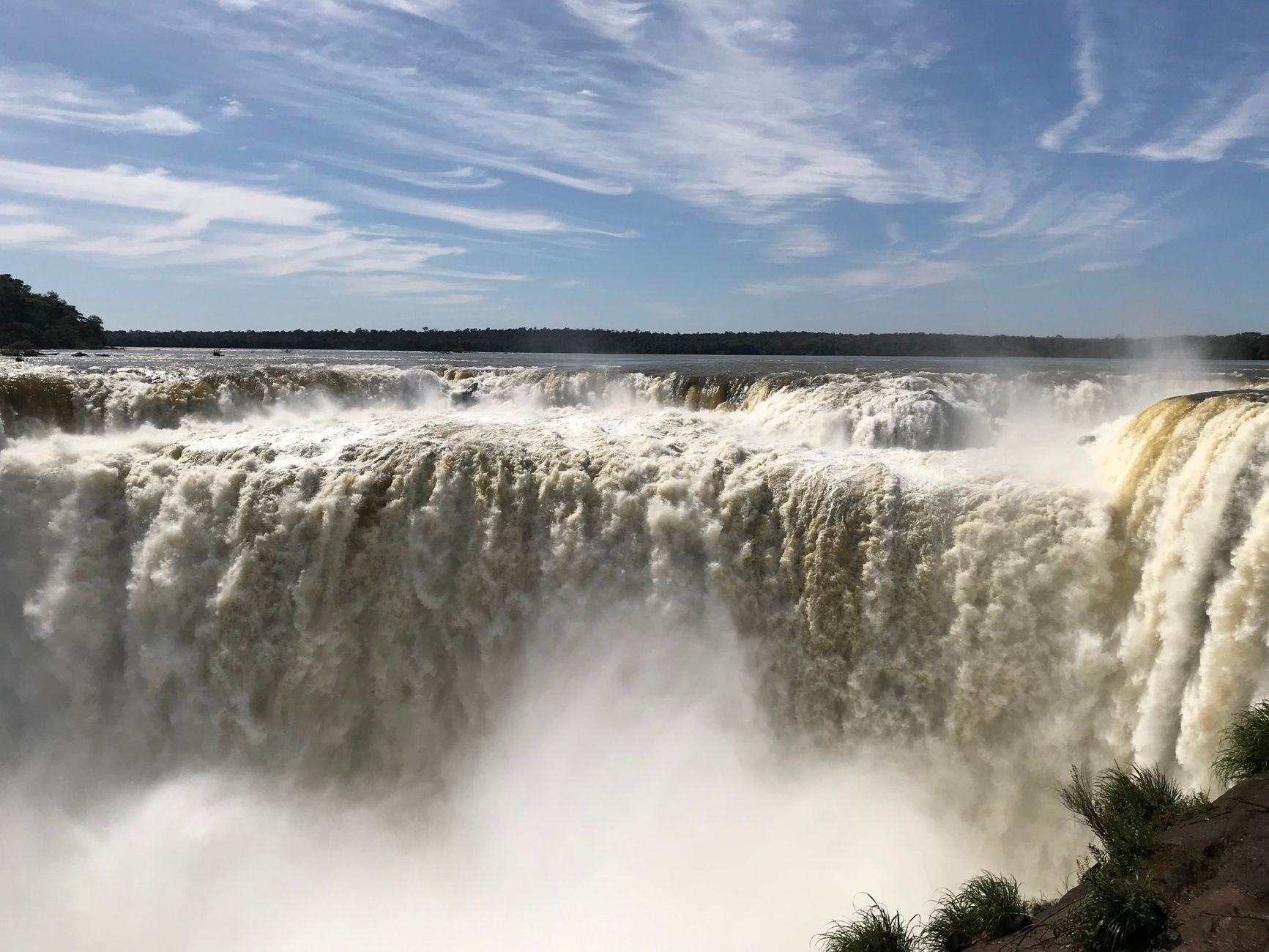
Day 4 is the Argentine side of Iguazú — the catwalks at the lip of the falls, the descent into the canyon, and the free ferry to an island that puts the full falls wall in front of you from river level. Get to the park early; the light is better and the swifts are out.
The park works on circuits. The Ecological Jungle Train (included in park entry) runs from the visitor center to three stations; exit at Garganta station for the main event. Garganta del Diablo — "the throat of the devil" — is where the Iguazú River drops an average of 1,750 cubic meters per second through a U-shaped canyon eighty meters down, and the name names the experience precisely. The suspended catwalk brings you out above the lip; you look into the void while the mist soaks your clothes in under ten minutes. Bring a waterproof poncho (not an umbrella — the mist is horizontal). Great dusky swifts (Cypseloides senex) nest in the cliff faces behind the spray and fly in dense flocks through the mist columns in the morning hours; this is not incidental wildlife, it is part of the visual experience of the place.
From Garganta, walk back toward the visitor center for the Upper Circuit (Circuito Superior): 800 meters along the canyon rim, top-down panoramic views of the full waterfall arc. Best in early morning when light catches rainbows in the spray. Then descend to the Lower Circuit (Circuito Inferior): 1,600 meters of catwalks and staircases taking you down to river level, into the canyon, face-to-face with individual falls from below. The afternoon light works better here than morning. From the Lower Circuit, a free short ferry runs to Isla San Martín — a rocky island mid-river with a steep 170-stair trail to a viewpoint looking directly at San Martín Falls, with Devil's Throat visible in the distance. The ferry only runs when water levels allow (check with staff) and closes at approximately 3:15pm; plan accordingly.
The Gran Aventura is the paid add-on worth having: a zodiac speedboat that drives directly beneath San Martín and Tres Mosqueteros Falls. You get completely soaked. The boat driver takes the zodiac into the curtain. Bring dry clothes and leave electronics in lockers near the embarkation point; the Gran Aventura package includes a 25-minute jungle drive to the boat, though the drive is essentially a transfer (the boat is the experience). Some visitors book just the nautical segment at the park office for less.
Coatis (Nasua nasua, a ring-tailed omnivore from the raccoon family) are the park's most reliably visible mammal — they forage actively along the catwalks, bold and unphased by visitors. Do not feed them; they bite and are a disease vector. They are also excellent.
For dinner, skip the in-park cafeteria (expensive, mediocre) and walk back to Puerto Iguazú town's Feirinha — an informal open-air food court where locals and tourists eat alongside each other at low prices. The Misiones province kitchen is not Buenos Aires steakhouse territory: it runs on cassava, corn, local cheese, and river fish, reflecting centuries of Guaraní agricultural practice. Chipá — small baked cheese breads made from cassava flour, crispy outside, soft inside — are the everyday snack of the region and are sold at the stalls and on street corners throughout town. Mbeju is the flatbread counterpart: a crispy cassava pancake, pan-cooked, somewhere between a crepe and a corn tortilla. River fish like surubí (a local catfish) and pacú appear on menus; try one if the stall looks right.
Quick reference — Day 4
- Argentine side park entry: Approximately $22 USD for non-resident adults; children 6–12 approximately $5; under 6 free. Fees are peso-denominated and adjusted for inflation — verify current rate at iguazutickets.com or at park entrance. Second-day half-price discount: have your ticket stamped on exit Day 4; return ticket costs 50% on Day 4 or 5 if within 72 hours.
- Ecological Jungle Train: Included in park entry. Runs from visitor center to Garganta, Central, and Apeadero stations.
- Garganta del Diablo catwalk: 1,200m walk from Garganta station. Allow 1–1.5 hours. Pack a waterproof poncho — mandatory, not optional.
- Upper Circuit (Circuito Superior): ~1 hour. Access from main trailhead.
- Lower Circuit (Circuito Inferior): 1.5–2 hours. More physically demanding; connects to Isla San Martín ferry.
- Isla San Martín ferry: Free with park entry. Last boat ~3:15pm (check conditions; closes when river is high). Allow 30–45 minutes for island visit.
- Gran Aventura: ~$65–85 USD per person (mid-2026 operator summaries from GetYourGuide and Viator; verify in-park peso rate). Separate from park entry. Allow 90 minutes. Leave electronics in lockers; everything gets wet.
- Feirinha de Puerto Iguazú: Downtown Puerto Iguazú, short walk or taxi from most hotels. Cash helps for smaller vendors.
- Getting to the park: Public bus from Puerto Iguazú terminal to park entrance every 20–30 minutes, ~$3–5 USD; ~20 minutes. Last bus in early evening — check posted times at the entrance.
Day 5: The Brazilian Panorama and the Return

Day 5 crosses the border to Brazil for the panoramic view, pairs the falls with the bird park next door, and closes the circuit back toward Buenos Aires. The eVisa is the prerequisite — if you have it, this is one of the best days of the trip.
The Brazilian side of Iguazú (Parque Nacional do Iguaçu) offers what the Argentine side cannot: a single elevated walkway that puts the full arc of 275 cascades in one frame, including a close-approach view of Garganta del Diablo from across the canyon. From the Brazilian catwalk, you hear the roar of Devil's Throat before the mist reaches you — a wall of sound crossing the water that reads differently from the Argentine lip, where you're already inside it. The two sides are genuinely complementary — you've spent Day 4 inside the falls; now you step back and see the scale of the whole thing at once. Cross by public bus (Linha 120, running roughly hourly from the Puerto Iguazú terminal to the Brazilian park entrance) or taxi (~$15 USD). Allow at least an hour for the border crossing — the bus stops at Argentine and Brazilian immigration for passport stamping; carry your passport at all times. If your eVisa is sorted, the crossing is uncomplicated.
Immediately adjacent to the Brazilian park entrance: Parque das Aves (the Bird Park), the largest bird park in Latin America, with over 1,300 birds representing 143 species including free-flight aviaries where you walk among toucans, macaws, and parrots inside the enclosures. A 10-minute walk from the park entrance. Allow 1.5–2 hours. This is worth the detour even if you are not a dedicated birdwatcher — the immersion aviaries are a different category of wildlife experience from spotting birds on a catwalk.
For travelers who skip Brazil (no eVisa, or choose not to deal with the crossing): the Macuco Trail (Sendero Macuco) is the Argentine side's best day-two option. A 4.8-mile round-trip jungle hike through subtropical Atlantic Forest to Arrechea Falls — a 23-meter cascade with a swimmable natural pool at the base. Quieter than the main circuits, genuine wildlife density (capuchin monkeys, toucans, dense canopy), and the only place in Iguazú National Park where swimming is permitted. Also the most honest counterpart to a day of catwalks: here you're in the forest, not above the water. The Hito Tres Fronteras (Three Borders Landmark) at sunset closes any Day 5 well — the point where Argentina, Brazil, and Paraguay converge, marked by an obelisk on the Argentine bank. You look across the confluence of the Iguazú and Paraná rivers to two other countries from a single fixed point. Free, ten minutes from downtown Puerto Iguazú, and genuinely unusual.
Return to Buenos Aires from IGR; your international flight home departs EZE. Factor the AEP→EZE transfer and buffer again on the return — or consider the open-jaw option (flying into Buenos Aires and home from a different South American city, so you never retrace ground). An open-jaw ticket — flying into one city and home from another, so your return leg doesn't double back over the same route — makes the Buenos Aires-to-Iguazú-to-Rio-de-Janeiro shape work efficiently, for travelers extending into Brazil. Verify the logistics with your booking platform.
Quick reference — Day 5
- Brazilian eVisa (US/Canadian/Australian citizens): Required since April 2025. Apply at brazil.vfsevisa.com. Cost $80.90 USD. Processing ~5 business days. Multiple-entry; apply before departure — not obtainable at the border.
- Linha 120 bus to Brazilian park: Roughly hourly from Puerto Iguazú terminal. ~$5–8 USD. Border crossing adds ~1 hour for immigration; plan accordingly.
- Taxi to Brazilian park: ~$15 USD one-way.
- Brazilian park entry:
R$100 BRL ($20 USD) as of mid-2026; verify at park or online before visit. - Parque das Aves (Foz do Iguaçu, Brazil): Entry
R$80 BRL ($15–16 USD); under 8 free. Open daily. Rodovia das Cataratas km 17.1. Allow 1.5–2 hours. - Macuco Trail (Argentine side, no-eVisa alternative): Open daily 8am–3pm (gate closes for your return). 4.8 miles round-trip; allow 2.5–3 hours. Bring bug spray, water, swimwear. Included in park entry.
- Hito Tres Fronteras: Free. 10-minute walk or short taxi from downtown Puerto Iguazú. Best at sunset.
- Return from IGR: AEP or EZE depending on your booking. Factor 45–60 minutes for the AEP→EZE transfer and a minimum four-to-five hour buffer before your international departure from EZE.
Practical Notes
Buenos Aires and Iguazú are two different logistical environments — the capital city of 15 million people and a border town of 85,000 built primarily for tourism — and they warrant separate practical rundowns.
Money in Argentina in 2026. The blue dollar exchange arbitrage that defined Argentina travel advice from 2019 to early 2025 is obsolete. Since April 2025, Argentina's currency decontrol (the lifting of the cepo cambiario, or exchange-rate restrictions) has brought the official, MEP (Mercado Electrónico de Pagos), and parallel rates within 2–3% of each other — all sitting around 1,430–1,460 ARS per USD as of mid-2026. Foreign Visa/Mastercard purchases automatically apply a rate near the MEP rate, which is currently slightly better than cash exchange at most venues. The rule: always choose ARS (pesos) not USD when prompted at card terminals; selecting USD triggers dynamic currency conversion, which is always worse. ATMs carry $10 USD fees and limit withdrawals to ~60,000 ARS ($40–50 USD) per transaction; Red ATM offers lower fees; Wise and Revolut cards outperform standard US bank debit cards on the exchange rate. Tips must be paid in cash, in pesos, 10%, directly to the server.
The EZE/AEP split — one more time. Every experienced Buenos Aires traveler who has tried to do a same-day EZE arrival and AEP domestic departure has a story. Four-to-five hours minimum buffer. If your onward flight is the morning after arrival, you're fine; if it's same-day, confirm the math.
Getting between airports. Taxi or remis from EZE to city center: ~$38–50 USD, booked at the official taxi counter in arrivals. Tienda León shuttle bus: ~$11.70 USD to Madero Terminal, ~50 minutes. No direct metro from EZE. For AEP→EZE specifically: taxi is the standard move, ~$38–50 USD, 45–60 minutes depending on traffic.
Health and entry. US citizens don't need a visa for Argentina (up to 90 days, passport valid for at least 6 months from entry). Carry travel or basic health insurance — no specific dollar-amount mandate applies to Argentine entry, but standard travel coverage is practical. For the Iguazú leg: yellow fever vaccination is recommended (not required) for the Misiones region, particularly if continuing into Brazil. Use insect repellent with DEET; dengue is present in the area. No malaria risk at Iguazú.
Safety in Buenos Aires. Medium risk level; petty theft (pickpocketing, bag snatching) is the primary concern, concentrated around the Obelisco, Retiro station, and in La Boca after dark. Use front trouser pockets or a cross-body bag for valuables; don't display phones or cameras. Common scams are distraction-based rather than violent — the substance-on-clothing trick is the most reported; unofficial taxi offers inside EZE arrivals are a known tourist-price environment. Take taxis from the street or book Cabify/Uber.
Buenos Aires runs late. Restaurants fill after 9pm; the scene peaks after 10pm. Milongas don't warm up until midnight. Bars before midnight are quiet. Plan dinner for 9pm at the earliest and the evening will make sense.
Iguazú packing. A waterproof poncho is non-negotiable for the Garganta del Diablo catwalk — not an umbrella, which is useless against horizontal mist. Quick-dry layers and sturdy shoes for the Lower Circuit and Macuco Trail. Waterproof bags for electronics if you do the Gran Aventura. Bug spray with DEET. The park ATM often runs empty during peak periods; withdraw cash in town before visiting.
Language. Buenos Aires speaks Rioplatense Spanish — an Argentine variant with Italian melodic prosody (from significant nineteenth-century Italian immigration) that uses vos rather than tú for second-person singular. English is spoken in tourist-facing businesses throughout Recoleta, Palermo, and San Telmo; drops sharply outside the tourist circuit. In Puerto Iguazú, basic Spanish is practical at smaller restaurants and the park. The phrase "segundo día" gets you the half-price return ticket at the Argentine park.
Frequently asked questions
Is five days enough for Buenos Aires and Iguazú Falls?
Five days works well for this circuit: three full days in Buenos Aires cover the historic core, the cultural anchors (Teatro Colón, Recoleta Cemetery), and a real milonga evening, then a two-hour flight from AEP delivers two full days at the falls. Days 4 and 5 are enough for the Argentine side circuits and the Brazilian panorama — provided you sort the Brazilian eVisa before you leave home.
What's the difference between EZE and AEP airports in Buenos Aires?
EZE (Ministro Pistarini International Airport) handles all intercontinental long-haul arrivals and is about 35 km southwest of the city center — a 45–60 minute taxi ride. AEP (Aeroparque Jorge Newbery) is the domestic and regional airport, much closer to the city near the Palermo waterfront. Every onward domestic flight to Iguazú, Mendoza, or Bariloche departs from AEP. Don't plan a same-day international arrival at EZE and domestic departure from AEP without a minimum four-to-five hour buffer.
How do I get from Buenos Aires to Iguazú Falls?
Fly from AEP (Aeroparque, the domestic terminal) to IGR — the flight is about one hour fifty-five minutes, with multiple daily departures on Aerolíneas Argentinas, Flybondi, and JetSMART. Fares run from around $37 one-way at the low end, with typical prices between $80 and $150 depending on how far ahead you book and which carrier you choose (aggregator summaries, June 2026). Book at least two to three weeks out for the better fares.
How many days do you need at Iguazú Falls?
Two full days is the minimum that lets you do the experience justice: one day for the Argentine side (Garganta del Diablo, Upper and Lower Circuits, Isla San Martín), a second day for the Brazilian panorama and Parque das Aves. A single-day excursion from Buenos Aires is possible but consistently described as rushed — the flight each way, the park queue, and the catwalk distances add up. Two nights in Puerto Iguazú is the right structure.
Should I see the Argentine side or the Brazilian side of Iguazú?
Both, if you can. The Argentine side puts you inside the falls — catwalks at the lip of Garganta del Diablo, the Lower Circuit descending into the canyon, the Isla San Martín ferry. The Brazilian side gives you the all-275-cascades panorama in a single frame. Most experienced visitors rate both sides as genuinely complementary rather than one being superior. If you can only do one, the Argentine side offers more varied experience; if budget and eVisa logistics allow, do both.
When is the best time of year for a Buenos Aires and Iguazú trip?
March through May and September through November are the consensus best windows for Buenos Aires — mild temperatures, lower crowds, good fare availability. For Iguazú, May through September gives the most comfortable conditions: drier, cooler, good water flow from the rainy season just past. Argentine summer (December–February) means peak falls volume but also peak heat, humidity, and crowds. Argentine summer fares into EZE typically run higher than the July–August 2026 fares cited in this post.
Do I need travel insurance to visit Argentina?
Carry travel or basic health insurance for the trip — there is no specific dollar-amount coverage mandate for Argentine entry, but Argentine public hospitals do not have the same infrastructure visitors may be used to, and medical costs abroad can be significant. Standard travel insurance that covers emergency medical treatment and evacuation is sufficient. Separate from health coverage, trip cancellation and flight delay coverage is worth having on a circuit that involves multiple domestic legs.