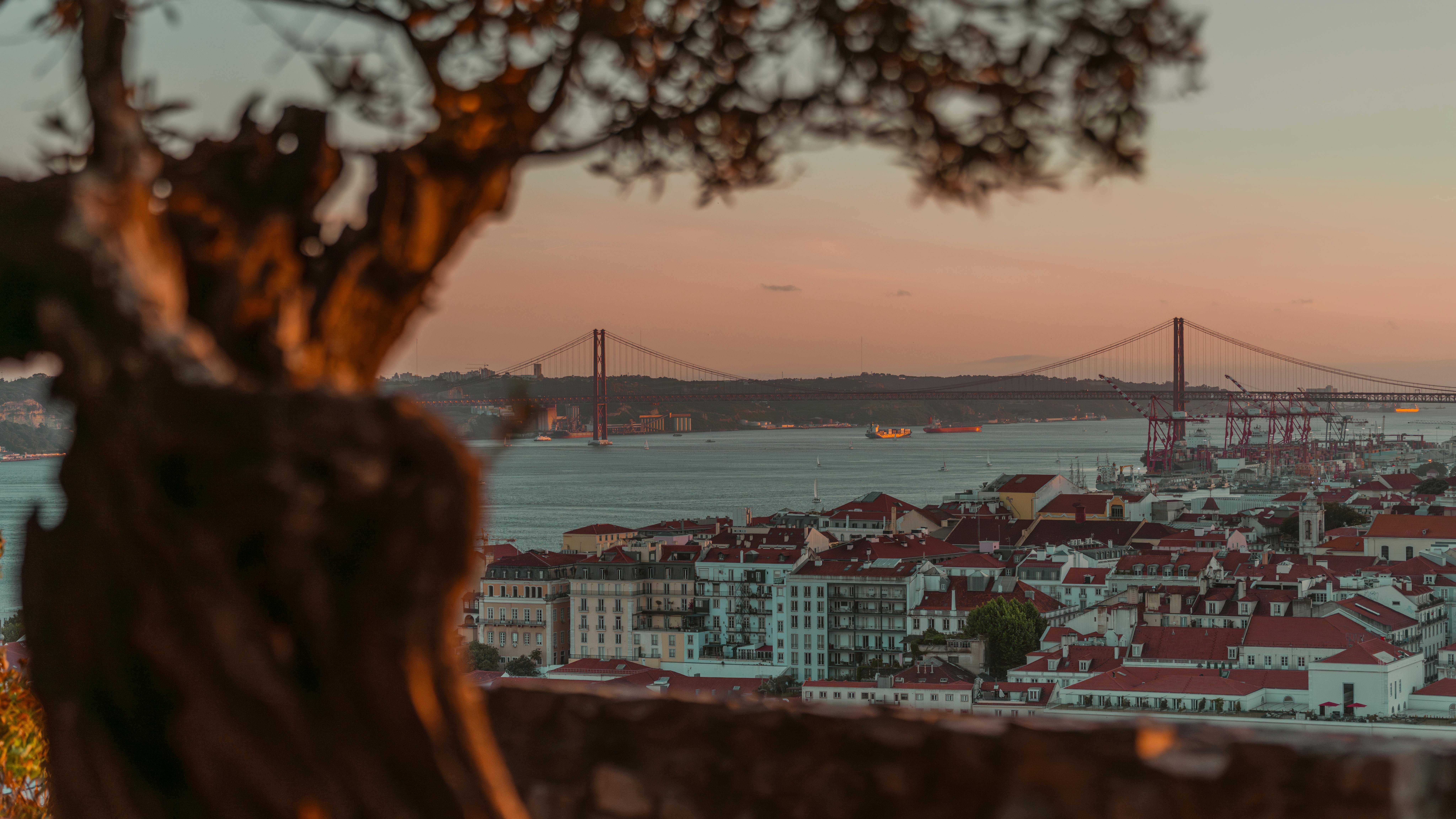
5 Days in Lisbon & the Algarve by Train
The Alfa Pendular threads south out of Lisbon, crosses the broad mouth of the Tejo, and runs the long open plains of the Alentejo until the land softens into the Algarve coast — and at the end of the line waits Tavira, where a seven-arched bridge steps across the Gilão River and the Ria Formosa lagoon stretches east toward the Spanish border in a haze of salt marsh and sandbar. That single rail line is the whole trip: one set of tracks carries you from the capital you start in to the fishing-town coast you came for. Five days, one transatlantic airfare, no rental car — Lisbon as the opening leg, the quieter eastern Algarve as the destination, the part of the coast that the package tours mostly skip on their way to the western beach resorts.
Why Lisbon as the gateway
Lisbon isn't the cheapest door into Portugal — Porto undercuts it from US East Coast hubs — but it is the one with the direct train to the Algarve and the only hub TAP routes its transatlantic flights through. What Lisbon gives you instead of the lowest fare is the rest of the trip: the coast sits a sub-three-hour ride south, and the train sets you down in the middle of Faro, not out at the airport. Porto runs about $100–$300 cheaper for travelers who don't need the coast.
That train is the Alfa Pendular, run by Comboios de Portugal, and it is the reason this whole trip works without a car. It glides out of Lisbon-Oriente and reaches Faro in under three hours; from Faro you change to the slower regional line and rattle another forty minutes east along the coast to Tavira. No transfers to rent, no motorway to drive, no parking to find in a medieval old town — one ticket south, one ticket back, and the country does the moving for you.
The piece that makes it easy to book is the TAP Free Stopover. Any TAP ticket connecting through Lisbon lets you stay in the city for up to ten days at no extra airfare, and adds a discount on a second domestic TAP flight inside Portugal. Book TAP from the US East Coast onward to the Algarve via Lisbon and the stopover absorbs your Lisbon nights for free — the trip collapses to a single transatlantic ticket, the train down, and the train back.
One honest boundary: there is now a direct way into the Algarve that skips Lisbon entirely. United began flying Newark to Faro in May 2026, and it is the only nonstop between the US and the Algarve coast. If your trip leans heavily on beach days and you'd rather not change cities at all, that's a real alternative — but it's four flights a week and unproven, and it trades away the Lisbon half of the trip that the train version is built around. The recent-low fares below are what the search tools were showing; treat them as a floor, not a promise, and expect to pay more in July and August.
Quick reference — the gateway numbers
- Fares (recent lows): JFK–Lisbon round-trip from $264 (Skyscanner, May 2026); Boston–Lisbon round-trip from $403 (Kayak, May 2026); JFK one-way from $347 (Expedia, May 2026). Typical booked fares run higher, sharpest July–August.
- Train south: Alfa Pendular, Lisbon-Oriente → Faro, ~2h 52m fastest. €8 in 2nd class booked 5+ days ahead; ~€33.90 standard walk-up (CP, 2026; Seat 61, 2026; Omio, May 2026). Faro station is in the city center.
- TAP Free Stopover: up to 10 free days in Lisbon on any TAP ticket connecting through it, plus a 25% discount on a second domestic TAP flight (TAP Air Portugal, 2026; TravelPulse, 2024).
- Direct alternative: United Newark → Faro, launched 15 May 2026, four weekly, ~7h 20m — the only US–Algarve nonstop; durability unverified (Flight Connections, 2026; Quinta do Lago, 2026).
Day 1: arrival in Lisbon, Alfama, Fado at night

Day 1 turns arrival fatigue into the parts of central Lisbon you flew here for — a pastel at a marble counter in Chiado, the river viewpoints of Alfama, and a Fado dinner in the neighborhood the music came from. Begin in Chiado at Manteigaria, where the pastéis de nata come out of the oven in waves and you eat them at the counter, warm, dusted with cinnamon from the shaker the woman behind the marble slides toward you without a word. It's the easy alternative to the hour-long line at the more famous bakery in Belém, and most Lisboetas will tell you it's the better tart anyway.
From there, walk east into Alfama, the oldest quarter in the city — a hillside knot of cobbled lanes, tiled house-fronts, and miradouros that open without warning onto the river below. This is the birthplace, with neighboring Mouraria, of Fado — Portugal's mournful, guitar-backed song of longing — and you'll feel the neighborhood lean toward music as the afternoon cools. Anchor the late afternoon at the Miradouro das Portas do Sol and Miradouro de Santa Luzia a block uphill, both looking out over the red-tiled roofs to the Tejo. The exterior of São Jorge Castle is worth a slow circuit; the paid interior is not the strongest use of a five-day trip.
Tram 28 grinds up the same hill you're walking, and you can ride it for the ride — but only early, before 9 a.m., when it's nearly empty. By midday it's the single densest pickpocket scene in the city, and the police know it well enough to post warnings at both ends of the line. Walk the route if you've missed the early window; you'll see more on foot anyway.
For dinner, go to Mesa de Frades, a Fado house tucked inside an 18th-century chapel in Alfama, its walls still lined with original blue tilework. The performances are intimate and the room is small, so reservations are essential. If you want it looser and unticketed, Tasca do Chico in Bairro Alto runs amateur fado vadio ("street fado," sung by whoever stands up) most nights — cramped, casual, no bookings, but get there half an hour before the set or you'll be standing on the stairs.
Quick reference
- Manteigaria (Chiado counter, Rua do Loreto): ~€1.40 per pastel. Eat at the counter, warm.
- Miradouro das Portas do Sol & Santa Luzia: Free. Best 4–6 p.m. for light.
- São Jorge Castle: €15 interior; exterior approach free. Skip the interior on this trip.
- Tram 28: €3 single; ride before 9 a.m. or walk the route. Highest pickpocket density at peak — police post warnings (IsItSafeToVisit, 2026; Off Path Portugal, 2026).
- Mesa de Frades: Reservations essential; ~€60–€90 per person with dinner (Mesa de Frades; Time Out Lisbon, 2026).
- Tasca do Chico: Walk-up only; arrive 30 min before 9 p.m.; ~€10–€20 per person.
- Book tonight: Sintra Day 3 timed entry (Pena Palace) for May–September trips.
Day 2: Belém and the calibrated pastry stop

Day 2 rides west along the river to Belém, the district where Portugal's age of sea voyages is written in stone, then loops back into the central city for a residential afternoon and an unhurried dinner. Keep the Belém visit shorter than the guidebooks want you to — and check before you go, because Belém Tower has been wrapped in restoration scaffolding since mid-2025, and the most honest version of the visit right now is from the outside.
The morning belongs to Jerónimos Monastery, and it earns the trip on its own. Stand under the soaring vaulted nave, find Vasco da Gama's tomb near the door, then step into the two-tier cloister, where the Manueline stonework — Portugal's early-1500s late-Gothic style, dense with carved ropes, knots, sea-monsters, and armillary spheres — runs riot across every column. It's the work of stonemasons showing off at the height of a seafaring empire, and you can read the whole national obsession with the ocean in the carving. Outside, the Padrão dos Descobrimentos monument rises from the riverbank with a great tile compass set into the plaza at its foot, and the wrapped Tower sits along the water beyond it.
On pastries, the decision is simpler than the reputation suggests. Pastéis de Belém still bakes to the original 1837 convent recipe, and the line is a real hour deep. Manteigaria — the same name you met on Day 1 — turns out tarts that local writers rate equal-or-better, with no queue and a spare hour in your pocket. Skipping the famous line doesn't mean missing the real thing; it just means choosing a different excellent tart and keeping your afternoon.
Take that afternoon back into the middle of the city. Lunch at the Time Out Market is the high-floor option — a hall of the city's stronger kitchens under one roof — or drop into a small tasca in residential Campo de Ourique for the version Lisbon actually eats. Keep the evening quiet, and lock in your Sintra timed-entry tickets tonight if you haven't.
Quick reference
- Jerónimos Monastery: ~€18 interior; closed Mondays. Pre-book skip-the-line in season (UNESCO; Jerónimos Monastery Tickets, 2026).
- Belém Tower: Verify DGPC for restoration status — scaffolding reported mid-2025 (Travelers Universe, 2026). Exterior approach is the realistic visit through 2026.
- Manteigaria (Belém or elsewhere): ~€1.40 per pastel, no line (Time Out Lisbon, 2026; Ola Daniela, 2026).
- Pastéis de Belém: History, not recommendation; 60+ minute line.
- Time Out Market: Open 10 a.m.–midnight; ~€8–€18 per dish.
Day 3: Sintra by train

Day 3 is a single day trip out to Sintra, the misty hill town thirty minutes from Lisbon where the National Palace, Pena Palace, Quinta da Regaleira, and the Moorish Castle all sit inside one UNESCO-listed forest. So many remarkable sites packed into so small a space is what makes Sintra the right third day; nothing else within easy reach of the city comes close.
Catch the suburban train from Rossio station — they run every twenty minutes and take about half an hour — and go early. The palace queues are shorter in the morning, the forest paths cooler, and you slip in ahead of the midday tour-bus wave. Pena Palace, the riotous red-and-yellow fantasy on the highest hill, is the day's primary stop and needs a pre-booked timed-entry ticket from May through September. Quinta da Regaleira comes second, with its spiral initiation well plunging into the hillside; the Moorish Castle ramparts are the third if your legs are still willing.
Back in Lisbon, give the final night to dinner — Bairro Alto for noise, Mouraria for grit, quiet Chiado if you'd rather wind down. Pack tonight: tomorrow the long train south leaves early, and it's the train the whole trip has been pointing toward.
Quick reference
- Rossio → Sintra train: Every 20 min, ~30 min, €2.40 single (CP, 2026).
- Pena Palace: ~€14; timed entry required May–September; pre-book at parquesdesintra.pt (Sintra Portugal, 2026).
- Quinta da Regaleira: ~€12; ~2 hours.
- Moorish Castle: ~€8.
- Book ahead: Tomorrow's Alfa Pendular to Faro on cp.pt. Promo fares require 5+ day advance.
Day 4: south on the Alfa Pendular, arrival in Tavira
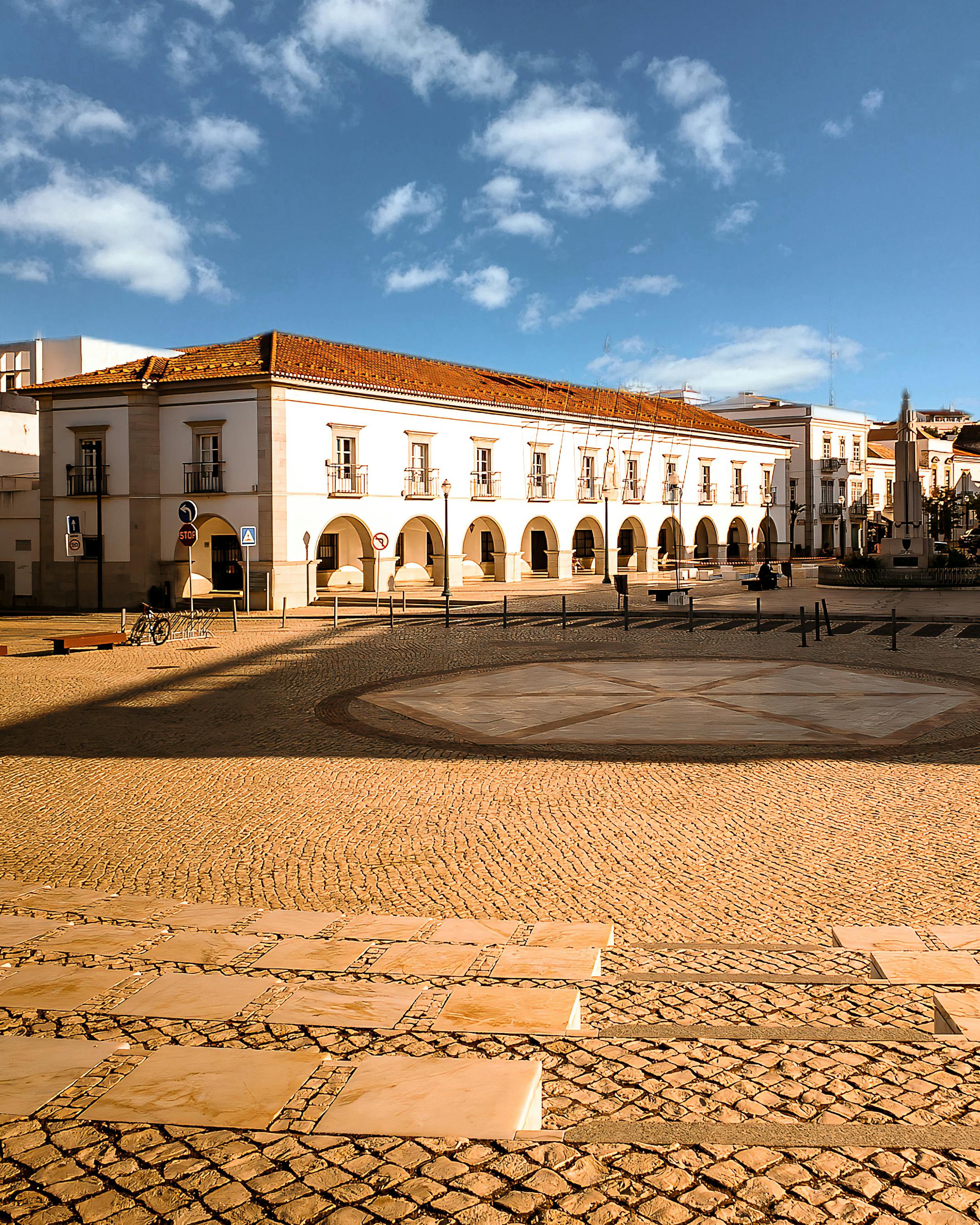
Day 4 is the day the trip turns south — a morning on the Alfa Pendular across the Tejo and down the Alentejo plains, an afternoon on the coast, and a Tavira dinner built around cataplana from a riverside tasca. Board the Alfa Pendular at Lisbon-Oriente for Faro; the fastest run is under three hours, and the early departures catch the train at its quietest. The ride empties out as the city falls away — the Alentejo opens into a long flat sweep of cork oak and wheat-gold plain, then the air turns soft and coastal as the south arrives. At Faro, the station drops you in the middle of town; change to the regional line and ride the last forty minutes east to Tavira, tracing the edge of the lagoon the whole way.
Tavira straddles both banks of the Gilão River, joined by a low seven-arched bridge — built in 1667 on far older Moorish foundations, so the "Roman" name the guides like to give it is a tidy fiction. Around it spreads a compact whitewashed old town you can cross corner to corner in fifteen minutes, studded with tiled house-fronts and an improbable count of baroque churches. The Ria Formosa barrier islands wait offshore, reached by a short ferry from Quatro Águas just east of the center — and that ferry is the heart of Day 5.
Dinner is cataplana, the dish that defines this coast. It's named for the hinged copper pan it's cooked in — a clam-shaped clamshell that seals tight and steams clams, white fish, and shellfish over wine, garlic, tomato, and coriander into something between a stew and a sea-perfume; the pan is carried to your table and opened in front of you, and the smell that rises out of it is the whole Algarve in one breath. It's cooked to order for two, so call ahead and let it take its half-hour. Matias sits right by the old bridge over the Gilão; Zeca da Bica and Água Salgada are near the market.
Quick reference
- Alfa Pendular Lisbon-Oriente → Faro: ~2h 52m fastest; €8 Promo (5+ day advance) / €33.90 standard / €30–€60 walk-up (CP, Seat 61, 2026).
- Faro → Tavira regional CP: ~40 min, ~€5, every 1–2 hours.
- Tavira old town: Seven-arched Gilão bridge, 1667 on Moorish foundations; old town walkable in 15 minutes corner-to-corner (Algarve Tips Tavira, 2026; Wikipedia Tavira).
- Cataplana dinner: Matias / Zeca da Bica / Água Salgada — ~€25–€45 for two plus wine, order ahead (Ola Daniela Tavira restaurants, 2026; National Geographic Travel; folkestonefoodies).
Day 5: Ria Formosa, then home
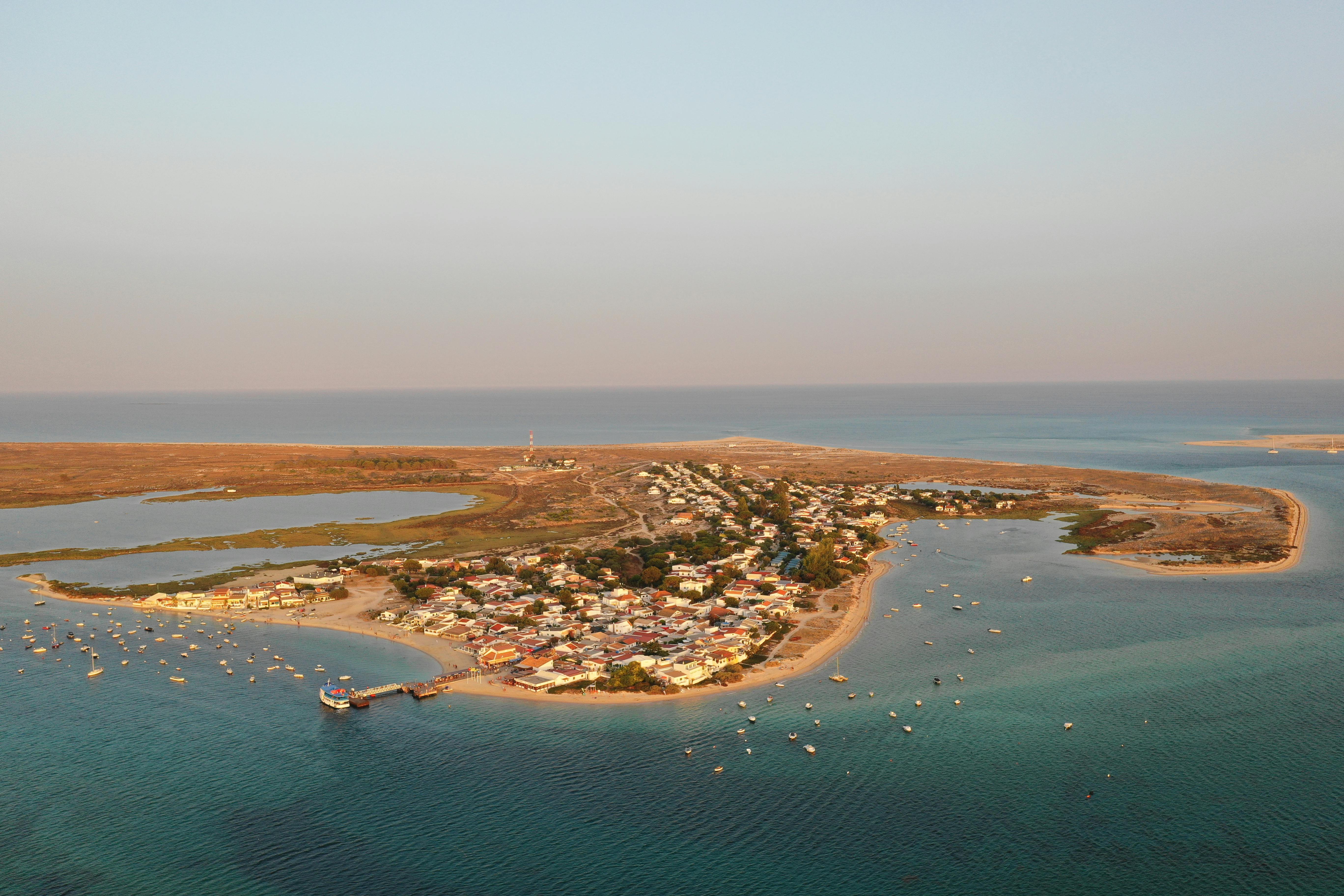
Day 5 is the open day, and the best way to spend it is out on the water — a short ferry across the Ria Formosa to a barrier-island beach, with Olhão's fish market or the cliffs of Sagres as alternatives. From Quatro Águas, the little Ria Formosa ferry crosses to Ilha de Tavira in about ten minutes, and on the far side opens 11 km of near-empty sand backed by dune and one shack grilling whatever came in that morning. You lie on the lagoon side of the country, salt drying on your skin, and you understand exactly what you took the train south for; the boat brings you back the same afternoon.
If sand isn't the point, two detours each earn the day on their own terms.
Olhão is the working heart of this coast, and you go for the fish and the strange beauty of the town. Fifteen minutes west by train, it's the Algarve's biggest fishing port, and its old quarter is a thicket of flat-roofed, cube-shaped houses — a North-African-influenced silhouette you'll see nowhere else in Portugal, built by sailors who traded with Morocco. The Mercado de Olhão, two brick halls on the waterfront, opens at dawn six days a week and sells the morning's catch off ice; lunch on cataplana from a different kitchen at Terra i Mar beside the market, then wander the Bairro dos Pescadores, the fishermen's quarter behind it where the cubist houses crowd tightest.
Sagres and Cabo de São Vicente are the long shot, at the far southwestern tip of the country — the last cliff before the Atlantic, the edge the old Portuguese navigators sailed off into the unknown from. A nineteenth-century lighthouse stands on sixty-meter cliffs above an ocean that does nothing but roar, and the Fortaleza de Sagres broods on the next headland. It's the most elemental landscape in the Algarve and a genuine two hours each way by bus from Tavira — worth it only if standing at the end of Europe means more to you than another lagoon afternoon. It is not the default day trip on a trip this short.
However you spend the day, leave for home in the evening. If you're flying out of Lisbon — the default for a TAP-routed trip — take the late Alfa Pendular back from Faro, booked when you booked the southbound, and overnight near the airport. If you booked the United Newark–Faro nonstop, you skip the return train entirely and fly home straight from the coast.
Quick reference
- Quatro Águas ferry to Ilha de Tavira: ~10 min; frequent in peak season; ~€2 round trip.
- Tavira → Olhão CP regional: ~15 min, ~€2.50. Mercado de Olhão: Mon–Sat, dawn–early afternoon (National Geographic Travel, 2024; i-escape, 2026; Algarve Tips Olhão, 2026).
- Sagres / Cabo de São Vicente: ~2 hr each way by bus; 19th-century lighthouse on 60–80 m cliffs (Idealista, 2024; Algarve-tourist.com Sagres, 2026). A long day.
- Faro → Lisbon return Alfa Pendular: Book at original southbound booking; same fare structure.
- Faro direct outbound (FAO): Only if you booked United EWR–FAO; otherwise return to LIS for outbound.
Onward connection and return
Three patterns close the trip: the Alfa Pendular back to Lisbon for the flight home, the United nonstop out of Faro, or — with extra days — a bus across the border to Seville. The default is the train back to Lisbon, the reverse of Day 4 on the same line at the same fares. Leave yourself a half-day buffer in the capital before the transatlantic flight; the train can run late and the airport isn't next door to Lisbon-Oriente.
The cleaner shortcut is the United Newark–Faro nonstop, which lets you fly home from the coast without ever doubling back to Lisbon. It reshapes the whole trip — two nights in the capital and three on the coast becomes plausible — and it makes the TAP stopover beside the point. It's a young route, four flights a week, so check the schedule when you book and have the train as a fallback.
The most rewarding extension, though, runs east. The old salt-and-fish coast you've been traveling doesn't stop at the Spanish border — it bleeds straight into Andalusia, and Seville is close enough to reach by bus before lunch. The ALSA coach from Tavira crosses into Spain and rolls into Seville in about two and a half hours, and because it stops in Tavira on the way out of Faro you can board on the coast without backtracking. Give it two nights and the trip stops being a Portugal trip and becomes an Iberian-coast one — the orange-tree courtyards and tiled palaces of Seville bolted onto the Algarve's lagoons. It's one of the most underused border crossings out of southern Portugal, and the easiest second country a five-day trip can grow into.
Quick reference — onward & return
- Train back to Lisbon: Alfa Pendular, reverse of Day 4, same fares and booking window. Build a half-day Lisbon buffer before the flight.
- Direct out of Faro: United Newark–Faro, 4 weekly from 15 May 2026, ~7h 20m; check schedule at booking (Flight Connections, 2026; Quinta do Lago, 2026).
- Seville extension: ALSA bus Tavira/Faro → Seville, ~2h 35m, €9–€29 advance, three operators daily; boards in Tavira (ALSA, May 2026; FlixBus, May 2026; CheckMyBus Faro-Seville, 2026).
Practical notes
Lisbon and the Algarve run on mostly the same rules — same euros, same Portuguese, the same easy tipping of 5–10% on a sit-down meal, the same 90-day Schengen entry for a US passport. Where the two diverge is the coast, and it diverges in two ways. Cataplana takes time — half an hour or more from order, since it's cooked from scratch for two — so call ahead in season; places like Matias take reservations and assume you'll want it. And the eastern Algarve is sharply seasonal: May through October is the window, July and August are the hot, crowded, expensive peak, and plenty of small coastal kitchens shut from November to February (Lonely Planet Algarve, 2026; Algarve Tips climate guide).
ETIAS — the new European entry authorization — is scheduled to launch in the last quarter of 2026, will cost €20, and will be valid for three years or until your passport expires (EU EEAS; AFAR, 2026). For any trip planned around or after that window, check the live go-live status on the EU EEAS site when you book.
Water and weather. The Algarve sat under a declared drought through 2024, so the considerate traveler posture is the obvious one — short showers, no running the pool, mindful use in the small guesthouses — and interior wildfire risk climbs in high summer. Check IPMA for current conditions before any trip built around water-intensive plans. It's a planning factor, not a reason to stay away.
Booking order. Promo fares on the southbound Alfa Pendular need five days' lead and come in at half the walk-up price, so book them early — and book the return train at the same time, not on Day 5. If you're extending to Seville, board the ALSA bus in Tavira rather than backtracking to Faro; it saves you an hour.
Frequently asked questions
Is 5 days enough for Lisbon and the Algarve?
Five days is enough when Lisbon is the opening leg and the Algarve is the destination. Three nights in Lisbon covers the central districts, Belém, and a Sintra day trip; two nights in the eastern Algarve (Tavira-based) covers the old town, a Ria Formosa ferry day, and the canonical cataplana dinner. It is not enough to do the western Algarve cliffs (Lagos, Sagres) on the same trip — that trip wants seven days and probably a rental car.
How do I get from Lisbon to the Algarve by train?
Take the Alfa Pendular high-speed train from Lisbon-Oriente to Faro on the Algarve coast. The fastest service runs about 2 hours 52 minutes; Promo fares start at €8 in 2nd class when booked at least 5 days in advance via cp.pt (Comboios de Portugal, 2026; Seat 61, 2026). Walk-up fares run €30–€60. Faro station is in the city center, not at Faro Airport, so transferring onward to Tavira or Olhão is straightforward.
Which part of the Algarve should I visit on a short trip?
The eastern Algarve — anchored on Tavira, with Olhão and the Ria Formosa barrier islands reachable in day trips. The east is on the train line from Lisbon, less developed than the western resort coast, and the part of the region most local writers recommend for travelers who want fishing-town authenticity over British package-tour density (National Geographic Travel, 2024; Algarve Tips, 2026). The dramatic cliff beaches at Lagos and Sagres are a separate trip.
Do I need a rental car in the Algarve?
Not for an eastern Algarve trip. The CP regional train line connects Faro, Olhão, Tavira, and Vila Real de Santo António; ferries reach the Ria Formosa barrier islands; the ALSA bus to Seville stops in Tavira if you want to extend onward. For a western Algarve trip (Lagos, Sagres, Ponta da Piedade), a rental car opens the coast meaningfully more, and the train terminates at Lagos with sparse local service beyond it.
Should I fly into Lisbon or Faro for a Portugal trip?
Lisbon for most US travelers in 2026. From US East Coast hubs, Lisbon (LIS) has more carriers and routinely lower transatlantic fares than Faro (FAO), and the Alfa Pendular train south is the easiest way to do the trip. United launched a direct Newark–Faro service on 15 May 2026 (four weekly, ~7h 20m), which is the only US–Algarve direct option — viable if your trip is Algarve-heavy and you want to skip the Lisbon transfer (Flight Connections, 2026; Quinta do Lago, 2026).
What is Fado?
Fado is Portugal's traditional song form — emotionally direct, often melancholic, usually a single singer accompanied by a Portuguese guitar (the round 12-string) and a classical guitar. It was born in Lisbon's working-class Alfama and Mouraria neighborhoods in the 19th century, and UNESCO listed it as Intangible Cultural Heritage in 2011. Most visitors hear it for the first time at a small Fado house in Alfama or Bairro Alto.