
A weekend in El Escorial from Madrid
You're flying into Madrid — and El Escorial is one of the trips you'll find on every short list for the northwest corridor. It should be. The Royal Monastery-Palace of San Lorenzo de El Escorial is a 33,000-square-metre UNESCO World Heritage complex that Philip II commissioned in 1563 to serve, simultaneously, as palace, basilica, monastery, school, library, and royal mausoleum. What makes a weekend in El Escorial from Madrid worth planning, though, is not the headline — it's the gap between what most visitors photograph and what they actually absorb inside. Two rooms stop a careful traveler in their tracks. Both of them are consistently underdescribed. Day 1 fixes that. Day 2 gets you outside — the monastery closes at 18:00, and the Herrería forest and Silla de Felipe II deliver a perspective on the building that no interior room can.
Book your flight into Madrid first.
Why El Escorial from Madrid
El Escorial sits 58 km northwest of Madrid, 50 minutes by Cercanías (the Madrid commuter rail network) on line C-8a, and at 1,028 metres above sea level — which means it runs 5–8°C cooler than the capital even in the middle of August.
The building's argument is unusual. Philip II did not build a monument to warmth or welcome. The monastery's exterior is Herreran architecture (the austere, grid-plan architectural style named after Juan de Herrera, the monastery's principal architect — characterized by plain granite, slate spires, and minimal ornament): long horizontal facades, no curves, slate spires, grey granite quarried from the surrounding mountains. The interior repeats the argument: the king's own apartments, a few metres from the gilded dome of the basilica, are famously stripped bare — closer to a monk's cell than a royal bedroom. Philip II wanted the contrast to be legible, and it is.
What the building offers beyond its architectural reputation is two rooms that earn extended attention: the Royal Library, where Philip II collected manuscripts in four languages alongside astrolabes and scientific instruments, and the Pantheon of Kings, where the dynastic logic behind 500 years of Spanish monarchy is stored in marble beneath the basilica floor. A weekend gives you the space to spend real time in both — and then step outside on Day 2 to see the whole complex from the hilltop where Philip II reportedly watched it being built.
Getting there from Madrid
The Cercanías C-8a line from Madrid Atocha or Chamartín runs directly to El Escorial in approximately 50 minutes, with trains every 30 minutes during peak hours and every 45–60 minutes off-peak. Cost is around €4.94–€5.50 each way — under €11 round trip. Walk-up tickets work fine at station machines or via the Renfe app; no advance booking required for the train itself.
One logistical point to plan around: the El Escorial Cercanías station sits in the adjacent municipality of El Escorial proper, about 1.5 km from the monastery in San Lorenzo. From the station, walk uphill 15–20 minutes or catch local bus L-1 for the final leg into town. If you'd rather be dropped at the town center, take the Autocares Herranz bus #664 from Madrid Moncloa bus station — it costs approximately €5.20 each way and delivers you closer to the monastery, though Moncloa itself is a metro ride from central Madrid.
Book your monastery tickets before leaving Madrid. From 17 February 2026, Patrimonio Nacional requires all visitors to pre-book a timed entry slot at tickets.patrimonionacional.es — including those entitled to free entry. Weekend slots sell out. Book in advance; walk-up entry is not currently possible.
- Train: Renfe Cercanías C-8a from Atocha or Chamartín, ~50 min, ~€4.94–€5.50 each way. Walk-up. (Renfe Cercanías, June 2026)
- Bus alternative: Autocares Herranz #664 from Moncloa, ~45–55 min, ~€5.20 each way. Walk-up; closer monastery drop. (Omio, June 2026)
- Driving: A-6 motorway, ~58 km, ~50–60 min. Parking at town edge; 5–10 min walk to monastery.
- Monastery ticket: €14 standard, €7 reduced. Timed entry required — book at Patrimonio Nacional. (Patrimonio Nacional, June 2026)
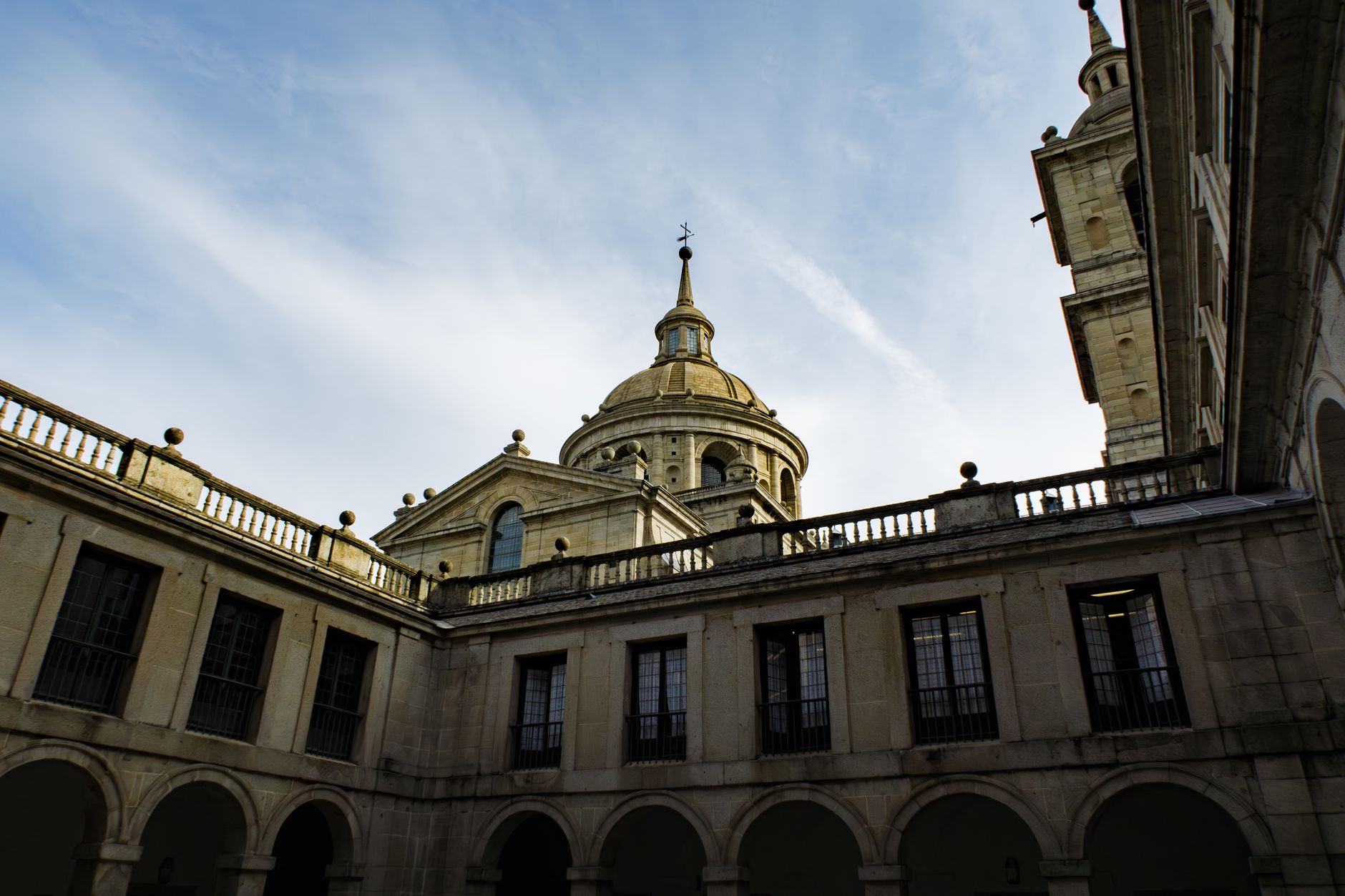
Day 1 — The monastery at depth
Day 1 covers the full monastery complex — over 30,000 sq m of basilica, royal apartments, Royal Library, and Pantheon of Kings, all accessible on a single timed-entry ticket. Certain areas, including the Pantheon, require a timed entry slot booked in advance. The sequence runs from the Lonja esplanade on the monastery's exterior through the basilica and royal apartments to the Royal Library and Pantheon beneath it. Together they take 2.5–3 hours if you give the Library and Pantheon the attention they deserve. An early arrival by 10:00 means 30–45 minutes before the tour groups from Madrid arrive.
The Lonja esplanade
The Lonja is the granite esplanade that surrounds the monastery on three sides — the paved forecourt from which the building's full facade proportion is legible before you enter. Standing here, the horizontal severity of Herreran architecture is most apparent: the west facade alone runs 207 metres, unbroken by ornament, punctuated only by granite towers at the corners. Arrive at opening and spend a few minutes on the Lonja before the interior crowds build.
Basilica and royal apartments
The basilica's gilded dome rises 95 metres and is the building's loudest statement — frescoed, ornate, the counter-argument to everything Philip II's exterior proposes. Spend time with both registers. The nave's scale is most legible from the crossing; the Flemish paintings in the retablo mayor (the monumental gilded altarpiece at the high altar) are worth locating.
Then walk to the royal apartments. The contrast is the point. Philip II's personal rooms are not a king's bedroom — they are a deliberate reduction: stone floors, simple furniture, a private window that looked directly into the basilica so the king could attend mass from his bed without leaving his quarters. Standing in both spaces within the same hour, the monastery's architectural argument clicks into place: monumentality and austerity as the same impulse, not opposites.
Quick reference — Basilica and royal apartments:
- Hours: Tue–Sun, 10:00–18:00 (Oct–Mar) or 10:00–19:00 (Apr–Sep). Closed Mondays.
- Ticket: €14 standard, €7 reduced; timed entry slot required. (tickets.patrimonionacional.es, June 2026)
- Time to allow: 45–60 min for both spaces together. Arrive by 10:00–10:15 for least crowding.
Royal Library — Biblioteca Real
Most visitors spend five minutes here. It rewards thirty.
The Royal Library sits above the main entrance on the monastery's upper floor — same ticket, same building, the room most travel writing gives a single sentence to before moving on. What Juan de Herrera built in 1584 was not simply a library for Philip II's manuscripts. It was a structural argument about how knowledge should be organized.
Medieval libraries arranged their collections in angled perpendicular bays, oriented toward windows for light. The Biblioteca Real broke this entirely — Herrera lined the 4,700 manuscripts and 40,000 printed volumes in continuous horizontal cases along both long walls, freeing the center of the hall. The spines face inward (a deliberate choice: the books were shelved facing the wall to protect the gilding on their covers), and the center of the room belongs to the scientific instruments: globes, astrolabes, maps. Philip II's intent was to put theology, the natural sciences, and the humanities under the same roof in the same room — Arabic and Hebrew manuscripts alongside Greek and Latin texts, alongside instruments for reading the sky. The ceiling frescoes depicting the seven liberal arts make this program explicit.
Stop under the frescoes and look along the length of the hall. The room is not decorative in the way the basilica is decorative. It is an argument about what knowledge should look like when a 16th-century monarch with the resources of an empire tries to hold it in one place.
Quick reference — Royal Library:
- Ticket: Included in monastery ticket.
- Photography: Permitted without flash.
- Time to allow: 20–30 min; more if the ceiling frescoes hold you. (Atlas Obscura Royal Library, 2024)
Pantheon of Kings — Panteón de Reyes
The Pantheon of Kings is reached by descending a marble staircase beneath the basilica — a gilded descent, lantern-lit, deliberately theatrical. The octagonal chamber at the bottom holds 26 marble sepulchres arranged in identical tiers along the curved walls: Charles I (the Holy Roman Emperor Charles V) on one side, the queens consort who bore heirs on the other. Nearly every Spanish monarch from the 16th century through the early 20th is here.
The room is formally beautiful. But the detail that reframes it is invisible.
Below the main chamber sits the pudridero (the decomposition vault below the Pantheon where royal remains were held for 20–30 years before being interred in their final niches). Not open to visitors. Not marked on most diagrams. It is the practical mechanism that makes the Pantheon's marble tidiness possible: royal remains entered through the pudridero, waited, and emerged — after the process was complete — ready for the identical marble sarcophagi in the Pantheon above. The chamber exists because Philip II's dynastic project required that kings and queens look the same in death as in the heraldry: orderly, permanent, above the circumstances of decomposition. The pudridero is the unglamorous infrastructure behind the marble ideal.
Knowing it is there changes how you walk through the room. The sepulchres are not simply where monarchs rest. They are the last stage of a process Philip II designed along with the building itself.
The audio guide is worth it here. Without context, the chamber reads as a dark marble hall rather than as five centuries of dynastic planning in stone.
Quick reference — Pantheon of Kings:
- Ticket: Included in monastery ticket.
- Audio guide: Recommended; sold at the monastery entrance.
- Time to allow: 30–45 min; arrive early in the day to avoid the worst crowding. (iberinbound.com, 2024)
Lunch in town
After the monastery, walk toward Calle Floridablanca and the streets around the complex for lunch. The local tradition is Castilian roast — cordero asado (wood-fired roast lamb) and cochinillo (roast suckling pig) at the town's asadors (wood-fired roasting restaurants). Charolés, operating since 1977 a few metres from the monastery, and Asador del Rey are both well-regarded local institutions for this style. Order a menú del día (the set lunch, typically starter, main, wine or water, and dessert) and take the full 90-minute service window — lunch runs 13:30–15:30.
Quick reference — Lunch:
- Price range: €20–€35 per person at a mid-range asador for the full menú del día. Tapa bars on the main street run €2–€5 per round.
- Timing: Lunch service 13:30–15:30; arrive by 13:30 without a reservation. (Wanderlog + TripAdvisor restaurant data, 2025–2026)
Where to stay overnight
San Lorenzo de El Escorial has mid-range hotel options in and around the town center — enough for a comfortable two-night stay without needing to commute from a larger nearby town, though the boutique selection is limited. The town is quieter after 20:00 than Madrid, which is part of the point: the monastery and surrounding landscape are the focus, not the evening. A hotel within walking distance of both the town center and the monastery complex keeps Day 2 flexible.
Day 2 — Outside and above
Day 2 starts in the Herrería forest and makes the same argument the monastery does, from the outside: that what Philip II built was made to be seen against the mountains as much as entered.

Herrería forest walk
The Bosque de la Herrería is a 497-hectare protected oak-and-chestnut woodland that flanks the monastery to the south and west. The trail to the Silla de Felipe II starts from the south end of town and runs 30–45 minutes through this forest — past picnic benches, a reservoir path, and the Ermita de la Virgen de Gracia hermitage en route. The forest section is shaded and quiet, the kind of walking the monastery's granite interior cannot offer. Aim for a morning start: cooler trail, better light on the building's facade from the platforms above.
Silla de Felipe II — viewpoint
The Silla de Felipe II is a set of granite rock platforms carved into the Abantos hillside, roughly 2.5 km south of town. Philip II's Chair — the name the platforms carry — marks where the king reportedly sat to watch construction progress on the monastery during the decades it was being built. The view from these platforms is the reason Day 2 has a structural argument: the monastery complex below, laid against the foothills of the Sierra de Guadarrama, in proportions that no interior view can communicate. The monastery as landscape object rather than enclosure.
Quick reference — Herrería forest and Silla de Felipe II:
- Access: Free. Trail well-marked; start from the south end of town.
- Distance: Roughly 2.5 km each way through Herrería forest; 30–45 min walk each direction.
- Time to allow: 1.5–2 hours round trip, plus time at the platforms.
- What to bring: Water; the trail section above the forest is sunny and open.
- Dogs: Allowed on leads in the Bosque de la Herrería.
- (visitmadrid.es, 2025; AllTrails, 2025)
Casita del Príncipe — if open
If Patrimonio Nacional has the Casita del Príncipe open on your visit, it is worth 45 minutes as a genuine counterpoint to everything Day 1 offered. Juan de Villanueva designed this neoclassical lodge in 1772 for the future Carlos IV — a pleasure retreat in every way Philip II's monastery was not: small scale, warm ornament, paintings by Giordano, Giaquinto, and Reni. The gardens surrounding it are free to access regardless of whether the lodge interior is open.
Check the current schedule before leaving Madrid at tickets.patrimonionacional.es — hours vary seasonally and the lodge is not reliably open every day. Do not build Day 2 around the Casita; build Day 2 around the Silla and treat this as a good addition if the timing works.
Quick reference — Casita del Príncipe:
- Gardens: Free access, open regardless.
- Lodge interior: Separate ticket; check current opening hours at tickets.patrimonionacional.es before departure. (Patrimonio Nacional, June 2026)
- Location: South of the monastery complex, a 5-minute walk.
Back to Madrid
The Cercanías C-8a runs late — the last train from El Escorial back to Madrid typically departs after 22:00, but exact departure times vary by day of the week and should be verified. Check the current schedule at renfe.com on the morning of your departure rather than relying on a fixed time.
This gives you flexibility for a late lunch in town or a final coffee before heading back. The train deposits you at Madrid Atocha or Chamartín — a weekend that started in the Sierra de Guadarrama foothills, 50 minutes from the capital.
Practical notes
The main logistical priority before leaving Madrid is booking a timed entry slot for the monastery — walk-up entry has not been possible since February 2026, and weekend slots sell out. Hours at the Silla de Felipe II trailhead are unrestricted, but the Casita del Príncipe and some monastery areas have season-specific schedules; verify both at tickets.patrimonionacional.es before you go. The return Cercanías runs late if you want a full second day.
- Book monastery tickets before leaving Madrid. Timed entry at tickets.patrimonionacional.es is required from 17 February 2026 — all visitors, including free-entry eligible. Weekend slots sell out. This is the single most important logistical step for this trip.
- Arrive at the monastery at opening (10:00). Tour groups from Madrid typically arrive at 10:30–11:00. The first 30–45 minutes are the least crowded.
- The monastery closes every Monday year-round. Verify on Spanish public holidays, when closures may shift.
- Cercanías station to monastery is uphill. The El Escorial train stop is 1.5 km from the monastery in San Lorenzo — 15–20 min walk uphill, or local bus L-1. The Herranz bus from Moncloa drops you closer to the town center.
- Bring a layer, even in summer. At 1,028 metres, El Escorial sits 5–8°C cooler than Madrid. If you're arriving from central Madrid in a light layer, pack an extra.
- Audio guide for the Pantheon. The room's architectural and dynastic context is hard to read without it; most commentary at the site is limited.
- Casita del Príncipe hours vary. Check tickets.patrimonionacional.es before departure — do not treat it as a guaranteed Day 2 stop.
- Return train times: Check renfe.com on your day of travel. Last services typically run after 22:00, giving room for a late lunch or coffee before departing.
- Best months: April–May (spring, 19–25°C, Herrería forest in bloom, pre-summer crowds) and September–October. Note: the Romería Virgen de Gracia festival draws 15,000+ visitors to the Herrería forest on the second weekend of September (September 11–14, 2026) — lodging is tight that weekend. Summer (July–August) is feasible: El Escorial's altitude makes it a genuine escape from Madrid heat. Winter (November–March) is uncrowded; possible snow on the granite; cold for forest walks but the interior is heated. (madrid-ticket.com, 2025; festivalesdeespana.com, 2026; whereandwhen.net, 2025; thetouristchecklist.com, 2025)
Frequently asked questions
How do I get from Madrid to El Escorial?
Take the Cercanías on line C-8a from Madrid Atocha or Chamartín — roughly 50 minutes, €4.94–€5.50 each way. Trains run every 30 minutes during peak hours. Walk-up tickets at station machines or via the Renfe app. Note: the El Escorial station is about 1.5 km from the monastery — allow 15–20 minutes uphill on foot, or catch local bus L-1 for the final stretch. (Renfe Cercanías, June 2026)
Do you need to book timed entry for El Escorial in advance?
Yes — and this is not optional. From 17 February 2026, Patrimonio Nacional requires all visitors to pre-book a timed entry slot at tickets.patrimonionacional.es before arriving, including those entitled to free entry. Weekend and Spanish-holiday slots sell out. Book before you leave Madrid — ideally a few days in advance. Walk-up entry is no longer possible for any visitor under the current protocol. (Patrimonio Nacional, 2026)
Is El Escorial worth a weekend, or is a day enough?
A day covers the monastery complex adequately, but a second day is worth it if you want to go deeper. Day 1 gives the Royal Library and Pantheon of Kings the time they deserve — most visitors rush these two rooms; they reward at least an hour between them. Day 2 gets you outside: the Silla de Felipe II hike through the Herrería forest delivers a view of the building that no interior experience can replicate.
What is the Royal Library at El Escorial?
The Royal Library (Biblioteca Real), on the monastery's upper floor and included in the standard ticket, holds 4,700 manuscripts in Latin, Greek, Arabic, and Hebrew alongside 40,000 printed volumes and early scientific instruments. Built in 1584 to a design by Juan de Herrera, it broke with the medieval perpendicular-bay arrangement — lining the collection along both long walls in continuous horizontal cases, freeing the center of the hall entirely. The ceiling frescoes depict the seven liberal arts. Allow 20–30 minutes.
What is the Pantheon of Kings at El Escorial?
The Pantheon of Kings (Panteón de Reyes) is a circular marble-and-bronze royal mausoleum beneath the basilica, reached by descending a gilded staircase. It holds 26 sepulchres with the remains of nearly every Spanish monarch from Charles I through Alfonso XIII. Below the main chamber sits the pudridero — the decomposition vault where royal remains waited 20–30 years before transfer to their final niches. Knowing it exists reframes the room. Bring the audio guide. (iberinbound.com, 2024)
Is the Silla de Felipe II hike worth doing?
Yes. The Silla de Felipe II is a series of granite rock platforms on the Abantos hillside, roughly 2.5 km south of town — reportedly where Philip II sat to watch construction on the monastery. The walk takes 30–45 minutes through the Herrería forest; from the platforms, the monastery complex reads against the Sierra de Guadarrama in a way no interior view can match. Free, well-marked trail; bring water. Allow 1.5–2 hours round trip. (visitmadrid.es, 2025)