A Weekend in Évora from Lisbon: Megaliths & Wine
Évora is a walled Alentejo town about ninety minutes east of Lisbon, built in granite around an intact first-century Roman temple, a 12th-century cathedral the color of dry stone, and a working historic center where Portugal's third-oldest university (founded 1559) still anchors the social rhythm. You're flying into Lisbon — and Évora earns a weekend because the layer outside the walls (the Almendres stones, a Cartuxa cellar, a Monsaraz drive over to Lake Alqueva) can't be done in a single day. The walled center handles the first day on foot from the rail station. The second day needs a rental car. The reward is two nights of an Alentejo trip the day-trip coaches turn around before they ever see.
The food carries half the case on its own. Stand in the Templo Romano at dusk, when the columns go honey-colored, and you start to notice that Évora is a town made of stone — Roman granite, the cathedral's fortress walls, the menhirs out in the fields, the castle on the hill at Monsaraz — set down in a sea of cork oak. That cork-oak woodland, the montado, is what the whole weekend grows out of: it raises the black pigs, it corks the wine, and it stretches the same silver-green to the horizon whichever way you drive out of the walls. Évora has the restaurant density to make a three-hour lunch the experience that anchors the trip, and the architectural stack — Roman, Visigothic, Moorish, and Manueline (the late-Gothic Portuguese style of the early 1500s, dense with carved ropes, knots, and maritime motifs) — to fill the hours around it.
Why Évora is worth two days from Lisbon
Two days work where one doesn't because the strongest Alentejo anchors are scattered across the countryside, not stacked inside the walls — and reaching them honestly takes a car and a second morning, which a same-day round-trip from Lisbon simply can't give you. This is the layer the coaches never reach.
The Cromeleque dos Almendres — 95 granite menhirs (standing stones) roughly 2,000 years older than Stonehenge — sits west of Évora on a dirt road with no bus service. Cartuxa, the former Jesuit estate that produces the flagship Pêra-Manca wines, is a short drive from the historic center but not bus-accessible. Monsaraz is a walled medieval village over Lake Alqueva, far enough east that it can't be reached and returned from in a single day from the capital. An overnight gets you all three; a same-day round-trip leaves them on the table.
The second reason is the evening, and it's quieter but just as real. Day-trip coaches clear out of Évora by late afternoon, and the town exhales. Praça do Giraldo — the 700-year-old main square, ringed with arcades — is a different place at eight in the evening than at noon: older men nursing a beer under the arches, swifts working the warm air over the paving, the cathedral going dark against the last light. The only way to see it is to stay over.
A note on overlap, since travelers ask: Évora's walled-UNESCO-town headline partly echoes Sintra, the other walled Lisbon satellite. The two are distinct — Sintra is Romanticist palace architecture in a forested hill setting; Évora is a Roman-through-Manueline whitewashed town on the open Alentejo plain — and the specific draws here (Alentejo cooking, an intact Roman temple, a megalithic ritual site, Pêra-Manca wine country) aren't available in Lisbon at the same depth.
Getting there from Lisbon
The cleanest pattern is the Alfa Pendular train out of Lisbon on Friday afternoon or Saturday morning, then a rental car for the second day's countryside loop out of town. Évora sits 135 km east of Lisbon, well connected by rail, bus, and a fast motorway, so the journey stays short however you make it.
The CP Alfa Pendular leaves from Lisboa Oriente — the Calatrava-designed station on the Red Metro line, all white ribs like a whale skeleton — and runs direct to Évora's station at the south edge of the walled center in about an hour and a half. Four direct services run each way per day; the Intercidades alternative is a touch slower and walk-up friendly. AP seating is assigned and sells out on summer weekends, so book before you fly.
Two alternatives are worth knowing. Rede Expressos buses leave from Lisboa Sete Rios (Blue Metro line, Jardim Zoológico stop) many times a day, and the last return runs late — around half past eleven at night from Évora — which is a genuine advantage if the second day runs long. Driving the A2 and A6 motorway corridor takes about an hour and a quarter, and it's the option that shapes the trip most, because the second day can't be done without a car at all.
That rental decision is the one to make before you leave. If you're committing to two days from the moment you book the flight, pick up the car at Lisbon airport on arrival — that puts it in your hands for the second day with no mid-trip pickup to arrange. If you'd rather take the train down and rent only when you need it, Évora has edge-of-town agencies open Friday evenings; collect the car after dinner on the first night. Either way, park outside the walls — there are free and paid lots near Mercado 1º de Maio and Praça do Giraldo — because the historic core is cobbled and partly pedestrian.
Quick reference — getting there
- Alfa Pendular (rail): Lisboa Oriente → Évora, ~1h30, 4 direct services each way daily. Round-trip ~€15–€32 in second class depending on AP vs Intercidades and booking lead time (CP.PT and Omio, May 2026). Intercidades ~1h55, walk-up friendly.
- Rede Expressos (bus): Lisboa Sete Rios → Évora, ~42 services/day, last return ~23:30. Advance fares from €3 each way, up to ~€21 at walk-up dynamic pricing (Rede-Expressos.pt and Omio, May 2026).
- Driving: A2 + A6, 135 km, ~1h15–1h30, ~€6.30 in tolls each way for a Class 1 vehicle (Via Verde toll info via tollguru.com, May 2026). Compact rentals from Lisbon airport ~€25–€60/day.
- Parking: Free and paid lots near Mercado 1º de Maio and Praça do Giraldo; core is cobbled and partly pedestrian.
Day 1: The walled center, on foot
Day 1 keeps everything within a fifteen-minute walk of Praça do Giraldo: the high-point Roman Temple and cathedral pair, a long Alentejo lunch, the Capela dos Ossos in the afternoon, and the central square at sunset. The rail station sits ten to fifteen minutes downhill from the historic core, so the day works the same whether you came in on a morning train or drove.
Templo Romano de Évora and the Sé Catedral rooftop
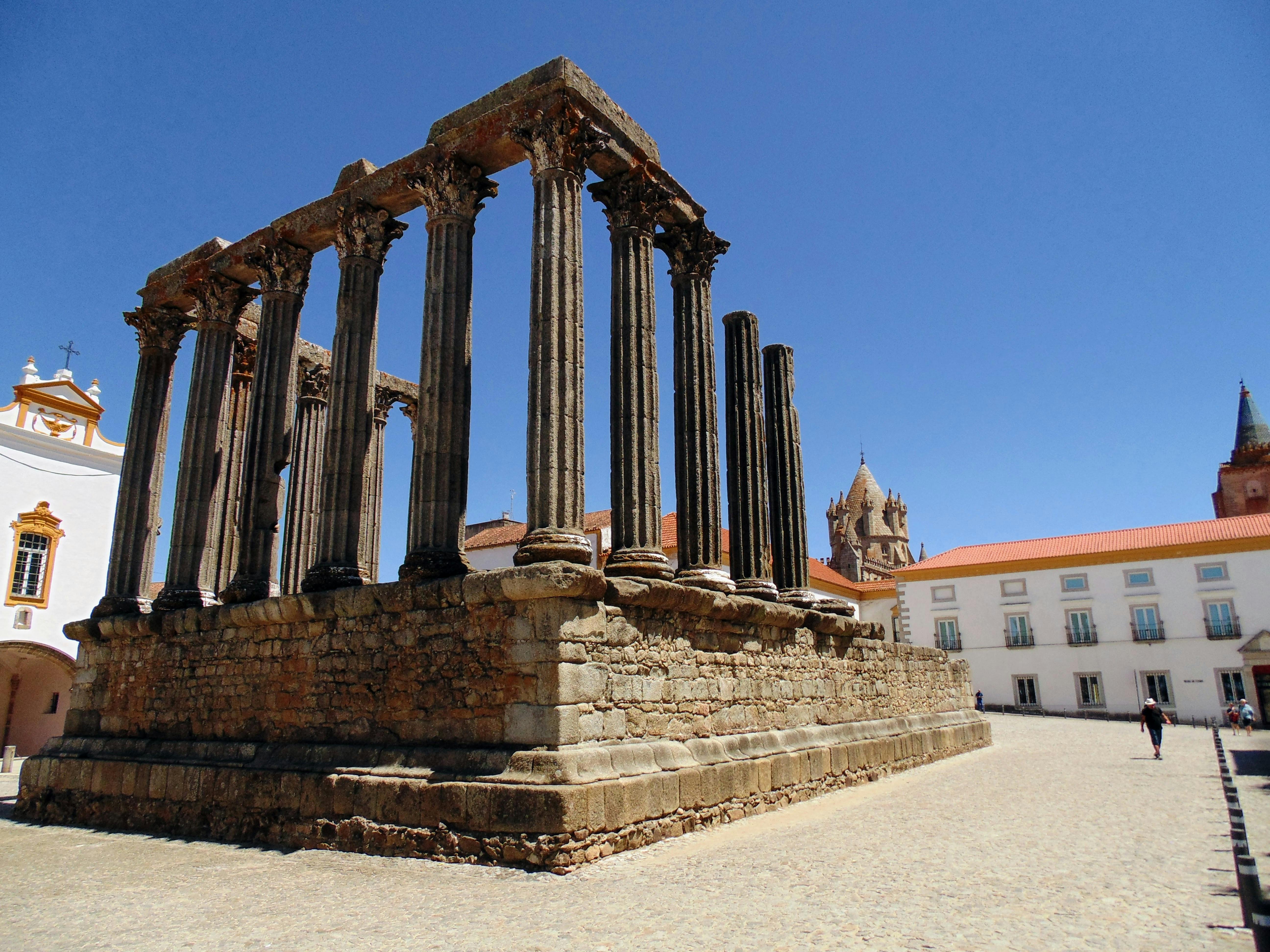
The Roman temple and the cathedral stand 200 meters apart at the high point of the walled town, so open the day with both as a single ninety-minute cluster while the light is still soft. The Templo Romano is the reason most travelers come to Évora, and it earns the billing: a first-century structure with fourteen of its original eighteen Corinthian columns still standing, one of the best-preserved Roman ruins on the Iberian Peninsula. It's open-air and free, and it reads best in late-afternoon light or after dark, when the columns are lit and the swifts scream around the capitals.
Across the small square sits the Sé Catedral de Évora (Sé is the Portuguese word for cathedral), the largest medieval cathedral in Portugal — granite Romanesque-Gothic with the silhouette of a fortress, because in the 1100s that's partly what it was. Buy the combined ticket rather than the cathedral-only one; it adds the cloister, the museum, and the panoramic terrace, and the terrace is the point. From the city's highest roofline the whole walled town drops away beneath you and the Alentejo plain runs flat to the edge of sight, cork oak and olive groves all the way out. Steep steps, and not stroller-friendly — but no other sight in Évora gives you the town from above like this.
An Alentejo lunch
Lunch is the experience that turns Évora from a sight-tour into a town worth staying for. Plan a ninety-minute-to-three-hour sit-down meal built on regional cooking — porco preto, açorda alentejana, migas, ensopado de borrego (a slow-cooked lamb stew served over bread), sheep's-milk cheese, a jug of regional red.
This is where the montado pays you back at the table. The black pig you're eating spent its life under those cork oaks, fattening on fallen acorns, and you can taste the difference — a deep, nutty richness no industrially raised pork carries. The canonical rooms are four. Fialho, open since 1945, is the historical anchor: borrego assado (roast lamb) and perdiz à convento (a convent-style partridge dish), family-run, formal in the way that earns the reservation. Dom Joaquim is the polished traditional option inside the walls. Botequim da Mouraria is the petiscos counter for travelers who'd rather graze than commit — petiscos are Portugal's answer to Spanish tapas, small shared plates ordered through the meal — where you stand at the marble and let the owner steer you. Enoteca Cartuxa pairs modern regional cooking with pours from the winery's flagship, a strong choice if you're saving the cellar itself for Day 2. Whichever you pick, reserve a few days ahead for Fialho and Dom Joaquim, and don't fight the clock: most kitchens close between roughly three and half past seven, because the Portuguese lunch-and-dinner schedule is the constraint, not a flourish.
Capela dos Ossos at Igreja de São Francisco
The bone chapel is what Évora is internationally known for, and it's worth seeing — but it's not the day's headline, and how you frame the visit matters. Capela dos Ossos is a small 16th-century chapel inside the Igreja de São Francisco whose walls, columns, and ceiling are lined with the bones of around 5,000 people. The friars who built it around 1590 weren't being macabre for its own sake; with the town's cemeteries overflowing, they made a room that argues, in skulls, that death is the one appointment nobody misses. The inscription over the door says it plainly — Nos ossos que aqui estamos pelos vossos esperamos, "Our bones await yours" — and standing in the low candle-colored light, you feel the argument land.
The ticket also gets you into the larger Gothic-Manueline church — the largest single-nave span of any Portuguese Gothic building — and two upstairs museum floors. The chapel itself is small; you'll spend fifteen or twenty minutes inside, forty-five to sixty for the full complex. Come mid-afternoon: early enough to miss the Lisbon coach-tour surge, late enough to give lunch room to breathe.
Aqueduto da Água de Prata in-town section
A short walking detour, easy to slot in before the cathedral if the train timing leaves you a half-hour gap. The Aqueduto da Água de Prata is a 16th-century Renaissance aqueduct, built 1532–1537 under King João III to carry water from the Divor estate into the walled city. Follow it to the section near Porta da Lagoa and the story gets stranger and better: over five centuries, townspeople simply built their houses into the arches, so the aqueduct now runs through people's front rooms — laundry strung between the piers, a cat asleep on a windowsill that used to be a void. It's one of the most photographed corners of Évora, and most coverage skips it entirely.
Free, outdoor, anytime. The full rural extension runs about 8 km out of town and is out of scope for a two-day trip; the in-town stretch is a thirty-minute detour.
Praça do Giraldo and Rua 5 de Outubro at sunset
Close the day in the center, where the town turns back into a town. Praça do Giraldo is the 700-year-old main square at the heart of the walled town, ringed by arcades, Igreja de Santo Antão at the north end, the tourist office, and cafés that spill onto the open paving. The arches are Moorish-pointed — a reminder of the seven centuries of layered rule that built this place — and after the buses leave, the people sitting under them are mostly locals.
Rua 5 de Outubro runs downhill toward the cathedral, cobbled and lined with shops selling regional ceramics, cork goods, ironwork, and painted furniture. Walk it slowly, but hold your wallet: the souvenir ceramics here cost about double what you'll pay direct from a workshop on Day 2. Then take a drink in the arcaded cafés as the square empties and the day-trip coaches pull away. Forty-five minutes to an hour for the square and the slow walk down.
Quick reference — Day 1
- Templo Romano: Free, outdoor, 24-hour access. Lit after dark. Best in late-afternoon light or after dark (Lonely Planet Évora; Visit Évora, 2024).
- Sé Catedral combined ticket: ~€4.50 (Cathedral + Cloister + Panoramic + Museum), ~€2 cathedral only, per cathedral tariff pages May 2026. Open 09:00–17:00, museum closed Mondays.
- Alentejo lunch: mains €15–€30, full meal with wine ~€35–€60 per person (Portugal Magik and Portugal Confidential, May 2026). Reserve 3–7 days ahead for Fialho or Dom Joaquim. Most kitchens close 15:00–19:30.
- Capela dos Ossos: ~€5 adult, ~€3.50 senior/child (Igreja de São Francisco official site, 2026). Open daily 09:30–18:30. Mid-afternoon slot avoids the coach surge.
- Aqueduto in-town section: Free, anytime, ~30 minutes.
- Praça do Giraldo at sunset: Free, café drinks ~€3–€6.
Where to stay overnight
Two nights inside or just outside the walls is the right pacing for this trip, and the historic convent-turned-pousada is the lodging choice that best matches it — boutique guesthouses and newer mid-range hotels fill out the rest of the options around it.
Pousada Convento de Évora (Pousada dos Loios) is the canonical historic choice: a 15th-century convent wedged between the cathedral and the Roman Temple, around 36 rooms, an outdoor pool in the old cloister garden. It's the rare hotel where the building is itself a reason to book — you walk to your room down a corridor where Loios friars walked for four centuries. Boutique guesthouses inside the walls cluster around the central square and the cathedral side. Newer mid-range hotels just outside the walls, like the Évora Olive Hotel, come with parking — a real consideration if you're driving in.
Book a couple of weeks ahead if your dates fall on Feira de São João (roughly June 22 into early July, a twelve-day run and one of the largest fairs in Portugal) or on a vindima weekend (the wine harvest, mid-September through mid-October, when the surrounding quintas open for harvest tastings). Both are good reasons to come; both tighten the rooms. Hold the trip to two nights, though — by Sunday afternoon you'll be ready to be back in Lisbon, and a third night pushes Évora past what it is as a leg of a Lisbon trip.
Quick reference — lodging
- Pousada Convento de Évora (Pousada dos Loios): 15th-century convent, ~36 rooms, outdoor pool. Doubles ~€130–€220 by season, shoulder-season lows ~€79 (Pousadas de Portugal operator pages, May 2026).
- Boutique guesthouses inside the walls: ~€70–€140.
- Mid-range hotels just outside the walls: ~€60–€100, with parking.
- Book ahead: 2–3 weeks for Feira de São João and vindima weekends.
Day 2: Megalithic stones, a Cartuxa cellar, and a Monsaraz drive
Day 2 is the countryside loop that's the reason to stay over: the standing stones at first light, a Cartuxa cellar mid-morning, a long lunch, and Monsaraz over Lake Alqueva in the afternoon. This is the layer of the Alentejo Lisbon can't reach in a day, and it's what turns Évora from a sight-tour into a region.
It does need a rental car, and there's no honest way around it — Almendres has no bus, Cartuxa is bus-inaccessible, and Monsaraz and São Pedro do Corval are car-only. The shape of the day is a loop: stones early, cellar mid-morning, lunch back in town or at the winery, then east on N256 for the Monsaraz afternoon. Collect the car the night before at an Évora agency, or arrive Lisbon-side with it already in hand.
Cromeleque dos Almendres
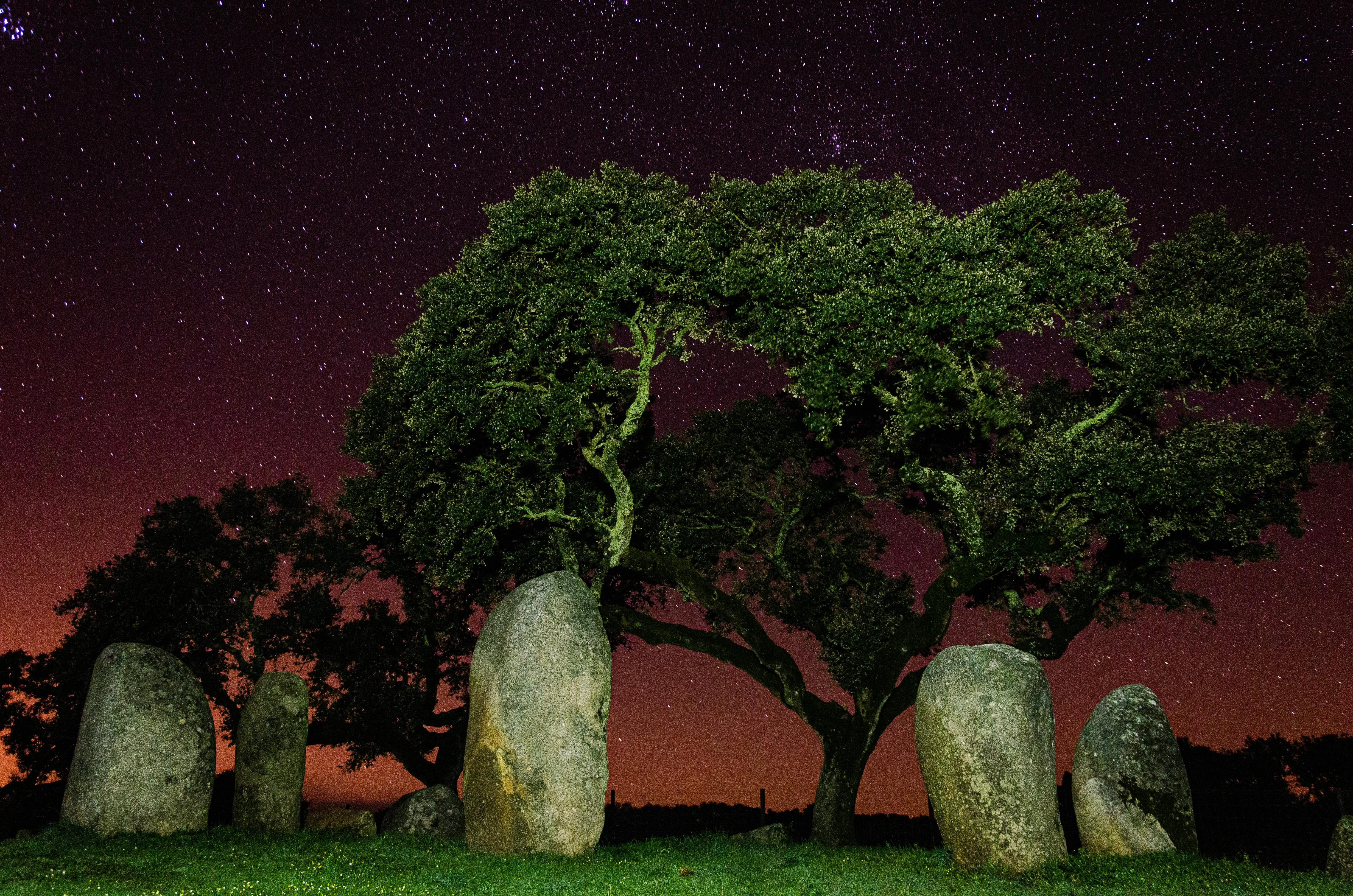
The single strongest reason to stay over, and the place where the town's stone motif goes prehistoric. The Cromeleque dos Almendres — a cromlech is a circular arrangement of standing stones from the Neolithic period — is a 95-stone megalithic complex west of Évora: two granite rings, one round and one oval, raised and re-set across some three thousand years, between roughly 6000 and 3000 BCE. It is the most important megalithic group on the Iberian Peninsula, and it predates Stonehenge by around two thousand years. You can walk in among the stones, put a hand on granite that people stood on end before the wheel reached this plain, and trace the carved spirals and cup-marks whose meaning archaeologists still argue over.
There's no fence, no ticket, no opening hour — just the stones, the cork oaks, and usually no one else if you come at first light. The drive is about half an hour from Évora; the final stretch is unpaved dirt road, fine in a normal rental in dry weather but worth checking after winter rain. Give it an hour to ninety minutes on-site, plus the drive each way, and let the early sun do the work — it rakes across the stones and pulls every carved mark out of the granite.
Cartuxa winery visit and Pêra-Manca tasting
Adega da Cartuxa is the former Jesuit estate — founded in 1540, the wine now made by the Eugénio de Almeida Foundation in what was once a Carthusian monastery — a short drive from central Évora. The flagship Pêra-Manca wines are among Portugal's most prestigious; it's a name even occasional Portuguese-wine drinkers recognize, the bottle saved for a daughter's wedding. The monastery setting gives the cellar tour a weight a generic regional tasting doesn't carry: cool stone, the smell of old oak and damp, a guide who treats the cellar like the chapel it nearly is.
The standard tour runs about ninety minutes and pours two wines. Book ahead, and don't drive after the tasting — take a taxi back to Évora or stay on for lunch at Enoteca Cartuxa, the foundation's restaurant, where the same pours meet modern regional cooking.
Lunch — Enoteca Cartuxa or back in the walled center
Two clean options here, and both are good. Enoteca Cartuxa on the estate is the paired choice — the same Pêra-Manca pours, modern Alentejo cooking, and no driving immediately after wine. Or drop the car at the hotel and walk back into Évora for one of the Day 1 lunch rooms you didn't use: Fialho if you skipped it, Dom Joaquim if you couldn't book ahead, Botequim da Mouraria for the petiscos counter. Either way, plan around ninety minutes — the Monsaraz drive doesn't need to start before 14:30.
Monsaraz and Lake Alqueva
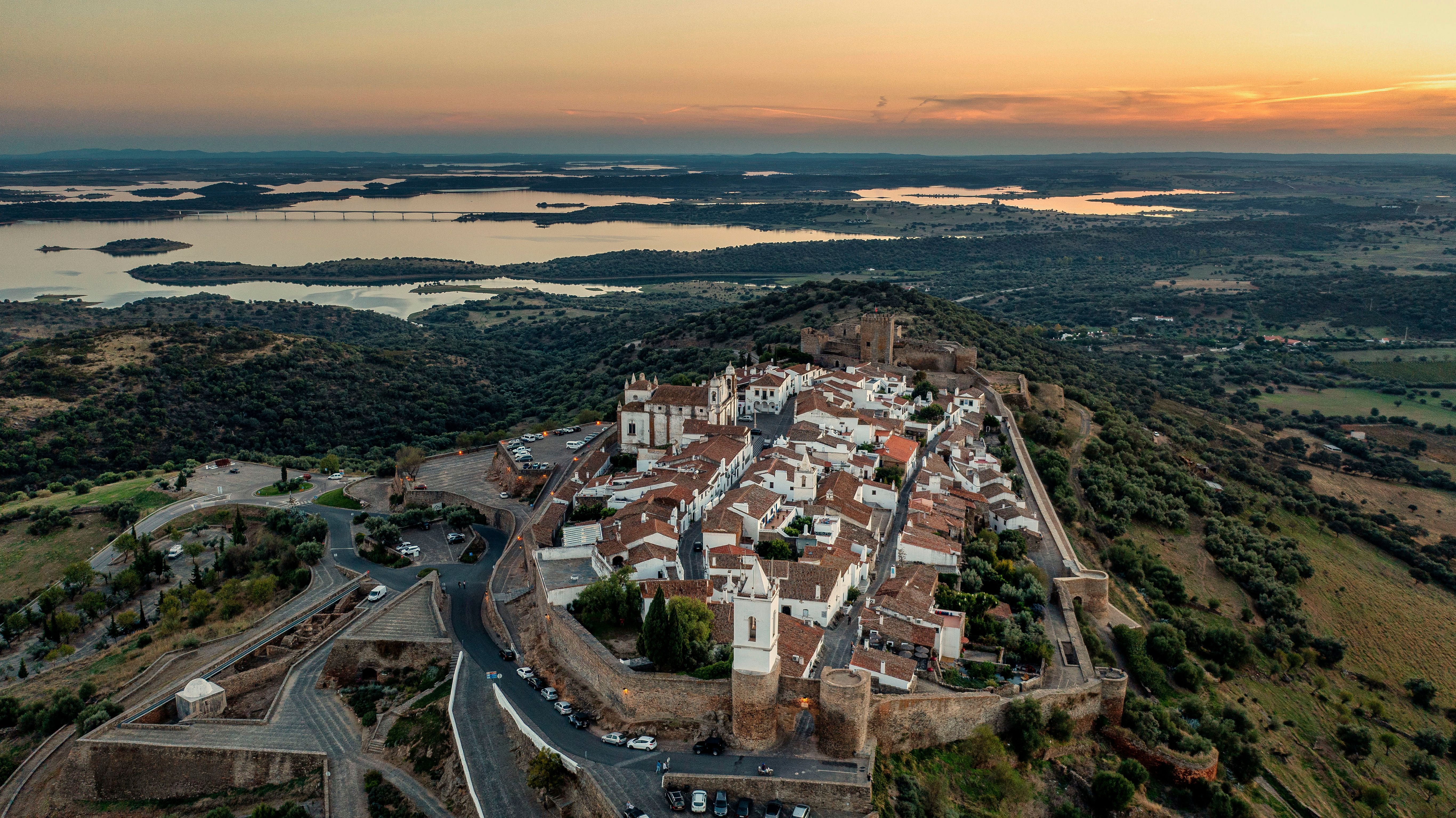
Monsaraz is the day's payoff and the trip's clearest case for the car: a walled medieval hilltop village about fifty minutes east of Évora on the N256, looking down over Lake Alqueva, Europe's largest artificial reservoir. Castle, cobbled lanes, whitewashed houses, and a sky so dark it's a designated Dark Sky Reserve — one of the world's first Starlight Tourism Destinations. Cars stay at the gate; the village is yours on foot.
The castle is free to climb, and the view from the battlements is the reason you stayed the second night. The wide cork-oak plain drops away to the reservoir, the white village clusters behind you on the hill, and the whole thing is exactly the kind of landscape Lisbon doesn't reach within a same-day round-trip. Give it about two hours for the castle view, a slow walk through the lanes, and a coffee in a village café while the light goes long.
São Pedro do Corval pottery workshops
A 5 km detour from Monsaraz, easy to fold into the afternoon, and the trip's only real shopping done at the source. São Pedro do Corval holds the largest concentration of pottery workshops on the Iberian Peninsula — more than twenty active olarias (the Portuguese word for pottery workshops) in one small village, turning out red-clay tableware hand-painted with Alentejo flowers and farm motifs.
Most workshops welcome walk-ins. You can stand and watch a potter pull a bowl up off the wheel, ask what the patterns mean, and buy direct at prices well below Évora's boutique souvenir shops — the same plates you eyed on Rua 5 de Outubro for half the money. Free to visit; bring cash, because the small olarias may not take cards, and check the hours, since many close on Sundays. Sixty to ninety minutes covers two or three workshops.
Quick reference — Day 2
- Almendres Cromlech: Free, 24-hour access. ~13 km / ~25–30 min drive from Évora; final 4 km unpaved. Early morning best. ~60–90 min on-site. No-car option: guided megalith tour ~€35–€60/person (Living Tours and Évora operators, May 2026).
- Cartuxa cellar tour: ~€20–€35 per person, ~90 min, two wines (cartuxa.pt wine tourism, May 2026). Book ahead; don't drive after.
- Lunch: Enoteca Cartuxa on-site OR back in Évora (~€35–€60 per person with wine).
- Monsaraz castle and Lake Alqueva: Castle entry free. ~50 km / ~50 min east via N256. Cars at the gate; village pedestrian-only. Designated Dark Sky Reserve and early Starlight Tourism Destination (Visit Évora; Bon Traveler, 2024).
- São Pedro do Corval pottery: Free to visit. Most open 09:00–13:00, 14:00–18:00; many closed Sundays (Visit Évora São Pedro do Corval page, 2024). Cash preferred. Prices ~30–60% below Évora boutiques.
Back to Lisbon
Plan the return for late Sunday afternoon, once the Monsaraz loop is done — the drive back on the A6 and A2 takes about an hour and a quarter, and the Alfa Pendular runs a thinner weekend schedule, so check the timing on cp.pt before you commit.
If you drove from Lisbon, the A6-and-A2 route home is the same fast corridor you came down on. If you picked up the rental in Évora, return it at the agency after Monsaraz and take the late-afternoon Alfa Pendular to Lisboa Oriente; the last AP departures run on a thin weekend schedule, so confirm the exact return time on cp.pt within a week of your trip. The late Rede Expressos bus to Sete Rios is the safety net if the day overran.
You're flying back out of Lisbon, and Évora was the weekend that earned the trip. The countryside outside the walls — the stones older than Stonehenge, the cellar in the old monastery, the white village over the lake — is precisely what can't be done in a single day from the capital, and the quiet of the walled center after the coaches leave is what made the second night worth booking. The UNESCO town is the headline most travelers buy on; the stone-and-cork plain around it is what the two days actually deliver.
Practical weekend notes
Season choice carries a lot of the weight on this trip: the spring shoulder and the autumn vindima are the windows where the countryside, the lodging, and the restaurant rhythm all line up, while high summer and deep winter each ask the traveler to give something up. Pick the window first, then book the rooms.
Spring shoulder, April through mid-June, is the best general window — daily highs in the high teens to mid-twenties Celsius, the countryside green and full of wildflowers, restaurants fully open. Feira de São João (around June 22 into early July) is one of the largest fairs in Portugal and tightens weekend lodging, so book a few weeks ahead. July and August bring real heat — mid-thirties most days, the occasional 40 °C spell — and midday walking turns punishing while some restaurants close for the August holidays; it's not the time to choose Évora over the coast. Vindima, mid-September through mid-October, opens the surrounding quintas for harvest tastings, and if that's your window, anchor the trip on a Cartuxa or Esporão booking. November through March works for the indoor anchors only.
A few practical notes for the ground. Cards work at restaurants, hotels, and museum desks, but carry small euro cash for the São Pedro do Corval workshops and for parking lots. Tipping at a sit-down meal runs around 5–10% and is never demanded. English is standard in tourism settings, but a little Portuguese — "olá," "bom dia," "obrigado" or "obrigada" — earns real goodwill from older Alentejano hosts, and goes further in the rural wineries and pottery workshops than it does in town.
And hold the line at two nights. That's the right pace for Évora as an excursion from a Lisbon base. If the trip starts wanting a third, you've outgrown what Évora is as a leg of a Lisbon trip — and at that point the better move is to extend the Lisbon stay instead, or to come back and give Évora a trip of its own.
Frequently asked questions
Is Évora worth staying overnight, or is one day enough?
Évora rewards two days more than one if you want the countryside layer outside the walls. A single day covers the Roman Temple, the cathedral rooftop, the Capela dos Ossos, and an Alentejo lunch. An overnight adds the Almendres Cromlech, a Cartuxa cellar tour, and a Monsaraz drive — none of which fit a same-day round-trip from Lisbon, and all of which need a rental car.
Can I visit the Almendres Cromlech without renting a car?
There is no public bus service to Almendres Cromlech. The only no-car option is a guided megalith tour from Évora, typically running around €35–€60 per person based on operator-published rates (Living Tours and Évora-based operators, May 2026). If Almendres is part of the trip, plan to pick up a rental car — either at Lisbon airport on arrival or at an Évora agency on the first evening.
Where should I stay in Évora for a weekend?
Pousada Convento de Évora (Pousada dos Loios) is the historic anchor — a 15th-century convent between the cathedral and the Roman Temple, doubles roughly €130–€220 depending on season, with shoulder-season lows around €79 (Pousadas de Portugal operator pages, May 2026). Boutique guesthouses inside the walls run €70–€140; newer mid-range hotels just outside run €60–€100. Book 2–3 weeks ahead for Feira de São João and the vindima weekends.
What's the best way to get from Lisbon to Évora — train, bus, or car?
Rail is the cleanest default for the first day, and a rental car is the necessary commitment for the second. The CP Alfa Pendular from Lisboa Oriente runs about 1h30, around €15–€32 round-trip second class (CP.PT and Omio, May 2026). Rede Expressos buses from Sete Rios run later and cheaper but slightly slower. A drive on A2 + A6 takes ~1h15–1h30 with ~€6.30 each way in tolls.
Is it worth combining Évora and Monsaraz in one trip?
Yes — Monsaraz is the second-strongest countryside anchor in this slate and sits ~50 km / ~50 minutes east of Évora via N256. The castle view over Lake Alqueva and the village's pedestrian-only lanes are the kind of countryside Lisbon doesn't access on a same-day round-trip. Pair with São Pedro do Corval's pottery workshops 5 km away for a full second-day afternoon.
What is Alentejo cuisine, and where should I eat in Évora?
Alentejo cooking is bread-based, slow-cooked, and rural — built around dishes like açorda alentejana (a coriander-and-egg bread soup with poached eggs), migas (garlic-fried breadcrumbs served with pork), and porco preto (Iberian black pig raised on acorns). For sit-down meals, Fialho (since 1945) is the historical-canon choice; Dom Joaquim is the polished traditional option; Botequim da Mouraria is the petiscos counter; Enoteca Cartuxa pairs modern regional cooking with the winery's flagship Pêra-Manca.
What is porco preto?
Porco preto is the Iberian black pig, raised semi-wild on acorns in the montado — the cork-oak woodland that defines the Alentejo countryside. The acorn diet gives the meat a deep, nutty flavor; the same animal produces presunto (Iberian cured ham). On Évora menus you'll see it as plumas de porco preto (a quick-grilled cut) and secretos de porco preto, usually served with migas.
What is Manueline architecture?
Manueline is a late-Gothic Portuguese architectural style of the early 1500s, named for King Manuel I and dense with maritime motifs — twisted ropes, knots, armillary spheres, coral, sea creatures — that celebrated Portugal's Age of Discoveries. In Évora the Igreja de São Francisco (the church that houses the Capela dos Ossos) carries the largest single-nave Manueline span in Portugal, and elements appear in the cathedral cloister and the convent of Pousada dos Loios.