
A Weekend in Girona from Barcelona
You are flying into Barcelona — and Girona is worth two days of that trip. Forty minutes north on the Renfe AVANT, it is a city of 109,000 people that has been continuously occupied since Roman times, and its old quarter stacks roughly 2,000 years of history up a single hill above the Onyar River. Cross the first bridge and the painted houses lining the riverbank stop you — yellows, oranges, reds and blues climbing straight up off the water, a wall of color that tells you, before you've set foot in the Barri Vell, that this is not another corner of Barcelona.
Almost everything in Girona is built of the same thing: stone, laid down layer over layer for two thousand years. Roman walls you can still walk. A Romanesque cloister of paired columns on the edge of the old town. The lanes of El Call, the medieval Jewish quarter, worn smooth by six centuries of feet. And up at the top of those 90 cathedral steps, a Gothic nave that vaults a single span wider than any other in the world, with no column to break it. A day trip from Barcelona handles the essentials. An overnight lets the stone slow you down and handle the city.
Why Girona from Barcelona
One night earns you the city that the last train home takes away — the Barri Vell before 09:00, when the lanes of El Call run empty and the Cathedral opens with no queue at your back, plus the Saturday market and a proper dinner the day-trippers never reach. You get a Saturday at the Mercat del Lleó, where Girona residents still buy their artisan botifarra (a Catalan fresh or cured pork sausage) and local cheese from stalls run by the same families since 1944. You get the Romanesque cloister at Sant Pere de Galligants, a monastery at the edge of the old town whose carved capitals most day-trippers from Barcelona never reach. And you get dinner on the Rambla de la Llibertat on a Saturday night, when the terraces fill at aperitivo hour and the last day-trip coaches are long gone.
The numbers help too. Girona runs consistently cheaper than Barcelona — beds, lunch, and monuments all cost less — so two days here lands lighter on the trip than a single comparable day in the hub. The Cathedral, El Call, the city walls, a long Catalan lunch: that's the day-trip version, and it's good. Staying over is what turns a checklist into a place.
Getting there from Barcelona
The cleanest pattern is the Renfe AVANT out of Barcelona Sants — direct, fast, and the simplest connection of any town in the Barcelona satellite set, with no transfer to think about and trains running late enough that the second day never feels clipped.
The AVANT high-speed service covers Barcelona Sants to Girona in well under an hour with no change of train, runs many times a day in each direction, and drops you a short walk from the old town. Seats on the AVANT need an advance reservation, so book at renfe.com or through Omio before you fly — Renfe prices move with the date and the booking window, and the cheapest fares go first. If you miss the AVANT booking window, the slower regional Media Distancia trains take walk-ups for a longer ride. Last departures back to Barcelona Sants run late into the evening, so a second day that ends after dinner still gets you home the same night.
For a weekend, book both legs ahead. Spring weekends and Temps de Flors week — the flower festival in the second week of May — fill the fastest.
Quick reference — getting there
- Renfe AVANT (rail): Barcelona Sants → Girona, 38–40 min, no transfers, ~16–18 direct services/day, last trains back past 22:00. From ~€7–€17 one-way, round trips from ~€14–€30 (based on searches in June 2026; renfe.com — dynamic pricing shifts by date and booking window). AVANT requires advance seat reservation; book at renfe.com or via Omio.
- Media Distancia (regional): walk-up tickets, ~1h 15m–1h 45m, for missed AVANT booking windows.
- Station to old town: ~10–12 minute walk to the Cathedral and the Barri Vell — no taxi or bus needed for most visitors.

Day 1
Day 1 stays inside the walled old town — the Cathedral and El Call in the morning, the Arab Baths and the Roman walls through the afternoon, and the painted Onyar riverfront as aperitivo hour settles in. It's the full day-trip route, but walked at a pace that lets the stone register, and closed with a booked dinner on the Rambla de la Llibertat.
Catedral de Girona
Open April–October 10:00–20:00; November–March 10:00–17:00. Tickets: €7.50 adults (Cathedral + Basilica of Sant Feliu); €12 adults for the combo with the Art Museum (catedraldegirona.cat, 2026).
Climb the 90 bare stone steps to the Catedral de Girona right as it opens at 10:00, before the coach groups from Barcelona arrive around eleven — the staircase is a slow, deliberate approach, and it sets you up for what's inside. The nave undoes you for a second. In 1417, the architect Guillem Bofill talked the building committee out of the planned three-aisle layout and vaulted a single 23-metre span from wall to wall, with no interior column to carry it. You step in and the space just runs, uninterrupted, all the way to the apse, with nothing in the sightline. Barcelona's own cathedral, La Seu in the Barri Gòtic, is a fine Gothic church — but it keeps the standard three aisles, and there is nothing like this single sweep anywhere in the hub city. Off the nave, the treasury holds an 11th–12th century Romanesque tapestry of the Creation, one of the finest medieval textiles on the Iberian Peninsula.
El Call — Girona's medieval Jewish quarter
Museu d'Història dels Jueus: Carrer de la Força 8. Admission €4 adults, €2 reduced, free under 14 (girona.cat/call, 2026). Open Tue–Sat 10:00–18:00, Mon/Sun/holidays 10:00–14:00.
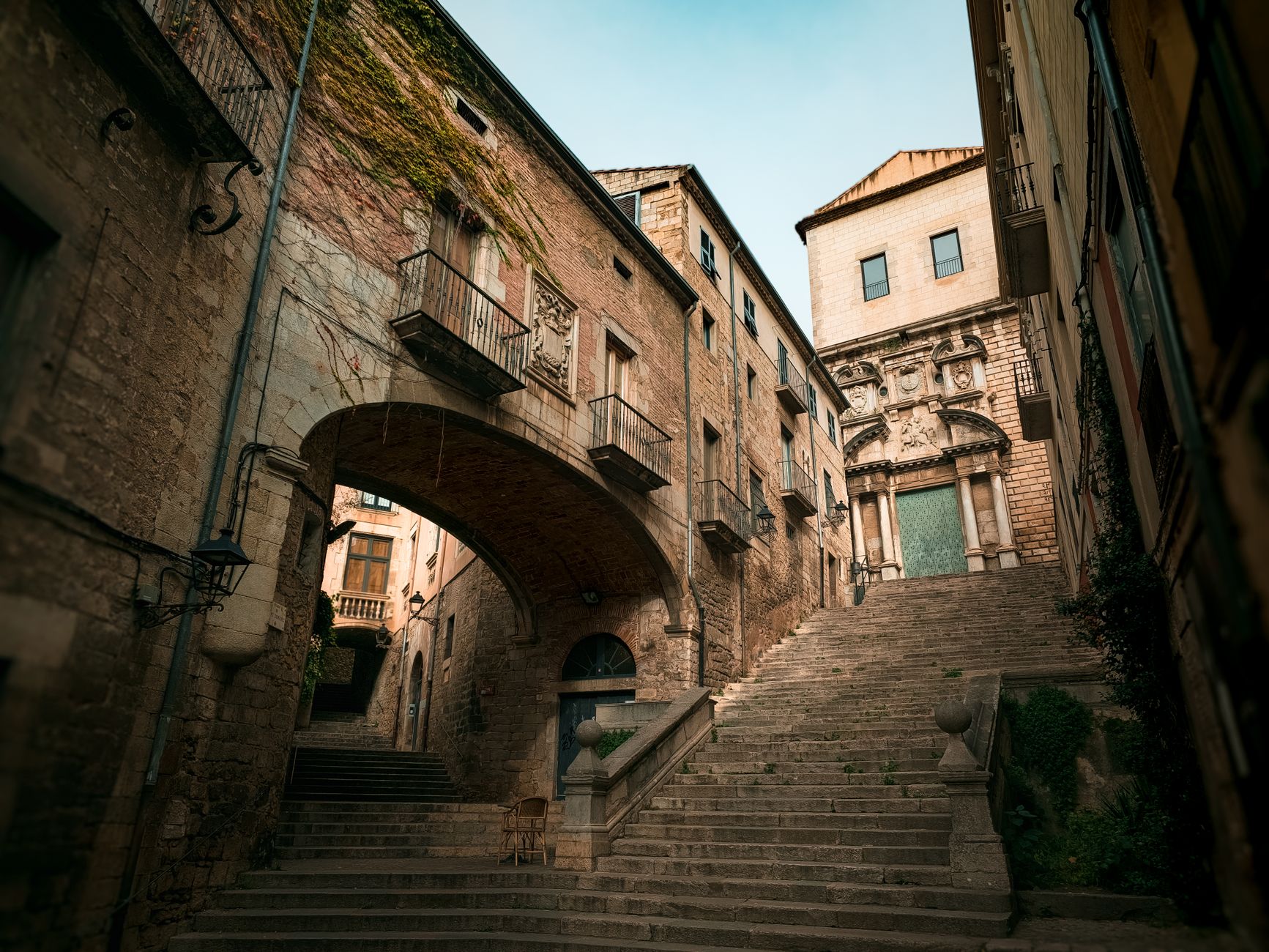
Step out of the Cathedral and the lanes of El Call drop away immediately below — a warren of narrow stone passages, arched doorways and crooked stairways laid by the Sephardic community that lived on this hill from at least 890 CE until the expulsion of 1492. This was not a backwater. At its 13th-century peak it was one of the great centers of Kabbalistic scholarship in medieval Iberia, the home ground of the rabbi and scholar Nachmanides — and you feel the weight of that history pressing in from the stone as you walk, the lanes barely wide enough for two people to pass.
Barcelona has its own El Call, near Plaça de Sant Jaume, with the MUHBA museum and the remains of a medieval synagogue — but later building has all but buried it, and it no longer reads as a neighborhood you can walk. Girona's survives almost whole. The passages underfoot are the same ones the medieval community used, and the right way to see them is to put the map away and let yourself get lost. When you want the history behind the stone, the Museu d'Història dels Jueus lays out the community's 600 years on this hill and its Kabbalistic learning.
Banys Àrabs (Arab Baths)
Admission €3 adults, €2 reduced, free under 8 (banysarabs.cat, 2026). Open March–October Mon–Sat 10:00–18:00, Sun/holidays 10:00–14:00.
A few minutes' walk from El Call, the Banys Àrabs (Arab Baths) are a public bathhouse built in 1194 by Morisco craftsmen on the old hammam plan — frigidarium (cold bath), tepidarium (warm bath, with an octagonal pool), and caldarium (steam room). Stand in the tepidarium and look up: an octagonal skylight floats above the central pool, carried on a ring of slender Romanesque columns, and the light comes down through it onto the water. It's one of the best-preserved Arab-style bathhouses on the Iberian Peninsula outside Andalusia, and the quiet of the room is half the point.
Passeig de la Muralla — the city walls
Free access. Best entered from behind the Cathedral. Allow 45–60 minutes.
From behind the Cathedral, follow the signs up onto the Passeig de la Muralla and walk the wall itself — Roman at the base (1st–4th century CE), built higher through the Carolingian period and the Middle Ages, and one more layer of the same stone the whole town is made of. About 1.5 km of rampart is open today, and from the towers the terracotta rooftops of the Barri Vell fall away below you toward the Pyrenean foothills on a clear afternoon. Barcelona's Roman walls survive only as broken fragments wedged into Gothic Quarter buildings; a continuous elevated walk like this one, right around the old city, doesn't exist in the hub. Come around 17:00, when the light goes warm on the rooftops.
Cases de l'Onyar and the Onyar riverfront
Free. Best viewed from Pont de Pedra or the Eiffel Bridge. Best light: 17:00–19:00.
Come down off the walls toward the river as the evening settles. The Cases de l'Onyar — that climbing wall of houses in yellow, orange, red and blue along the west bank — read best from one of the footbridges: the Pont de Pedra for the head-on view, or the Pont de les Peixateries Velles (the iron footbridge built by Gustave Eiffel's engineering company in 1876, the one everyone calls the Eiffel Bridge) for a wider frame. The colors you're looking at date to a 1983–1984 restoration by the architects Fuses-Viader. At the north end of the row, Casa Masó is the only one of these houses you can go inside — the home of the architect Rafael Masó, done in the Noucentisme style; check the seasonal hours at girona.cat before you turn up. Then let the Rambla de la Llibertat carry you into the evening: from around 19:00 the locals fill the terraces for aperitivo hour, the coaches gone, and dinner follows on naturally from there.
Day 1 quick reference
- Cathedral: opens 10:00; €7.50 adults (Cathedral + Basilica); arrive early to avoid coach groups. Treasury holds an 11th–12th c. Romanesque Creation tapestry. Allow 45–60 min.
- Museum of Jewish History: opens 10:00 Tue–Sat; €4 adults; Carrer de la Força 8. Allow 1.5–2 hours with the quarter.
- Arab Baths: opens 10:00; €3 adults; 30–40 min.
- City walls: free; 45–60 min; enter from behind Cathedral; ~1.5 km accessible.
- Onyar riverfront: free; best light 17:00–19:00. Casa Masó hours at girona.cat.
- Dinner: Rambla de la Llibertat and adjacent streets; book ahead on Saturdays.
Where to stay overnight
Two nights in or just beside the Barri Vell is the right pace for this trip, and the best beds are the boutique places set straight into the old town's own stone. A handful of newer mid-range hotels sit a short walk out, for travelers who'd rather trade the cobbles for a lift and easy parking.
Inside the historic center, Hotel Museu Llegendes de Girona sits close to the Cathedral and the Arab Baths, in the thick of the old town; Hotel Nord 1901 is a few minutes' walk from the Barri Vell with a little more room around it. Either puts you in the lanes before 09:00 and after the day-trippers have gone, which is the whole reason to stay. Book a few weeks ahead if your dates land on Temps de Flors — the flower festival in the second week of May — when the rooms tighten fastest. And hold the trip to two nights: the pace of both days fits cleanly inside that, and a third would push Girona past what it is as a leg of a Barcelona trip.
Quick reference — lodging
- Boutique, historic center: Hotel Museu Llegendes de Girona (near Cathedral and Arab Baths); Hotel Nord 1901 (minutes from the old town).
- Old-town rates: ~€90–€180 mid-range, spring–summer (April–October); ~€70–€110 January–February (approximate reference ranges as of June 2026 — verify on booking platforms before reserving).
- Book ahead: 3–4 weeks for Temps de Flors (second week of May); midweek festival nights have better availability than weekends.
Day 2
Day 2 is the half of Girona the day-trip timetable can't reach: the Mercat del Lleó in the morning before it shuts at 14:00, then the Sant Pere de Galligants cloister and the climbing palace street of the Pujada de Sant Domènec through the afternoon. This is the clearest argument for having stayed the night — and it's quieter, older stone than Day 1.
Mercat del Lleó — Saturday morning
Plaça Calvet i Rubalcaba. Open Mon–Sat 07:00–14:00. Free entry.
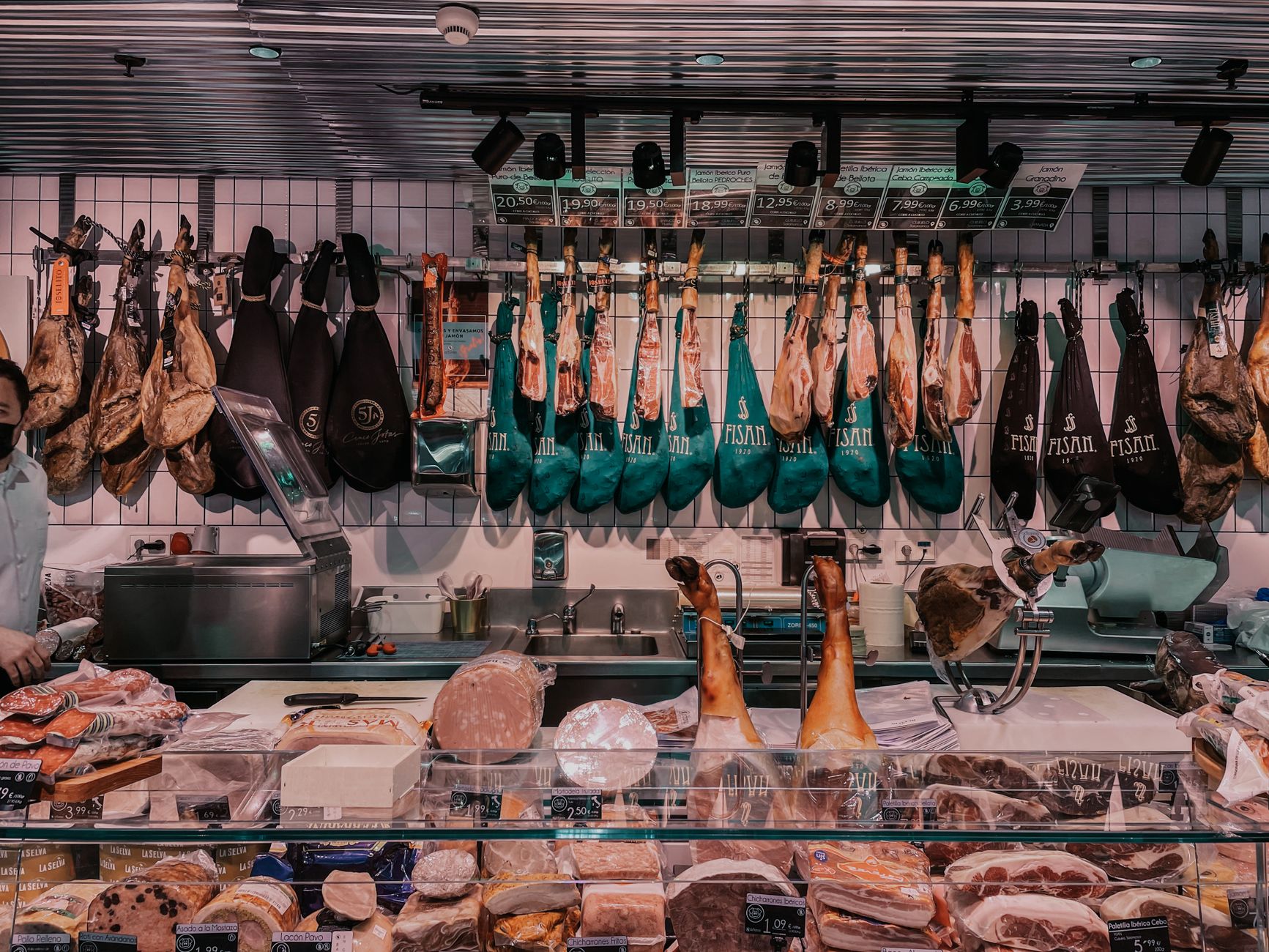
Start the morning at the Mercat del Lleó, Girona's covered market since 1944 and still, across more than sixty stalls, a working local one. Where Barcelona's La Boqueria has tilted hard toward prepared-food counters for visitors, the Lleó is where Girona actually shops — artisan botifarra, regional cheese, fresh produce, Catalan charcuterie from small producers up the road. Come before 09:00 for the full spread of stalls; by eleven on a Saturday the aisles thicken.
There's a good chance you'll meet the riders before the market even opens. Girona is one of Europe's most important bases for professional road cycling — around a hundred pros live here — and on a Saturday morning the cafés near Plaça de la Independència and along the green Parc de la Devesa fill with riders in team kit over coffee. You queue behind them for an espresso, lean bodies and bright jerseys, and then carry your own coffee the few minutes to the market doors.
Sant Pere de Galligants — Romanesque monastery and cloister

Admission €7 adults (patrimoni.gencat.cat, 2026). Open June–September Tue–Sat 10:30–19:00, Sun/holidays 10:00–14:00; October–May Tue–Sat 10:00–18:00, closed Mondays. Allow 1–1.5 hours.
On the north edge of the old town, Sant Pere de Galligants is a 12th-century Benedictine monastery that now holds the Girona branch of the Museum of Archaeology of Catalonia — but the building is what you come for. Romanesque, the round-arched, carved-stone style that came before the Gothic, is the whole language here, and it reaches its high point in the cloister: paired columns ringing a quiet courtyard, every capital chiseled with a different scene of beasts, leaves and figures. Walk it slowly and read the carvings one by one — there is no cloister of this age and quality anywhere in central Barcelona. The archaeological collections inside run the Girona region from prehistory through the medieval centuries.
Pujada de Sant Domènec
Free. Allow 30–45 minutes. No ticket required.
A ten-minute walk from the monastery brings you to the Pujada de Sant Domènec — a broad stepped street that climbs out of the old town through a run of Renaissance palaces toward the old Dominican convent. The Palau dels Agullana (15th–16th century) leans over the lower steps; the baroque front of the Església de Sant Martí Sacosta caps the top. This is exactly the kind of unhurried walk the day-trip clock never allows — half an hour or so of stairways and palace facades, no ticket, no coaches on a Sunday afternoon. During Temps de Flors, the flower festival in the second week of May, the floral installations cluster thickest right here.
By 17:00 or 18:00 you've walked the Pujada and the rest of the afternoon is open — time for a last drink on the Rambla de la Llibertat before a train south.
Day 2 quick reference
- Mercat del Lleó: Mon–Sat 07:00–14:00; free; arrive before 09:00 on a Saturday. ~60+ stalls since 1944.
- Cycling cafés: Plaça de la Independència and Parc de la Devesa; ~100 resident pros, ProTour teams incl. Israel Premier Tech and EF Education First (Catalan News; Girona ProSport, 2025).
- Sant Pere de Galligants: €7 adults; closed Mondays; allow 1–1.5 hours.
- Pujada de Sant Domènec: free; 30–45 min; no ticket. Temps de Flors check: girona.cat/turisme.
- Return trains: last departures from Girona past 22:00 — verify at renfe.com before travel.
Back to Barcelona
Aim for a late-afternoon train south once the Pujada is walked — the last AVANT services leave Girona well into the evening, but the exact times shift by day and service, so check renfe.com before you commit. Finish the second day by 17:00 or 18:00 and there's still room for a drink on the Rambla de la Llibertat before a 20:00–21:00 departure, no rush. Buy the return when you book the outbound; AVANT seats sell out on Sunday evenings in spring and summer.
The case for Girona was never that it's obscure. It's specific, and it's all in the stone: a Gothic nave unlike any in the hub city, a medieval Jewish quarter more legible than Barcelona's own, Roman walls you can actually walk, a market that still works as a market, and two days that cost meaningfully less than a comparable Barcelona weekend. You are flying into Barcelona — and Girona is worth two days of that trip.
Practical notes
Girona's logistics are the simplest of any town in the Barcelona satellite constellation: a single Renfe connection with no transfers, English-language booking at renfe.com, and last trains running back to the hub past 22:00, so the rest is just small stuff worth knowing before you go.
Getting into the Barri Vell from the station: It's about a 10–12 minute walk from the station to the Cathedral and the old town — no taxi or bus needed for most visitors.
Seasons: Spring (April through early June, outside Temps de Flors week) is the default — 15–22°C, long days, crowds below peak. The autumn shoulder, mid-September into early October, is just as comfortable. Summer (July–August) brings 28–32°C midday heat and the thickest coach-tour crowds, so if you come then, be on the streets before 10:00. The second week of May is Temps de Flors, when over 100 floral installations fill the Barri Vell, all free, with around 350,000 visitors over nine days — book lodging 3–4 weeks ahead for that week. Late October brings the Fires de Sant Narcís, Girona's biggest annual festival for the city's patron saint, with correfoc (a fire-run procession through the streets), castells (the Catalan tradition of building human towers), and parades, most of it free (Tripologiste; Naturaki; annual timing, late October to early November).
Accessibility: The Barri Vell's stairways and sloping stone streets are steep in places. Travelers with mobility considerations should check girona.cat/turisme for accessible-itinerary guidance before booking.
El Celler de Can Roca: Girona is home to a three-Michelin-star restaurant that's been ranked among the best in the world, at Can Sunyer 48, where a table takes roughly a year of advance planning (cellercanroca.com). If you can plan that far out, it's reason enough to build the whole weekend around the reservation. If you can't, it's still the tell for why a city this size cooks well above its weight — Girona takes its food seriously at every price point.
Filming connection: Several streets and the Cathedral steps appeared in Season 6 of a major television production filmed here in 2015. By 2019, only 5% of visitors to Girona even knew about it (Catalan News, 2019). The medieval city stands entirely on its own; the filming history is incidental for most visitors.
Language: Catalan is the first language of daily life — signs, menus and public notices are mostly in Catalan. Spanish is understood and spoken everywhere, and English is widely available in tourist-facing spots in the Barri Vell.
Making a longer trip of it? Two more easy escapes from Barcelona: Roman Tarragona and a weekend in Vic.
Frequently asked questions
Is Girona worth staying overnight, or is a day trip enough?
A day trip covers the essentials: Cathedral, El Call, city walls, a Catalan lunch. But one night changes the experience — you get the Barri Vell before 09:00, when day-trippers are still on the train north, a Saturday at the Mercat del Lleó, a proper dinner on the Rambla de la Llibertat, and time for Sant Pere de Galligants. The overnight is worth it for most visitors with a flexible schedule.
How do I get from Barcelona to Girona?
The Renfe AVANT high-speed train from Barcelona Sants to Girona is the straightforward option: 38–40 minutes, no transfers, roughly 16–18 direct services per day, and last trains back past 22:00. Fares run from approximately €7–€17 one-way as of June 2026 — check renfe.com for current pricing and book in advance for the best availability on AVANT services.
When is the Mercat del Lleó open?
The Mercat del Lleó at Plaça Calvet i Rubalcaba is open Monday through Saturday, 07:00 to 14:00. It does not open on Sundays. A Saturday morning visit — arriving by 09:00 if you want the full stall selection before locals finish their shopping — is the right timing for a weekend traveler staying overnight in Girona.
What is Temps de Flors in Girona?
Temps de Flors is Girona's annual flower festival, held for nine days in the second week of May each year. Over 100 installations of flowers and floral art fill the Barri Vell's courtyards, monuments, and normally private spaces — all free to enter. Roughly 350,000 visitors attend over the nine days. Accommodation fills 3–4 weeks in advance; midweek visits during the festival have better availability than weekends. Check girona.cat/turisme for the current year's exact dates.
What is El Call in Girona?
El Call (from the Catalan word for the medieval Jewish quarter, rooted in the Hebrew kahal, meaning community) is the name for Girona's medieval Jewish neighborhood. It was inhabited from at least 890 CE until the expulsion of Jews from Spain in 1492 and was a significant center of Kabbalistic scholarship linked to the 13th-century rabbi Nachmanides. The physical fabric — narrow lanes, stone archways, stairways — survives largely intact, making it one of the best-preserved medieval Jewish urban environments in Europe.
Is Girona cheaper than Barcelona?
Meaningfully so. Mid-range accommodation in Girona's old town runs approximately €90–€180 per night (as of June 2026) versus comparable Barcelona hotels at €130–€250 or more. Lunch menus — the menú del dia (a fixed-price two- or three-course lunch) — typically run €12–€18 in Girona versus €15–€25 in similar Barcelona neighborhoods. Monument entries are all under €8.
Do I need to book Girona Cathedral tickets in advance?
Walk-up tickets are generally available at the cathedral entrance. Advance booking via tickets.catedraldegirona.cat is worth considering during peak periods — summer weekends and Temps de Flors week — to avoid queues. The Cathedral + Basilica of Sant Feliu + Art Museum combo at €12 per adult is the best-value option for a thorough visit. Entry to the Cathedral and Sant Feliu alone is €7.50 adults as of 2026.