
A weekend in Saint-Émilion from Bordeaux
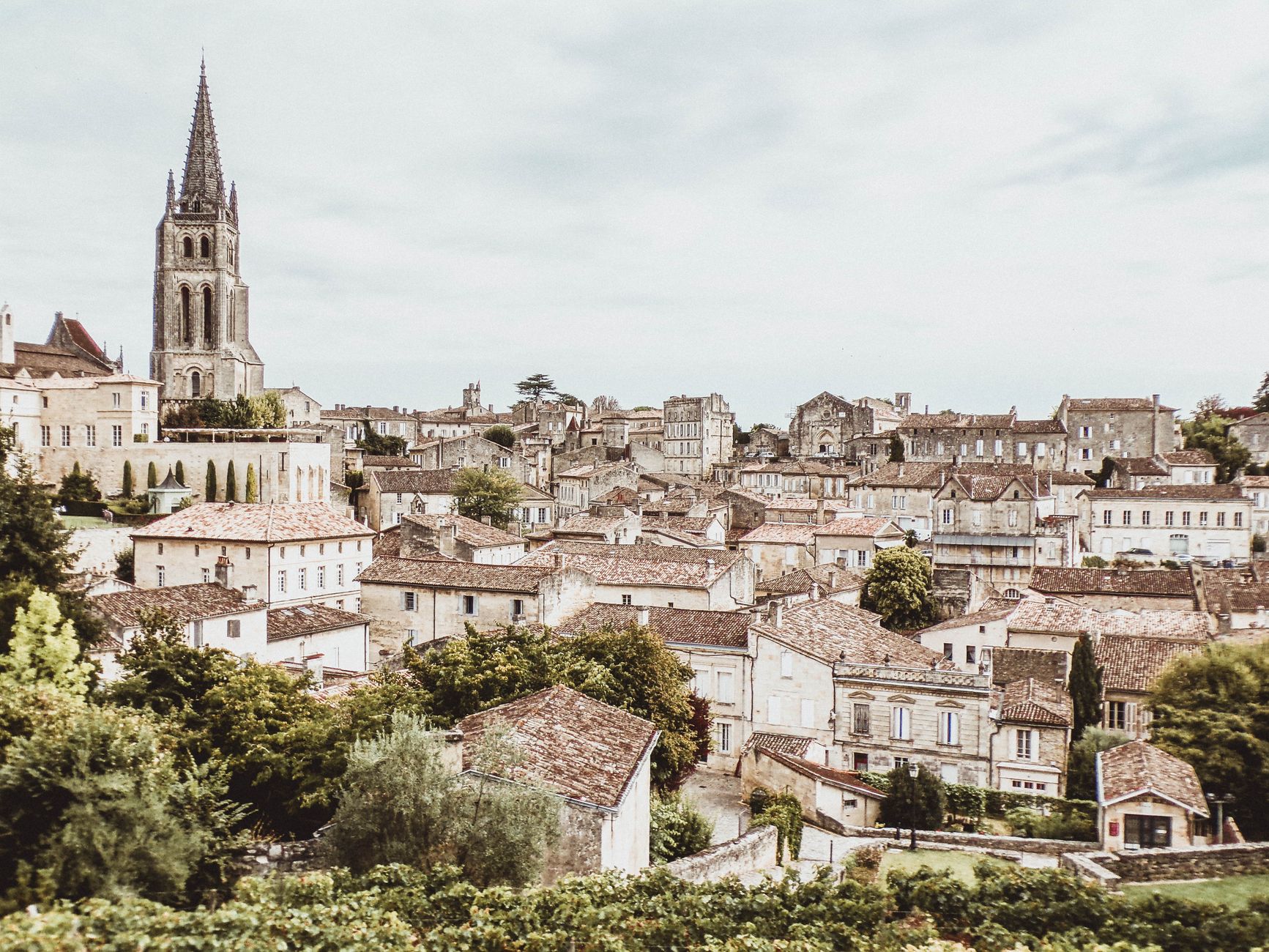
Saint-Émilion is a medieval village of honey-colored limestone tipped over a slope of Merlot vines, 40 km east of Bordeaux across the Dordogne, where the cellar work and the sightseeing both happen underground. You're flying into Bordeaux — and a Saint-Émilion weekend earns a slice of that trip because the things that make the village worth the journey only come alive after the day crowds leave. The underground church and the King's Tower fill the afternoons everyone shares; the empty cobbled lanes after five, the Michelin tables that only serve at dinner, and a second morning among estates you can't reach on foot are the reasons to stay two nights instead of racing the last train home.
That last train is the quiet argument running under this whole trip. The final evening service back toward Bordeaux leaves around eight, which is comfortable for a long lunch and an afternoon tasting but cuts a leisurely dinner off at the knees. Stay over and the calculation flips. The day visitors thin out, the village settles into its resident rhythm — fewer than 1,800 people live here — and the place you walked through at noon becomes somewhere you actually live for an evening.
Why Saint-Émilion earns the weekend
Saint-Émilion is the right bank's counter-argument to Bordeaux — a medieval wine village 40 km east — and a weekend is what lets you hear the whole thing rather than the loudest part, the underground heritage and the Merlot estates both. Bordeaux the city is a left-bank story — grand 18th-century quays, Cabernet-led Médoc wines, a flat river port you tour on foot. Saint-Émilion holds what the city center simply doesn't: a hilltop medieval village built from the limestone it stands on, carved through with cellars and catacombs, surrounded by Merlot.
The wine is genuinely different, not just a different label. Where Bordeaux-city tasting tends to mean Médoc Cabernet-Sauvignon, Saint-Émilion is Merlot-dominant — plusher and softer, grown on cool clay-and-limestone soils — and it runs its own classification, revised roughly each decade, rather than the fixed 1855 Médoc list. Several Grand Cru Classé estates (the higher, quality-ranked tier of the appellation's own ranking) sit a short walk from the village square, and a few more, the ones a weekend unlocks, sit a drive beyond it.
A day handles the highlights. A weekend is what makes the difference between seeing Saint-Émilion and spending time in it: the after-dark hush, the destination dinner, and the slow second morning. That is the case for two nights, and the rest of this lays out how to use them.
Getting there from Bordeaux
Saint-Émilion is one of the most straightforward excursions from Bordeaux, 40 km east across the Dordogne, and the lowest-friction way in is rail — direct, frequent on weekdays, and short enough that it feels like a leg of the same trip. Direct TER trains — SNCF's regional service, on the line that continues toward Bergerac and Sarlat — run from Bordeaux-Saint-Jean to Saint-Émilion in roughly 30–40 minutes with no changes, and the round-trip fare sits in the low double digits. Buy on SNCF Connect, the TER Nouvelle-Aquitaine site, or walk up at the station.
The one wrinkle to plan around on both ends: Saint-Émilion's station is not in the village. It sits about 1.5 km away, a 15–25 minute uphill walk on a road with a sidewalk only part of the way. In season, a small shuttle bridges the gap for a few euros; outside those hours, or in winter, plan on the walk or a pre-arranged taxi — and don't assume a taxi will be waiting, so arrange it ahead. With a bag for two nights this matters more than it would on a day trip, so travel light or sort the shuttle before you go.
Driving is the alternative most useful if you want to reach outlying estates under your own steam — about 45 minutes each way, with the freedom to drive to the farther Grand Cru châteaux and out to Pomerol on the second morning. The trade-off is parking (use the marked edge-of-village lots; the core is pedestrianized) and France's strict drink-drive limit, which means a designated driver or a nominated taster if the tasting plan has any real volume. Organized minibus tours from Bordeaux exist as a no-logistics option, but they trade away exactly the thing a weekend is for: the run of the village after hours and the freedom to linger.
Quick reference
- Train: SNCF TER Nouvelle-Aquitaine, Bordeaux-Saint-Jean → Saint-Émilion, ~30–40 min direct; roughly hourly on weekdays, thinner Sundays/holidays — check SNCF Connect for your date. Round-trip ~€10–€16 second class, advance singles seen as low as ~€5 (TER Nouvelle-Aquitaine / SNCF Connect, June 2026).
- Station-to-village: ~1.5 km / 15–25 min uphill walk. Tuk-Tuk des Cordeliers shuttle ~€5/person, April–November, ~10:00–18:00; otherwise walk or pre-booked taxi (Saint-Émilion Tourist Office, 2026).
- Last train back: last evening service toward Bordeaux departs around 20:47 — verify the exact date on SNCF Connect, as it shifts by season and day of week (TER Nouvelle-Aquitaine / SNCF Connect, June 2026).
- Drive: ~45 min each way via the A89; modest fuel and tolls, car-rental day rate is the main cost (Rome2Rio, 2026).
Day 1: the underground heritage, then the village after dark
Day 1 takes the heritage core while the village is busy, then keeps you here for the hours the day visitors give up — the part of Saint-Émilion you can only have by staying. You arrive into a working village that receives over a million people a year, so the morning is shared; the evening is yours.
The underground monuments
Start underground, because that is literally where Saint-Émilion started. The guided tour from the tourist office takes you into the Monolithic Church — a 12th-century church hollowed as a single block out of the limestone the village sits on, the largest such church in Europe — along with the catacombs, the hermitage cave where the monk Émilion lived, and the frescoed Trinity Chapel. This is the thing Bordeaux-city has no equivalent of, and it is the part most rushed visitors skip in favor of pure tasting. Do not. The hour you spend below the streets is the hour that tells you why a town and a church grew here at all.
You step back up into daylight already understanding the village differently. Everything above ground — the church spire, the cellars, the very stone of the houses — came out of the same rock you just walked through.
The King's Tower
Climb the Tour du Roy next, while you have the light. It is a 13th-century Romanesque keep on a rocky outcrop, the only intact one in the Gironde, and 118 narrow, steep steps put you on top of the best single view in the village: medieval rooftops below, the slope of vines beyond, the whole shape of the place at once. The stairs are genuinely steep and tight — skip it if heights or close spaces are a problem — but the climb feels like a real medieval interior, not a museum staircase. This is the same tower the town's wine brotherhood still climbs each September to proclaim the harvest.
The medieval streets and ramparts
Spend the late afternoon simply walking. The steep cobbled lanes here are called tertres — the slope streets — and they connect the Porte Brunet, the surviving ramparts, and the Collegiate Church cloister into the open-air half of the village's UNESCO listing. This is the connective tissue between every paid sight, and it is free. Wear shoes with grip; the cobbles are steep and uneven, and they are exactly why the village photographs the way it does. Give it an unhurried hour and let the day-trippers funnel back toward the station around you.
Macarons de Saint-Émilion
Before the shops close, stop for macarons. Not the Parisian sandwich cookie — the macaron in its original form, soft chewy almond wafers first baked by the Ursuline nuns here in 1620, made from sweet and bitter almonds, egg whites, and sugar, with no filling and no shell. Maison Nadia Fermigier keeps the authentic four-century recipe, passed hand to hand since the convent. This is where the macaron actually comes from, which surprises most people, and a fresh dozen eaten the same day is the right way to learn it.
The dinner that needs the overnight
Now the reason you stayed. With the last train long gone, the village's destination tables are open and unhurried: Logis de la Cadène, a family restaurant founded in 1848 and now Michelin-starred under chef Alexandre Baumard, and La Table de Pavie, the two-Michelin-star table tied to Château Pavie, where fine Bordeaux are poured near retail. These are the tables a day visitor has to skip — they matter most at dinner, after everyone with a return ticket has gone — and they are what turn a weekend from nice to worth it. Reserve well ahead; tasting-menu pricing, dinner-focused. If you want something a notch lighter, L'Envers du Décor is the reliable wine bar-bistro with a 500-reference list, and L'Huitrier Pie cooks from its own garden in a 16th-century stone building.
Quick reference
- Underground monuments tour: ~45 min–1 hr, ~€15/person full underground monuments (shorter "Flash" church visit ~€5); departs Place de l'Église Monolithe; book at the tourist office; translations available on request (Saint-Émilion Tourist Office, 2025).
- Tour du Roy: ~€2/person (free under 6), ~20–30 min, 118 steep narrow steps — not for limited mobility (Grand Libournais Tourisme, 2025).
- Macarons: sold by the dozen, inexpensive, best fresh same day (Les Macarons de Saint-Émilion, 2026).
- Dinner: Logis de la Cadène (Michelin) and La Table de Pavie (two Michelin); reserve well ahead, tasting-menu pricing, dinner-focused (Club Oenologique, 2025).
Where to stay overnight
Lodging is plentiful for a village of fewer than 1,800 residents, and staying inside the medieval core is what buys you the after-dark hours — the empty cobbled lanes after five, and a walk back from dinner instead of a drive. Boutique hotels and guesthouses sit within the walls — Logis de la Cadène, La Maison du Clocher, and Badon Boutique Hôtel among them — while vineyard-set properties like Le Relais de Franc Mayne and Clos 1906 sit just outside, spanning mid-range to luxury. Two nights is the right length: enough for the after-dark village, a full dinner, and a slow second morning, without padding. Book well ahead for the June and September Jurade weekends, when the town fills and rooms tighten.
Day 2: a walkable estate, then the right-bank base
Day 2 is the slow morning a day trip can't reach — a tasting at your own pace, then a choice between two right-bank estates beyond the village. The streets are quiet again before the day's first trains arrive, so start early and let the village belong to its residents for an hour.
Crémant at the Cordeliers cloister
Begin at the Cloître des Cordeliers, a ruined medieval Franciscan cloister with a peaceful garden you can wander for free — and, 20 metres beneath it, 3 km of limestone tunnels at a constant 12°C where Les Cordeliers has aged Crémant (sparkling wine made by the same traditional method as Champagne) since 1892. It is the same limestone, again: the rock that holds the church holds the bubbles too. The underground tour ends in a tasting of three Crémants and a Saint-Émilion macaron, the right-bank sparkling counterpoint to all the still red. The cloister garden alone is worth the stop.
A walkable Grand Cru estate
For a serious estate without a car, walk to Château Soutard — an 18th-century Grand Cru Classé property about ten minutes from the village center, offering tours and tastings along with blending workshops, vineyard biking, and picnics. A walkable ranked château is exactly the kind of slow morning a round-trip never has time for: no rush to a train, no shared van schedule, just a tasting that runs as long as it runs. Around it, a handful of small ranked estates and guided vineyard strolls give a car-free visitor a real choice rather than a single option. Book ahead — only two to four estates open per day, fewer in winter.
The right-bank base: Pomerol and Libourne
If you have a car, give the late morning to Pomerol, the other right-bank appellation and Saint-Émilion's natural pair. Be honest with yourself about what Pomerol is, though: there is no village to wander and no tasting room to walk into — its celebrated estates are appointment-only, full stop. Booked ahead, it is a quiet, serious tasting among some of the right bank's most sought-after Merlot; unbooked, it is a drive past gates. Treat it as a planned estate visit, not a stroll.
Without a car, make Libourne your base instead. The right-bank market town 8 km away is where this corner of the Gironde actually does its business — a working town with a covered market and ordinary cafés, an easy lunch and a look at the non-touristed side of the right bank before you turn back toward Bordeaux. Either way, the second morning is the part of the weekend that reaches past the village walls, and past what any single day allows.


Quick reference
- Cloître des Cordeliers: cloister and garden free during opening hours; guided underground tunnel tour ~45 min ending in a three-Crémant tasting; English tours daily 17:30 in July–August (Les Cordeliers, 2026).
- Château Soutard: ~10-min walk from center; book tours/tastings ahead, fewer openings in winter; pricing varies by experience (Lost in Bordeaux, 2025).
- Walkable estate cluster: 2–4 estates typically open per day, reservation required; guided strolls via the tourist office (Visit Bordeaux, 2026).
- Pomerol: appointment-only estates, no village tourism; car or pre-arranged transfer needed (Saint-Émilion Tourist Office, 2026).
- Libourne: ~8 km, the right-bank market-town gateway; covered market and cafés (Saint-Émilion regional guides, 2025–2026).
Back to Bordeaux
You're flying into Bordeaux, and Saint-Émilion earns a weekend of that trip precisely because the train ride home is short and the reasons to stay are not — but on the second afternoon you do, eventually, head back. The last evening service toward Bordeaux leaves around eight, so an unhurried Day 2 lunch and one final tasting fit comfortably before the return. Plan the station last mile on the way out the same way you did on the way in: confirm the shuttle is running for your hour, or leave margin for the 15–25 minute walk downhill with your bag. Buy the return when you book the outbound — weekday evening trains thin out and weekends fill.
If the right bank has done its work on you, the natural next move is the left bank: the Médoc, with its Cabernet-led classed growths, is the counterweight to everything Saint-Émilion just showed you, and doing both banks from a Bordeaux base is the way to understand why people argue about them at all.
Practical notes
A Saint-Émilion weekend runs on a few specifics worth getting right before you go — the last train, the station gap, reservations, and the seasons that change what's open. None are hard, but each one can cost you an evening if you skip it. Here is what to lock down.
Last transport and the station gap. The last evening train toward Bordeaux leaves around 20:47, though it shifts by season and day of week and runs sparser on Sundays and holidays — verify your exact date on SNCF Connect. On both arrival and departure, plan the 1.5 km between station and village: the seasonal shuttle runs roughly April through November in daytime hours, and outside that you walk uphill or pre-book a taxi.
Reservations and winter openings. Wineries are reservation-only, and in winter only two to four open per day, with many restaurants and shops closed from late November through March — the deepest dip is the last week of December into early January. If you go off-season, the village belongs to its residents and a handful of open cellars, which is its own quiet reward, but call ahead and confirm every winery and table or you'll find locked doors.
When to go. May–June and mid-September–October are the best windows: golden vines, active estates, mild weather. The June Jurade spring festival and the September harvest proclamation are quintessential times to be here, but lodging tightens — book two to three weeks ahead for those weekends.
On the ground. Cards work almost everywhere; carry a little cash for the shuttle and small shops. Service is included by law in French restaurants, so rounding up is normal but not expected. The village is steep and cobbled and the tower and underground tours involve narrow stairs, so bring shoes with grip. English is widely spoken in tasting rooms, the tourist office, and tourist-facing restaurants, though a little French is always welcome.
Frequently asked questions
Is Saint-Émilion worth staying overnight, or is a day trip enough?
A day trip covers the village's heritage core. An overnight earns its keep for what the day can't reach: the streets once the visitors leave on the late-afternoon trains, the Michelin-starred dinner tables that only serve in the evening, and a slow second morning at estates beyond walking distance. If wine and dinner are the point, stay two nights.
Where should I stay in Saint-Émilion village?
Lodging is plentiful for a small place. Boutique hotels and guesthouses sit inside the medieval core — Logis de la Cadène, La Maison du Clocher, Badon Boutique Hôtel — while vineyard-set properties like Le Relais de Franc Mayne and Clos 1906 sit just outside. Book well ahead for the June and September Jurade weekends, when rooms tighten fast.
Can I visit Pomerol and Libourne from Saint-Émilion?
Yes, on a second morning. Pomerol, the other right-bank appellation, has no village or tasting-room walk-ins — estates are appointment-only, so book ahead and arrange a car or transfer. Libourne, the right-bank market town 8 km away, is the walkable, car-free alternative: a working town with a covered market and an easy lunch before you head back to Bordeaux.
What's the best way to get from Bordeaux to Saint-Émilion?
Direct TER trains (SNCF's regional service) run from Bordeaux-Saint-Jean to Saint-Émilion in about 30–40 minutes with no changes — roughly hourly on weekdays, thinner on Sundays and holidays. The station sits 1.5 km below the village, so plan the last-mile shuttle or a short uphill walk on arrival. Driving takes about 45 minutes.
What's the difference between Saint-Émilion wine and Bordeaux city wine?
Bordeaux-city tasting usually means the Médoc on the left bank — Cabernet-Sauvignon-led wines on gravel soils. Saint-Émilion is the right bank: Merlot-dominant, plusher and softer, grown on clay and limestone. It also runs its own classification, revised roughly each decade, rather than the fixed 1855 Médoc list. The two banks taste genuinely different.
What are the macarons de Saint-Émilion?
Soft, chewy almond wafers first baked by the Ursuline nuns here in 1620 — the macaron in its original pre-Parisian form, with no filling and no sandwich shell, just sweet and bitter almonds, egg whites, and sugar. Maison Nadia Fermigier keeps the authentic recipe. Buy them by the dozen and eat them fresh the same day.