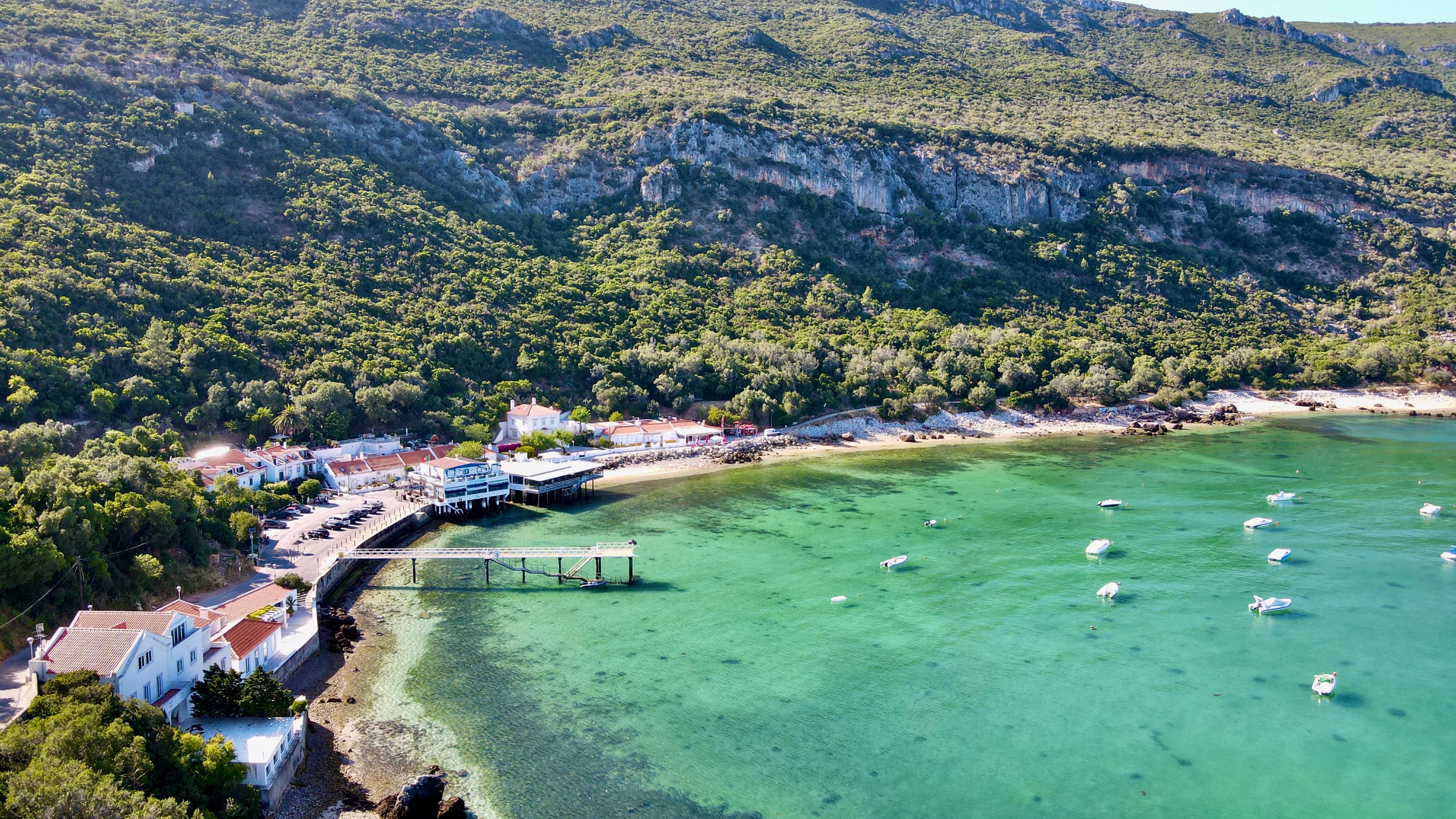
A weekend in Setúbal from Lisbon
Setúbal is a working Atlantic fishing port pressed against a wild limestone mountain range, fifty kilometers south of Lisbon and fifty-seven minutes away by direct train. You're flying into Lisbon — and here's why Setúbal earns a weekend: two of its draws are landscapes you simply can't reach on a single day out and back. The first is the cliff-and-cove beaches of Arrábida Natural Park, where limestone drops straight into turquoise water. The second is the Azeitão wine villages inland, where Portugal's oldest table-wine house still ages century-old Moscatel de Setúbal — the regional fortified sweet wine made from Muscat grapes — in oak. The third draw is the city itself, and the thread that ties the whole weekend together: the fish. A covered market lands it at dawn. The cooks fry it into the dish Setúbal invented. A resident pod of dolphins lives on it, and a Roman town once grew rich salting it.
The Fertagus train pulls out of Lisboa Roma-Areeiro every twenty minutes on weekdays, crosses the 25 de Abril Bridge over the Tagus, and sets you down in Setúbal in time for a Saturday morning at the market. Plan a Saturday arrival. The Mercado do Livramento — the main covered fish-and-produce hall — closes Sundays and Mondays, and a weekend that misses it gives up one of the real reasons to come. Sunday is then Arrábida or Tróia. The last weekday train back is 00:43; the Sunday cutoff thins to 23:03 (Fertagus, May 2026).
Why Setúbal from Lisbon
Setúbal rewards the overnight on specifics, not on a generic coastal-Portugal claim, and three of those specifics — a Mediterranean coastline, a resident dolphin pod, and the country's first Manueline church — are things a day from Lisbon can't fold in. Lisbon has its own beach access along the Cascais line and Costa da Caparica. What it doesn't have is the cliff-and-cove form of Arrábida, where limestone ridges drop straight to crescent coves of turquoise water, a Mediterranean coastline distinct from Lisbon's open-Atlantic stretches. It doesn't have a resident bottlenose pod either. Lisbon's Tagus dolphins are migratory visitors riding the high tide; Setúbal's are sedentary, living year-round in the Sado estuary, one of only five resident estuarine pods in Europe.
The third specific is architectural. The Convento de Jesus, the convent church on the north edge of the old town, is the earliest known building anywhere to use the Manueline style. Diogo de Boitaca's spiraled-rope granite columns rose here around 1490–1510, a full decade before the famous Manueline at Jerónimos, and they set the pattern that Portugal's golden-age architects went on to copy. Then there is the regional table Lisbon barely touches: choco frito (fried cuttlefish), invented here on Avenida Luísa Todi; Moscatel de Setúbal, the fortified sweet wine the Azeitão cellars built their name on; Queijo de Azeitão, the raw sheep's-milk cheese from the village twelve kilometers inland, named in the 2014 Great Taste Awards top fifty. The overlap that worried you in planning starts to read as complement, not redundancy.
Quick reference — why it earns the overnight
- Dolphins: ~28 resident Sado-estuary bottlenose, one of only five resident estuarine pods in Europe; operator sighting rates near 95% (Sado Arrábida operator pages; Portugal Travel Guide dolphins page, 2026).
- Convento de Jesus: earliest known Manueline building, ~1490–1510, predates Jerónimos by a decade (Monastery of Jesus of Setúbal, Wikipedia; VisitSetubal, 2026).
- Regional table: choco frito, Moscatel de Setúbal, Queijo de Azeitão — none of them Lisbon's.
Getting there from Lisbon
The fastest way down is the Fertagus train from Lisboa Roma-Areeiro, a 57-minute run that crosses the 25 de Abril Bridge over the Tagus with no transfers and drops you a five-minute walk from the market. Fertagus is a private operator on the South Bank suburban line; trains leave every 20 minutes on weekdays and every 30 on weekends and holidays. Tickets come from station vending machines or the Fertagus app, and walk-up is fine — you rarely need to plan ahead. The Lisbon-side intermediate stops at Entrecampos, Sete Rios, and Campolide all sit on the metro grid, so you board wherever is closest to where you're sleeping. For a Saturday-arrival weekend, an early departure puts you on the market floor before the fish-landing rhythm tapers.
The bus is the slower fallback. TST Sul do Tejo runs lines 561 and 563 from Praça de Espanha, roughly hourly; take it only if your Lisbon accommodation sits closer to Praça de Espanha than to a Fertagus station. Driving earns its place only if you're pairing Arrábida or Azeitão with the city — and only outside the Arrábida O2 summer car-access window. From June 7 through September 15 each year, car access to the inner Arrábida beaches (Albarquel, Creiro, Galápos, Galapinhos, Portinho da Arrábida) is restricted from roughly 07:00 to 19:30, and a vehicle cap closes the road at the Pinheiro intersection when it fills; a free TML shuttle covers Creiro → Galápos / Galapinhos through those dates. Plan around it or accept the shuttle.
Quick reference — getting there
- Fertagus train: Roma-Areeiro → Setúbal, ~57 min; €1.50–€4.55 one-way, ~€7–€9 round-trip second class; every 20 min weekdays, 30 min weekends (Fertagus, May 2026).
- TST bus: lines 561/563 from Praça de Espanha; ~€4.45 one-way / ~€8.90 round-trip (TST, May 2026).
- Drive: A2 via 25 de Abril Bridge (€2.10 northbound toll) or A12 via Vasco da Gama Bridge (€2.85); 45–60 min. Arrábida O2 car cap Jun 7 – Sep 15 (Município de Setúbal Arrábida O2 program, 2025).
- Last return: 00:43 weekdays, 23:03 Sunday.
Day 1
Day 1 follows the fish through a working port: a market that lands it at dawn, a lunch that fries it into the dish the city invented, and an afternoon on the water with the dolphins that live off it. Around that spine sit the Convento de Jesus in the morning and a golden-hour fort at dusk. Arrive on the Fertagus, walk to the market first, and let the day unspool from there — nothing on it is more than a fifteen-minute walk apart.
Mercado do Livramento
The Mercado do Livramento is the heart of the working port, a 1930 Art Deco hall five minutes from the Fertagus station, its cast-iron columns wrapped in large azulejo (Portuguese tin-glazed tile, typically blue and white) panels of Sado fishing scenes. Get there before nine and the fish hall is still loud — vendors heaving crates of last night's catch onto crushed ice, calling prices in fast Setubalense across the marble, fishmongers slitting and gutting in a blur while the cheese, honey, and Arrábida-produce stalls along the edges fill up more slowly. Around 300 independent traders work the floor; the fish is the headline, the rest is the half-hour bonus.
The market runs roughly 07:00 to 14:00, Tuesday through Saturday, and shuts Sundays and Mondays — which is exactly why this weekend is built around a Saturday arrival. By mid-morning the auction energy thins, so come early. Bring small euro cash; not every stall takes cards.
Quick reference — Mercado do Livramento
- Free entry. Tue–Sat ~07:00–14:00. Closed Sun/Mon. Five-minute walk from Fertagus station. Named by USA Today in 2015 among the world's best fish markets (Setubal Bay; Culinary Backstreets, 2026).
Convento de Jesus
From the market it's a ten-minute walk up through Praça do Bocage — the 18th-century pedestrian square named for the satirical poet born here in 1765 — to the Convento de Jesus on the northern edge of the old town, where Setúbal holds a genuine first-in-Portugal claim. This is the earliest known building anywhere to use the Manueline style. Diogo de Boitaca raised it around 1490–1510 under the royal sponsorship of João II and Manuel I, and what makes it matter is not just that it came first but how it came: his signature spiraled-rope columns, cut from the pinkish Arrábida breccia quarried out of the same mountain you'll walk on tomorrow, twist out of the floor like cables hauled from the sea. The hall-church plan he worked out here became the model Portugal's Manueline architects, including the ones who built Jerónimos in Belém, would follow a decade later. For anyone who cares about how a national style is born, this is the room where it happened.
The church and its adjoining museum reward 15–20 minutes for the nave and another 30–45 for the cloister. For travelers who care about architectural lineage, this is the most under-recognized Manueline sight in the country.
Quick reference — Convento de Jesus
- Adult admission ~€2–€3 (verify on visitsetubal.com — policies shift around restoration phases). Open Tue–Sun, 10:00–13:00 and 14:00–18:00; closed Mon.
Choco frito on Avenida Luísa Todi
Choco frito is fried cuttlefish — strips of fresh cuttlefish in cornflour crumbs, deep-fried, served with hand-cut chips and a wedge of lemon — and Setúbal didn't just adopt it, the city invented it, which is why the canonical place to eat it is here and not in Lisbon. The strip is Avenida Luísa Todi, between the market and the harbour, where two rival houses face off: Casa Santiago — Rei do Choco Frito, open since 1974 at Av. Luísa Todi 92, and Adega Leo do Petisco, opened in 1987 by the younger brother of Casa Santiago's owner at R. da Cordoaria 33. (A petisco is a small plate, the Portuguese equivalent of a tapa.) Portuguese food press and reader polls keep naming them the city's top two, with Casa Lagarto third. The cuttlefish on your plate may well have crossed the market floor you walked through an hour before — that proximity, the harbour across the road and the market two blocks back, is the rest of the experience, and the reason a Lisbon version never quite lands the same.
A full meal with regional white wine runs around €20–€28 a head, and Saturday lunch in season fills up — reserve a day ahead.
Quick reference — choco frito
- Casa Santiago / Adega Leo do Petisco, Av. Luísa Todi. Mains €12–€18; lunch ~12:00–15:30. Reserve Saturdays.
Sado-estuary dolphin tour
The Sado-estuary dolphin tour out of the Doca dos Pescadores is the afternoon's draw, and it is genuinely different from the dolphin trips out of Lisbon: the roughly 28 bottlenose dolphins here are not passing visitors but residents, one of only five resident estuarine pods in Europe, which is why a boat that goes looking for them comes back having found them almost every time. They feed on the same Sado fish runs that fill the market at dawn — you spend the morning watching the catch come in and the afternoon watching what hunts it in open water. Boats leave the dock and within twenty minutes the skipper cuts the engine; you wait, and then a dark fin breaks the surface off the bow, then two, then a calf riding its mother's slipstream.
The standard tour runs 2.5–3 hours; the afternoon departure is the natural fit after a market morning and a long lunch. Vertigem Azul is the most-cited operator, with Sado Arrábida and Nautur the credible alternates. Bring sun cover and a warm layer — the estuary breeze cuts the heat even in July.
Quick reference — dolphin tour
- ~€30–€40 adults, €15–€20 children 4–12; 2.5–3 hrs. Morning ~10:00–10:30, afternoon ~14:30–15:00. Book 2–3 days ahead at vertigemazul.com or sadoarrabida.pt. Operators run year-round; rough-water cancellations a deep-winter risk only. Sighting rates near 95% (Sado Arrábida; SeaBookings; Portugal Travel Guide dolphins page, 2026).
Fort of São Filipe at golden hour
End the day with the climb to the Fort of São Filipe, the six-pointed star fortress that Italian architects Filippo Terzi and Leonardo Torriani built into the hillside between 1582 and 1600, under Philip I of Portugal, to guard the mouth of the Sado against North African corsairs and the English and Dutch warships prowling the coast during the Iberian Union. The ramparts hold the best view of the weekend: the working harbour directly below, the estuary opening south, the low sandbar of the Tróia peninsula across the water, and the Arrábida coastline running off to the west — tomorrow's country, laid out in advance. Inside the walls, the small Capela de São Filipe is lined floor to vault in blue-and-white azulejos, cool and quiet after the heat of the climb.
It's a 20-minute uphill walk from Praça do Bocage, or a short taxi if the dolphin tour has worn you out. Dinner is back down on Avenida Luísa Todi.
Quick reference — Fort of São Filipe
- Free; grounds, chapel, ramparts ~45–60 min. 20-min uphill walk from Praça do Bocage, or a €5–€7 taxi. The historic Pousada inside the fort closed in 2014 (see lodging, below).
Where to stay overnight
Two nights in central Setúbal keep you within a fifteen-minute walk of the market, the Convento de Jesus, the dolphin docks, and the choco frito strip — close enough that the second morning starts with a coffee in the old town rather than a commute. Mid-range shoulder-season rooms run €55–€110 a night: Hotel Esperança on Av. Luísa Todi (central, €65–€100 doubles), ibis Setúbal (budget-business, ~€55–€85), Bocage Guesthouse (€60–€90), and Casal das Oliveiras (~€55–€80). One trap to dodge: the historic Pousada de Setúbal inside the Fort of São Filipe closed in 2014, but third-party booking sites still surface legacy entries — verify current status before you book anything trading on that name. Two nights is the right length; book the second now. For the Feira de Sant'Iago window (late July into early August), book three to four weeks ahead, when central lodging tightens hard.
Day 2
Day 2 climbs out of the port and into the Serra da Arrábida (the mountain range that runs west of Setúbal along the coast) — limestone ridges, Mediterranean scrub, and crescent coves of turquoise water on the south slope, with Portugal's oldest table-wine house twelve kilometers inland in Azeitão. The default Sunday is Arrábida-and-Azeitão; the alternate, for anyone who skips the beach, follows the fish thread one last time — a ferry across the estuary to the Roman salting town of Cetóbriga.
Galápos and Galapinhos in Parque Natural da Arrábida
The whole reason to have stayed the night reveals itself at Galápos and Galapinhos, two adjacent crescent beaches tucked inside Parque Natural da Arrábida where the limestone of the Serra drops straight to the sea. Galápos is the larger, with a couple of restaurants and a steep path down; Galapinhos, its smaller twin, gets named the most beautiful beach in Portugal in the domestic press most years, and standing on it you see why — clear blue-green water cupped between cliffs furred with Mediterranean scrub, a coastline shape the open-Atlantic Costa da Caparica near Lisbon simply doesn't have. A swimmer pushes out past the rocks; a family stakes an umbrella in the one strip of morning shade.
Entry to the park and beaches is free. Outside the Arrábida O2 summer window you can drive in and park at the beach lots; in season, take the free TML shuttle from Creiro or arrive before the daily cap. The walk down to Galapinhos is steep but short, and not stroller-friendly. Bring water and food — the only kitchens are at Galápos and Portinho. The whole range has carried a UNESCO Biosphere Reserve designation since September 2025, for roughly 1,400 plant species spread across the Setúbal, Palmela, and Sesimbra municipalities.
Quick reference — Galápos / Galapinhos
- Free. Parking ~€3/day off-season. Arrábida O2 car restrictions Jun 7 – Sep 15; free TML shuttle from Creiro in season. ~10-min steep walk down to Galapinhos. UNESCO Biosphere Reserve since Sep 2025 (UNESCO Man and the Biosphere Programme, 2025).
José Maria da Fonseca winery in Azeitão
Twelve kilometers inland, in Vila Nogueira de Azeitão, the José Maria da Fonseca cellar tour is where the Moscatel finally makes sense — JMF, founded in 1834, is Portugal's oldest table-wine house, and it makes both Periquita (the country's oldest named red) and Moscatel de Setúbal. The tour walks three working adegas (winery cellars), and the one that earns the trip is the Adega dos Teares Velhos, where Moscatel vintages more than a century old still rest in oak, the air thick and raisined. The premium tasting pours two table wines and then the aged Moscatel — sweet, amber, tasting of dried apricot and orange peel and a little of the dust of its own barrels. That pour is the reason to come here rather than to a generic winery closer to Lisbon.
Next door, the Pedaços de Azeitão queijaria (cheese shop) sells Queijo de Azeitão, the raw sheep's-milk, vegetable-rennet cheese protected as a regional denomination from this village; soft enough to spoon at room temperature, it travels back to Lisbon well as a half-wheel. Don't drive after the tasting — taxi or rideshare back, or bring a designated driver.
Quick reference — José Maria da Fonseca
- Tours €10–€25 per tier; Mon–Sat ~10:00–12:00 and 14:30–17:30; allow 60–90 min. Book on jmf.pt. Pedaços de Azeitão queijaria next door for Queijo de Azeitão.
Alternate: Tróia ferry and the Cetóbriga Roman ruins
If you skip the beach, the alternate Sunday closes the fish thread two thousand years back: a Tróia ferry to a Roman town that grew rich on the same Sado catch. The 25-minute foot-passenger catamaran leaves the Doca dos Pescadores for the Tróia peninsula across the estuary, and on the far side the Ruínas Romanas de Tróia (Cetóbriga) hold the remains of the largest fish-salting center in the Roman Empire, worked from the 1st century BCE through the 6th century CE. You walk among the salting tanks where workers once packed estuary fish in brine for shipment across the Mediterranean, past the bathhouses and surviving mosaics — the industry that paid for it all running on the very fish runs you watched land at the Mercado do Livramento the morning before, the same water, two millennia apart.
Beyond the ruins, the southern tip of the peninsula opens onto 65 kilometers of empty Atlantic sand — the longest stretch of beach landscape in the region that a Lisbon trip never reaches.
Quick reference — Tróia ferry + Cetóbriga
- Foot-passenger ferry ~€5.30 each way, roughly every 30 min in day hours. Cetóbriga ruins ~€5, Tue–Sun 10:00–12:30 and 14:00–17:30 (verify on the Tróia Resort website).
Slow-travel option: the N379-1 scenic drive or Convento da Arrábida
With a car and good weather, the N379-1 — the "Estrada de Escarpa" that climbs the spine of the Serra da Arrábida — turns up on most domestic-press shortlists of the country's finest drives, and it's easy to see why from the wheel. Fourteen kilometers of cliff-edge road wind up to about 500 meters, threading a string of miradouros (lookout points) and the 16th-century Convento da Arrábida, a Franciscan monastery folded into the southern slope and now run by the Fundação Oriente (visiting the convent itself needs advance booking; foriente.pt). The road is free, narrow, and not for nervous drivers.
Pair it with a late lunch in Portinho da Arrábida — a small beach village just west of Galápos — and drop back into Setúbal for the train. If you only have time for one Day 2 move, take Arrábida-and-Azeitão; the N379-1 is the third option when Sunday stretches long.
Quick reference — N379-1 / Convento da Arrábida
- Free road, ~14 km, climbs to ~500 m. Convento da Arrábida by Fundação Oriente booking (foriente.pt). Last Fertagus to Lisbon 23:03 Sunday — verify before a late lunch.
Back to Lisbon
The last Sunday-return train from Setúbal back to Lisboa Roma-Areeiro leaves at 23:03, noticeably earlier than the weekday 00:43, which leaves a thinner cushion than you'd think if a long Sunday lunch happens to overrun. Aim for an early-afternoon return from Arrábida or Tróia, leave an hour back in town to collect bags and grab a pastry, and take a train somewhere in the 19:00 to 21:00 band. Check the Sunday timetable on fertagus.pt before you commit to anything later, because the schedule shifts around national holidays.
You're flying into Lisbon, and now that the working port and the Arrábida coast have done their work, you ride back into the capital for the rest of the trip with a clearer sense of what the south bank of the Tagus actually holds — the fish market, the dolphins, the salting tanks, all the same water.
Practical notes
This is the weekend-specific fine print the day-by-day flow doesn't quite carry, and it comes down to two constraints that catch first-time visitors: the seasonal car restrictions in Arrábida and the Sunday/Monday closure of the market. Accept the rail-and-Saturday-arrival shape and the rest of the trip runs low-friction.
Money. Round up at cafés; 5–10% at sit-down restaurants is standard, never demanded. Cards work at most restaurants, the dolphin operators, and museum desks; carry small euro cash for the Mercado do Livramento stalls and the smaller wineries and cheese shops in Azeitão. ATMs (Multibanco machines, the country's interbank network) are common in central Setúbal.
Getting around the city. Walking, almost entirely. The Fertagus station, Mercado do Livramento, Convento de Jesus, Praça do Bocage, Casa da Baía, and most of the choco frito strip sit within a 15-minute walk of one another. The climb to the Fort of São Filipe is the only real uphill.
Arrábida access in summer. The single biggest planning miss is the Arrábida O2 car-access restriction (June 7 – September 15). Drivers turn up expecting to park at Galápos or Portinho and get turned back at the Pinheiro intersection once the daily vehicle cap is hit. The free TML shuttle from Creiro works, but it is a different shape of day from "drive to the beach." Build the shuttle into the plan or come in shoulder season.
Sunday and Monday closures. The Mercado do Livramento is closed both days, and many small choco frito houses also shut on Mondays. The Saturday-arrival pattern in this trip exists because of that — don't reverse-engineer it into a Sunday arrival.
Dolphin operator licensing. The three credible operators — Vertigem Azul, Sado Arrábida, Nautur — are licensed by ICNF, Portugal's nature-conservation agency. Licenses are periodically renewed; if you're booking far ahead, check current ICNF status on the operator's site before you pay.
Language. "Olá," "bom dia," "obrigado" or "obrigada" carry real weight in a working town that doesn't trade primarily on English-speaking tourism. Dolphin-tour operators and central restaurants run in English; the market fish vendors mostly do not.
Safety. Setúbal is low-crime inside the historic center and the harbour zone. Keep standard pickpocket awareness near the Fertagus station and the market. Avoid the residential neighborhoods east of the railroad tracks (the Bela Vista direction) at night — they sit outside the visitor circuit.
Frequently asked questions
Is Setúbal worth a weekend trip from Lisbon?
Yes, when you want two distinct landscapes a single day can't reach — a working Atlantic fishing port with a resident dolphin pod on Saturday, then the cliff-and-cove beaches of Arrábida Natural Park and the Azeitão wine villages on Sunday. If your Lisbon trip is already coastal-heavy, the marginal pull is thinner; otherwise the contrast is genuine.
What is choco frito?
Choco frito is fried cuttlefish — fresh strips of cuttlefish coated in cornflour crumbs, deep-fried, and served with hand-cut chips, a wedge of lemon, and usually a glass of regional white wine. The dish was invented in Setúbal in the 1960s and is canonically eaten at two rival houses on Avenida Luísa Todi: Casa Santiago (since 1974) and Adega Leo do Petisco (since 1987). You can find versions in Lisbon, but the working-waterfront context is the rest of the experience.
What is Manueline architecture?
Manueline is the late-Gothic Portuguese style of the early 1500s, named for King Manuel I (1495–1521) and dense with maritime motifs — twisted ropes, knots, armillary spheres, sea creatures — that echo the Portuguese Age of Discoveries. The famous example is the Jerónimos Monastery in Lisbon's Belém district, finished in the 1540s. Setúbal's Convento de Jesus, built 1490–1510 by the architect Diogo de Boitaca, is the earliest known building in the style and predates Jerónimos by a decade.
What is Moscatel de Setúbal?
Moscatel de Setúbal is a fortified sweet wine made from Muscat grapes grown on the Setúbal Peninsula and aged for years (sometimes decades) in oak. It is the regional fortified-dessert specialty, in the same broad family as Port and Madeira but lighter and more floral. The canonical producer is José Maria da Fonseca in Vila Nogueira de Azeitão, Portugal's oldest table-wine house (founded 1834), whose Adega dos Teares Velhos cellar still holds Moscatel vintages over a century old.
How do I get from Lisbon to Setúbal — train, bus, or car?
Take the Fertagus train from Lisboa Roma-Areeiro: about 57 minutes, every 20 minutes on weekdays and every 30 on weekends, around €7–€9 round-trip second class (Fertagus, May 2026). TST buses from Praça de Espanha are the slower alternative. Driving (A2 via the 25 de Abril Bridge) helps only if you're pairing with Arrábida outside the summer car-access window.
Can I visit Arrábida Natural Park from Setúbal without a car?
Yes, but it depends on the season. From June 7 to September 15, car access to the inner Arrábida beaches is restricted under the Arrábida O2 program and a free TML shuttle bus runs Creiro → Galápos / Galapinhos (Município de Setúbal, 2025). Outside that window, taxis and rideshares from central Setúbal are workable but limited; plan the return in advance.
What's the best time of year for a Setúbal weekend?
Late September through mid-October is the strongest window — summer-quality weather, the Arrábida car restrictions have ended, beaches and trails are clear, and lodging is back to off-season pricing. Spring (March–May) is a close second. High summer brings the inner-Arrábida car cap and 30+ °C heat; winter narrows the trip to the indoor stops and the year-round dolphin tour.
Where should I stay in Setúbal for a weekend?
Lean on mid-range central options — Hotel Esperança on Avenida Luísa Todi, ibis Setúbal, Bocage Guesthouse, or Casal das Oliveiras, typically €55–€110 a night in shoulder season. Skip any third-party listing for the Pousada de Setúbal inside the Fort of São Filipe; the historic Pousada closed in 2014 and legacy entries still surface on booking sites.