
A Weekend in Tarragona from Barcelona
Tarragona sits on a clifftop above the Mediterranean, 80 kilometres south-west of Barcelona by rail, and it holds the most complete Roman city you can reach by train from anywhere in Western Europe. The amphitheatre faces the open sea, the way it did when 15,000 people filled it to watch men fight. The circus tunnels run intact beneath the modern streets, so the chariot-racing crowd's roar is still routed under your feet. The cathedral has stood at the high point of the Old Town since the twelfth century. You're flying into Barcelona — and Tarragona is worth two days of that trip for a specific reason: this was the capital of Roman Iberia, not a footnote to it, and the city is still built in layers of that stone, one Roman course under the next, at a scale Barcelona cannot offer.
What the overnight unlocks is something else entirely. By day the Part Alta — Tarragona's hilltop Old Town — belongs partly to visitors working down a monument list, headsets on, map open. After about 20:00 it belongs to the city. The Plaça de la Font fills with families on the evening stroll and old men arguing over a single beer; the restaurants on Carrer Major serve pa amb tomàquet (Catalan bread rubbed with ripe tomato, olive oil, and salt) and a glass of local wine to people who live two streets away. The cathedral, lit against a dark sky, is worth a second pass on foot. And a second morning hands you Pont del Diable — the Roman aqueduct out in its ravine — at walking pace instead of jammed against a return train.
For travelers landing in May, late September, or the first weekend of October in an even year, the case sharpens. Those are the dates when Tarragona's Roman past and its living Catalan present touch: gladiators re-enacted in the amphitheatre, human towers built nine tiers high in the square, fire-runners pouring sparks through the lanes. The festivals are the reason to come, not the backdrop.
Getting there from Barcelona
The right way to travel is the regional train from Barcelona Sants to Tarragona Estació, the city station — and the station name is the one detail that trips people up. Book a ticket that reads "Tarragona," never "Camp de Tarragona," and you arrive a five-minute walk from the ruins instead of stranded on an industrial plain.
Camp de Tarragona is the high-speed AVE hub, dropped about 10–11 km outside the city, and arriving there without a plan means a taxi or a connecting bus before the weekend can start. The regional service — Rodalies R16 or Media Distancia — always uses the city station, which sits a 5–10 minute walk from the Rambla Nova and the Old Town. No reservation is needed: walk up to the machine or book online. The faster Renfe Avant trims the trip to under an hour, and for a weekend traveler who knows the return time, the Avant return ticket runs about a fifth cheaper than two singles. The last regional train back leaves late enough for an unhurried dinner first; the ALSA bus is a cheaper but slower fallback that ends the evening more abruptly.
Quick reference — getting there
- Regional train (Rodalies R16 / Media Distancia): Barcelona Sants → Tarragona Estació, ~1h05–1h20; the Renfe Avant is ~55–65 min. Roughly 32 trains daily on the corridor, regional departures about hourly; no advance reservation (ShowMeTheJourney, BarcelonaLowdown, June 2026).
- Regional fare: ~€7–€9 single, ~€11–€16 round-trip (Omio, Trainline, June 2026). Avant ~€10–€15 single, ~€14–€22 round-trip, with the return ticket ~20% cheaper than two singles (Rail Europe, Trainline, June 2026). Verify at renfe.com.
- Fare zone: Tarragona lies outside Barcelona's ATM integrated-fare zone — a separate ticket is required; a T-Casual card does not cover the journey.
- Last departures back: regional ~22:26–23:20 depending on the day. ALSA bus ~€8–€12 single, last departure 21:25 (ALSA.com, June 2026).

Day 1: Roman capital by day, Part Alta by night
Day 1 climbs the city the way Tarraco was built — from the sea-facing amphitheatre at the bottom, up through the Roman and medieval layers to the Old Town, and into the evening in the Part Alta. The day is shaped to deliver you to the overnight rather than drag you away from it.
Amfiteatre Romà
The 2nd-century AD amphitheatre is the place to start because it is the clearest single image of what Tarragona was: a Roman arena cut into a clifftop directly above the Mediterranean, the only one in Western Europe with a sea view. Roughly 15,000 spectators once filled it for gladiatorial combat, and the ruins of a 6th-century Visigothic basilica still sit in the arena bowl, raised on the spot where Bishop Fructuosus was burned alive in 259 AD — the empire's machinery for spectacle and execution, then a church built over the killing, all in one oval of stone. The setting is genuinely striking, but come prepared: the standing remains are low walls and a cleared floor, and twenty minutes of reading beforehand, or an audio guide, changes what you are looking at entirely. Stand at the seaward rim and the geometry does the rest.
Quick reference — Amfiteatre Romà
- Plan 1–1.5 hours. Admission
€5; the MHT combined ticket (€15) covers this plus the Circus vaults, the walls walk, and Casa Canals (entrades.museu.tarragona.cat, June 2026). - Opens 09:00 Tuesday–Saturday; closed Mondays.
Pretori i Circ Romà
The Praetorium and Roman Circus give you the single most physical experience in the whole ensemble: you walk into intact barrel-vaulted passages from the 1st century AD and realize the modern Part Alta is sitting on top of them. The circus ran roughly 325 metres by 115 metres — one of the largest chariot-racing venues in the empire, holding an estimated 30,000 — and pieces of its underbelly are now corridors you move through in the half-dark, your footsteps echoing off vaulting that carried a racetrack. It is a different order of experience from looking down at open-air ruins. Climb the Praetorium tower afterward — repurposed as an Aragonese royal residence in the medieval period — for the view back across the Old Town and out to the sea.
Quick reference — Pretori i Circ Romà
- Allow 1–1.5 hours; the MHT combined ticket applies (InSpain.org, Tarragona Turisme, June 2026).
Passeig Arqueològic
The Passeig Arqueològic — the Archaeological Promenade — is the easiest stretch of the day and one of the most rewarding: a walk along the outer face of Tarragona's defensive walls, the largest surviving Roman defensive structure in Iberia. The inner wall is Roman, roughly 1st–2nd century BC to 2nd century AD; the outer is medieval, so the walk itself reads as two eras of fortification stacked against each other. The path threads past towers, gateways, and terraced gardens, with the coastal plain dropping away toward the sea. It works perfectly as the transition between the lower city and the Part Alta — low effort, high payoff.
Quick reference — Passeig Arqueològic
- Admission ~€3.15–€5; the MHT combined ticket applies (Tarragona Turisme, InSpain.org, June 2026). Allow ~45 minutes.
Catedral de Tarragona and cloister
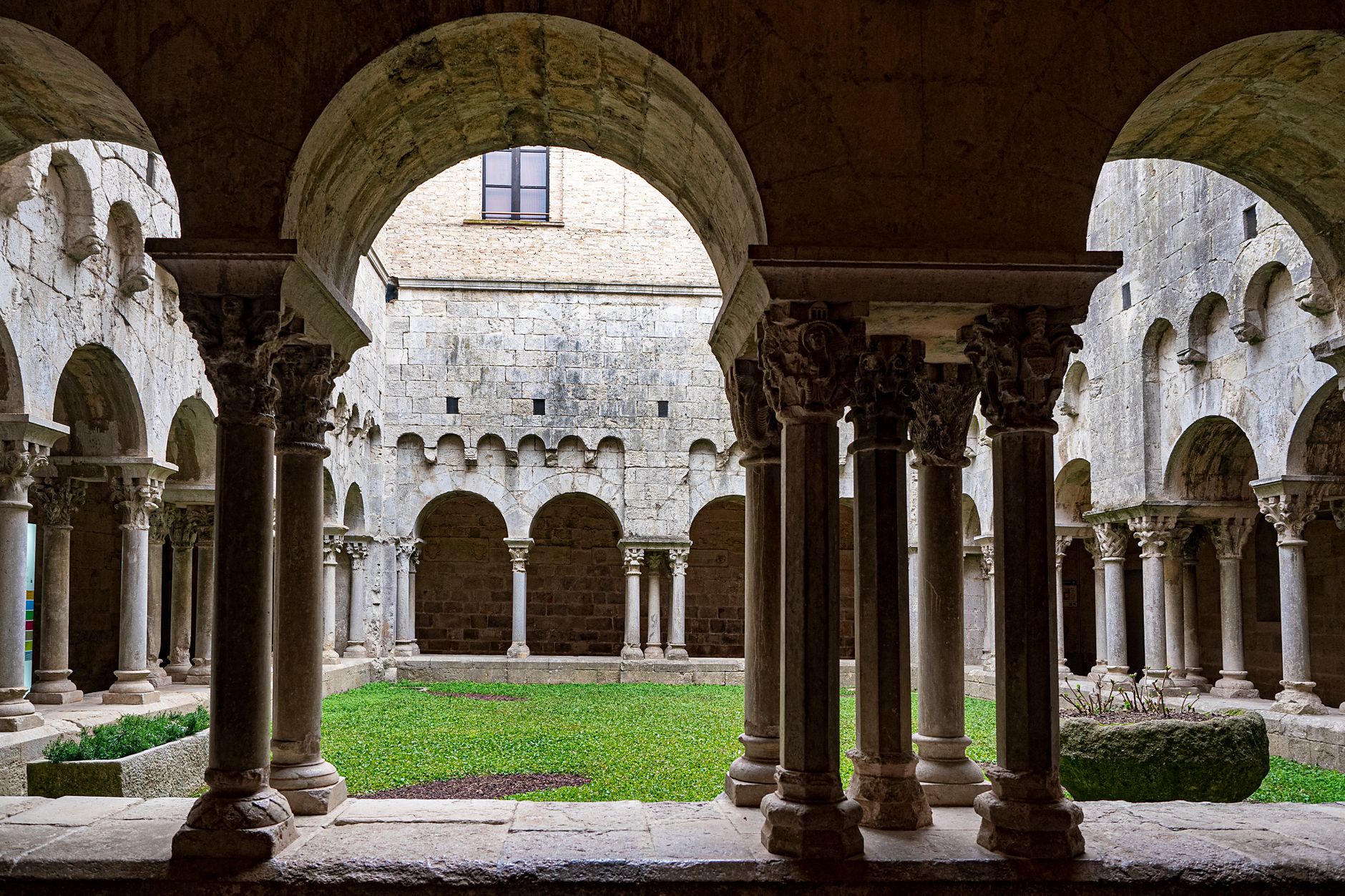
The Catedral de Tarragona is where the city's layering becomes a single building you can walk through: construction began in 1171 on the foundations of an earlier Roman temple to Jupiter, and the cathedral was consecrated in 1331. Start at the apse, which is Romanesque, walk the nave, which is Gothic, and you have read five centuries of changing taste in one pass without a label telling you so. The cloister is the part people remember — a 12th-to-14th-century arcaded courtyard with carved capitals and a quiet you don't expect in a city centre, the kind of place where the loudest sound is your own steps on stone. The Diocesan Museum inside holds Flemish tapestries and regional ecclesiastical art.
Quick reference — Catedral de Tarragona
- Admission ~€12 (cathedral, cloister, Diocesan Museum); reduced ~€8.50 for under-18s, over-65s, and teachers. Not included in the MHT combined ticket.
- Hours: June 16–September 14, Monday–Saturday 10:00–20:00; shorter in winter; closed Sundays and religious holidays (CatedralDeTarragona.com, June 2026).
Rambla Nova and Balcó del Mediterrani
The Rambla Nova is Tarragona's civic spine — a tree-lined, human-scaled promenade running southwest from the Old Town to a cliff-edge viewpoint called the Balcó del Mediterrani, the Mediterranean Balcony. Walk to the railing in the late afternoon and the amphitheatre ruins, the Platja del Miracle beach, and the open sea all line up below you at once. Locals reach out and touch the iron rail here for luck — tocar ferro, "touch iron" — above the old Roman quarry pit, a small habit that turns the viewpoint into something more than a photo stop. It is free, and the angled afternoon light across the ruins is the reason to time it for the end of the day.
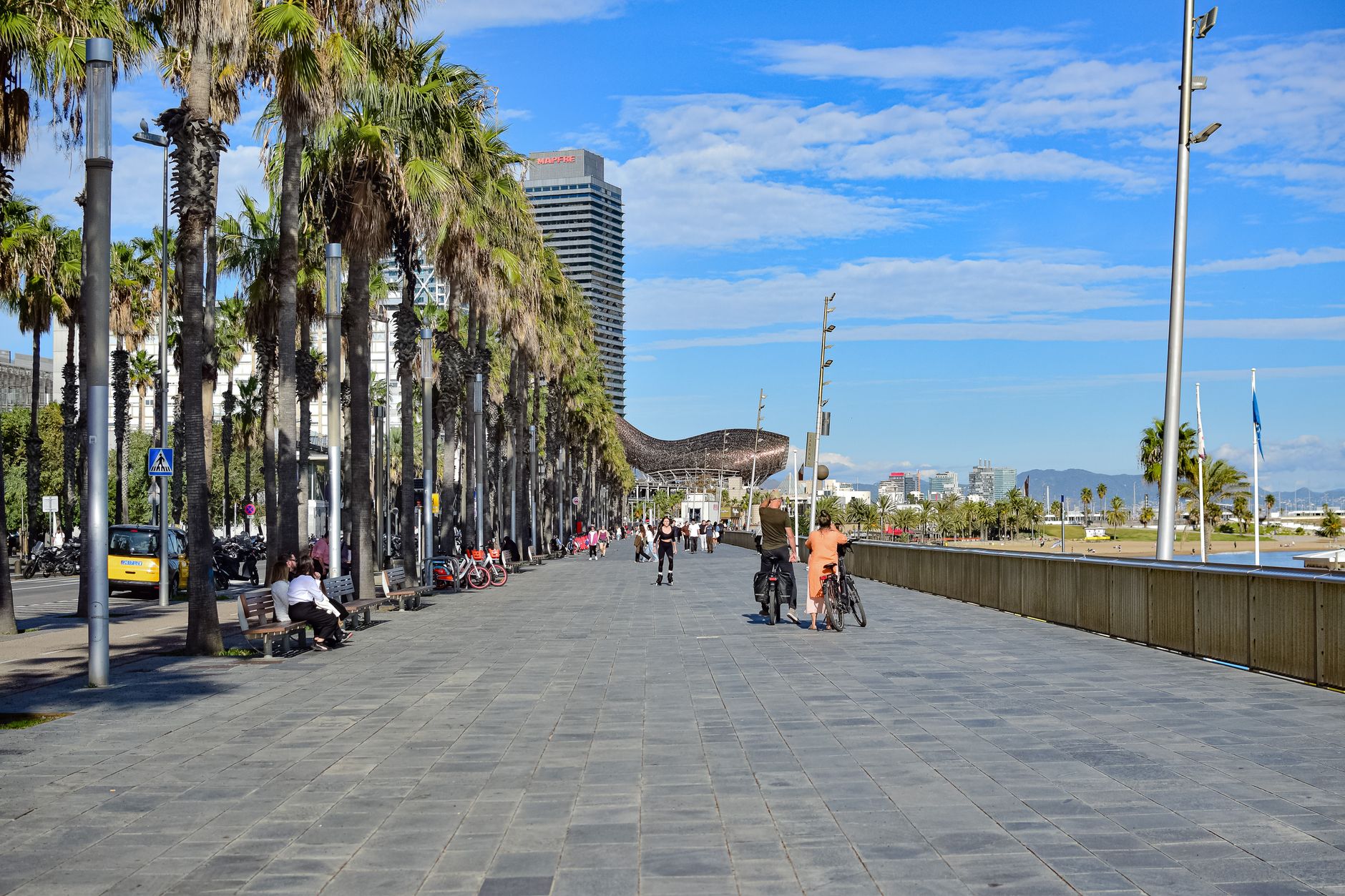
The beach directly below — Platja del Miracle — is a clean, sandy strip that works for a quick swim after a morning of ruins. It fills up on summer weekends, and travelers who came for the coast are better served by Salou and Cambrils to the south. For a dip between monuments, though, it does the job.
Part Alta evening and Plaça de la Font
This is the part of the day that earns the night. The Part Alta empties of day visitors by late afternoon, and by 20:00 the Plaça de la Font — the Old Town's main square — has become a local living room: outdoor tables, low-key bars, kids running between chairs while their parents take the slow evening passeig (the evening stroll). The lanes off Carrer Major hold Tarragona's best Catalan kitchens, most of them cooking for the city's 143,000 residents rather than for tourists — the place to order romesco (the toasted-nut and dried-pepper sauce born in this exact stretch of coast) on something grilled, with the cathedral going dark overhead. No admission, no itinerary; this is the evening that justifies staying.
Where to stay overnight
Stay inside the Part Alta or the Old Town, close enough to the Plaça de la Font that the evening promenade — the whole reason to spend the night rather than day-trip — is two minutes from your door. The Hotel Plaça de la Font sits right on the square at the heart of the Old Town, 550 metres from the sea. The H10 Imperial Tarraco is a four-star seafront option near the Mediterranean Balcony. One night is the right amount: the second day closes the loop before you'd ever want a third.
Quick reference — staying overnight
- Average weekend rates ~€68–€134 per room (Booking.com, Expedia aggregation, June 2026 — re-verify when booking; summer and festival periods run significantly higher).
- The Old Town and Part Alta hold at least eleven hotels and boutique guesthouses within the neighborhood (Agoda, June 2026).

Day 2: Aqueduct at pace, then artifacts before the train home
Day 2 is deliberately lighter — a slow morning at the Roman aqueduct with none of the clock-watching a day-trip imposes, then an hour with the artifacts at Tinglado 4 on the waterfront, set naturally on the walk back toward the station.
Pont del Diable — Les Ferreres Aqueduct
The reason to give the aqueduct a whole unhurried morning, rather than wedge it into a day trip, is what it does when there is nobody else on it. The Les Ferreres Aqueduct — locally Pont del Diable, the Bridge of the Devil — is the best-preserved Roman aqueduct in Spain outside Segovia: a 217-metre stretch of two-tiered arches standing 26 metres tall in a forested ravine 4 kilometres northwest of the city. You can walk the top, along the original water channel, with the pines below and the structure carrying nothing now but morning light. Arrive before the coaches and you have a working piece of imperial engineering essentially to yourself; arrive after, and you queue for the same photo. With a night already behind you, the early start costs nothing.
Quick reference — Pont del Diable
- Free, open 24 hours. Come before 10:00 to beat the tour coaches (Tarragona Turisme, BarcelonaTravelHacks, June 2026).
- Getting there: city bus 5 from Plaça Imperial Tàrraco, ~15 min, roughly every 30 minutes; taxi ~€10–15 each way. Allow 1.5–2 hours including transit.
Tinglado 4
Tinglado 4 is where the small finds live while the main museum is shut — the mosaics, inscriptions, ceramics, and sculptural fragments that give the open-air monuments their context, the human scale the big stone misses. The main MNAT (Museu Nacional Arqueòlogic de Tarragona) building at Plaça del Rei has been closed for renovation since April 21, 2025, with no confirmed reopening date as of June 2026, and this warehouse space on the Costa Wharf, on the port waterfront, holds a curated selection of the collection in the meantime. Spend an hour with the inscriptions and the city stops being only ruins and starts being the people who lived in them.
Quick reference — Tinglado 4
- Admission ~€4 adults, ~€2 seniors and students, free for under-15s and on the last Tuesday of the month October–June (MNAT, Tarragona Turisme, June 2026). Check mnat.cat for current hours.
- The waterfront location sits naturally between the aqueduct and the walk to Tarragona Estació for the afternoon train back to Barcelona.
Back to Barcelona
The last regional train from Tarragona Estació to Barcelona runs late, but for a Day 2 you'll want an early-to-mid afternoon departure — enough time for a relaxed Tinglado 4 visit and a waterfront lunch before you leave. You return to the same city station you arrived at, Tarragona Estació, so there's no camp-station confusion on the way home if you came in by regional service. Confirm the exact time on renfe.com for your travel date.
You're flying back out of Barcelona, an hour and a quarter up the line, and the weekend works precisely because the train makes that distance frictionless. Tarragona isn't a day trip that overstays its welcome — it's a real Roman capital with its own civic weight, the kind of place that earns its second morning and sends you back to the hub glad you gave it the night.
Quick reference — getting back
- Last regional train to Barcelona ~22:26–23:20 depending on the day; multiple afternoon and evening departures. Confirm at renfe.com.
Practical weekend notes
The handful of details below decide how well the weekend runs — when to book around festivals, how to handle summer heat, and what to skip — so read them before you lock in dates.
Festival booking lead times — be specific. Tarraco Viva runs roughly ten days in mid-to-late May (2026 edition: May 11–24); book accommodation 2–4 weeks ahead. Santa Tecla runs September 12–24 — lodging in the festival's final week fills well in advance, and the city is busy throughout. The Concurs de Castells (first weekend of October, even years only; verify the exact 2026 dates at concursdecastells.cat before booking) needs planning months ahead — accommodation is extremely tight for the competition weekend, and Reus and Salou are the practical overflow when the city sells out.
Summer heat. July and August bring daytime temperatures regularly reaching 32–38°C, and the Roman sites are largely unshaded. A Day 1 that starts before 09:00 and builds in a midday break is the sensible approach. Lodging prices peak in summer and drop noticeably from mid-September.
PortAventura. The theme-park resort sits about 10 km south near Salou. It is a standalone destination for a different traveler — families, thrill-ride visitors — and there is no practical case for folding it into a Roman-and-medieval Tarragona weekend.
Language. Catalan is co-official and dominant in daily life and signage; Spanish is widely spoken; English is understood in tourist-facing places but Tarragona is less English-saturated than central Barcelona. Signage at smaller monuments is often Catalan and Spanish only.
Tickets. The MHT combined ticket (€15) covers the amphitheatre, Circus/Praetorium vaults, walls walk, and Casa Canals; a shorter pass (€7.40) covers a subset (entrades.museu.tarragona.cat, June 2026). The Cathedral is separate (~€12 full; ~€8.50 reduced). Pre-book timed entry during Tarraco Viva and peak summer weeks. Tinglado 4 is ~€4 adults (MNAT, June 2026). All prices sourced June 2026 — verify at the relevant sites before traveling, as annual revisions occur.
Rule B glossary. A few Catalan and regional terms recur above. Correfoc is fire-running — participants in devil costumes run through the streets firing pyrotechnics — a central feature of Santa Tecla and other Catalan festivals. Romesco is a toasted-nut and dried-pepper sauce originating in the Tarragona area specifically, distinct from generic Catalan cooking. Fideuà is a noodle-based dish made the way paella is, typical of the Catalonia–Valencia coast and well represented on Tarragona's waterfront menus. These are genuinely local to this stretch of coast and worth ordering on purpose rather than defaulting to broader Catalan standards.
Making a longer trip of it? Two more easy escapes from Barcelona: a weekend in Vic and Tossa de Mar on the Costa Brava.
Frequently asked questions
Is Tarragona worth an overnight from Barcelona?
For most visitors, a single day covers the main Roman monuments. An overnight is worth it if you want the evening atmosphere in Part Alta after day visitors leave — the Plaça de la Font and local restaurants feel entirely different after 20:00 — or if you're visiting during Tarraco Viva (May), Santa Tecla (September), or the biennial Concurs de Castells (early October, even years only). A second morning also gives you an unhurried visit to Pont del Diable.
Which station do Barcelona–Tarragona trains use — Tarragona or Camp de Tarragona?
Use Tarragona Estació, the city station, which is a 5–10 minute walk from the Roman monuments and Old Town. Camp de Tarragona is the high-speed AVE hub located about 10–11 km outside the city; arriving there means a taxi (around €15 each way) or a connecting bus to reach the Old Town. Regional Rodalies R16 trains and most Media Distancia services use the city station. When booking, confirm your ticket shows 'Tarragona' or 'Tarragona Estació' — not 'Camp de Tarragona.'
When is the Concurs de Castells, and is it worth timing a visit around it?
The Concurs de Castells — the national human-tower competition held at Tarraco Arena Plaça — takes place on the first weekend of October in even years only (2024 was October 5–6; 2026 is next). Verify the exact 2026 dates at concursdecastells.cat before booking. If you're going, book accommodation months ahead: Tarragona fills completely, and Reus or Salou are the practical overflow options.
What are castellers, and can I see them in Tarragona?
Castellers are the groups — colles castelleres — that build human towers, stacking people into columns sometimes eight or nine tiers high, a Catalan tradition inscribed on UNESCO's Intangible Cultural Heritage list in 2010. Tarragona is one of the tradition's heartland cities, with four local colles competing during Santa Tecla each September. The biennial Concurs de Castells in early October (even years) brings colles from across Catalonia for the national competition.
What is the difference between Tarraco Viva and Santa Tecla?
Tarraco Viva (mid-to-late May, roughly ten days) is a living-history festival focused on the Roman monument sites — gladiator re-enactments, Roman theatre, and equine displays at the amphitheatre, circus, and aqueduct. Santa Tecla (September 12–24) is Tarragona's main civic patron-saint festival — castellers, correfoc fire-running, gegants processions, and city-wide celebrations. Both fill accommodation: Tarraco Viva by 2–4 weeks ahead, Santa Tecla's final week much earlier.
Can I visit Pont del Diable without a car?
Yes. City bus 5 from Plaça Imperial Tàrraco reaches the aqueduct in about 15 minutes, running roughly every 30 minutes. A taxi costs around €10–15 each way. The aqueduct is in a free, open public eco-park 24 hours a day, and you can walk the top of the structure along the original water channel. Allow about 45–60 minutes total for transit and the visit itself.