3 Days in Palermo: Your Opening Chapter in Sicily
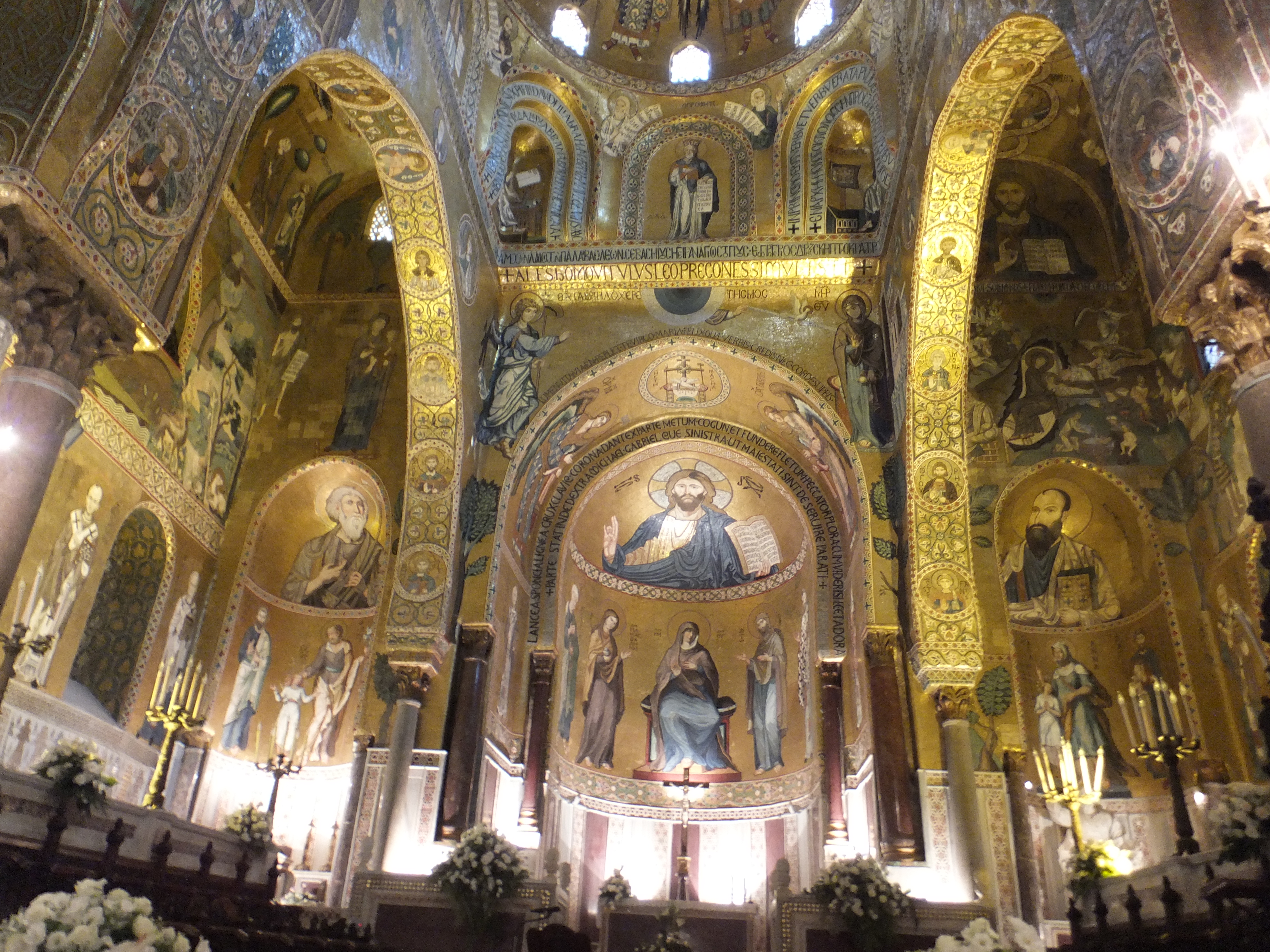
In the 12th century, the Norman kings of Palermo did something no European ruler had tried: they hired Arab craftsmen to lay geometric ceiling patterns above Byzantine mosaic programs, inside a royal chapel built on foundations that had been a mosque. The Cappella Palatina — the Palatine Chapel — was the result. It is still standing inside the Palazzo dei Normanni, and it is the most concentrated expression of what happened when two conquering civilizations chose to make something together rather than erase what came before. That room, and the dozen buildings that grew from the same impulse across the same century, are why Palermo is the right gateway into western Sicily — the opening entry point for an island circuit that no other airport sets up as cleanly.
It is also the right airport. Palermo (PMO) sits in Sicily's northwest corner; Catania (CTA) anchors the east. Fly into Palermo, drive south through Segesta and Agrigento, continue east toward Ragusa and Syracuse, and exit through Catania — that is an open-jaw ticket (flying into one city and out of another, so you never retrace the same ground), and it is the cleanest structure for a first Sicily circuit. No backtracking to the west. No three-hour round trip to Segesta. The geographic argument for PMO is simply that western Sicily is what Palermo opens.
Spend three days here. The UNESCO Arab-Norman monuments on Day 1, the markets and food culture on Day 2, Monreale Cathedral on Day 3 morning. Then pick up the rental car and drive south. The city will push back a little — traffic outside the historic center is genuinely chaotic, some blocks are rough, and the sanitation gaps outside the tourist core are real. None of that diminishes what's here. It just means you arrive prepared.
Why Palermo as a gateway to Sicily
Palermo is the logical entry point for western and central Sicily: the Arab-Norman monuments, Segesta, and Agrigento all radiate south and east from the city in a single clean routing line, and the island's no-backtracking circuit only works if you start at the western end.
Sicily has two international airports: Palermo (PMO) in the west, Catania (CTA) in the east. The choice is a routing question, not a pricing contest — in some booking windows, Catania fares from US markets run lower than Palermo's, so PMO is not reliably the cheaper option. The reason to fly into Palermo is geography: if your trip spends meaningful time in the west, or if you're running the full island circuit, PMO is where you start.
Recent fare context (point-in-time — verify before booking): One-way fares to PMO from New York area airports from approximately $331 from JFK; round-trip fares from US hubs have appeared as low as $699 (Expedia, Momondo, June 2026). Most US travelers connect through a European hub; intra-European fares to PMO have been as low as €18–€40 one-way (Treverra search data, April–May 2026). Catania fares have averaged lower than Palermo's in some comparison windows (BudgetYourTrip, 2026).
Getting from the airport to the city is simple. The Prestia e Comandè bus and the Trinacria Express (Trenitalia) both connect Falcone Borsellino Airport to the city center; a taxi takes 30–45 minutes.
Quick reference — airport to city
- Prestia e Comandè bus: €6.50 to Palermo Centrale / Via Libertà, every 30 minutes, ~50 minutes (Palermo Airport official, 2026).
- Trinacria Express (Trenitalia): €6.90, ~45–55 minutes to Palermo Centrale (Palermo Airport official, 2026).
- Taxi: ~€45 daytime, ~€55 night/holiday (Palermo Airport official, 2026).
Day 1: The Arab-Norman monuments and the historic spine
Day 1 makes the cultural case for Palermo in a single sequence: the Cappella Palatina's gold mosaics in the morning, the Quattro Canti crossroads as navigational center, the slower Kalsa quarter after lunch, and Teatro Massimo before the evening crowds arrive.
Start at the Palazzo dei Normanni near opening — around 8:30–9am depending on season. The Cappella Palatina (Palatine Chapel) inside is where you begin to understand what this city's monuments are actually doing. Step in and give your eyes a moment. Every surface — floor to ceiling, wall to wall — is covered in gold mosaic. The Christ Pantocrator fills the apse dome. Above that, a carved wooden ceiling carries intricate geometric patterns in a purely Arab aesthetic, the kind you'd expect in an Umayyad palace, not a Norman royal chapel. Norman architects built the shell; Byzantine craftsmen laid the mosaics; Arab woodcarvers finished the ceiling above. Roger II, the Norman king who commissioned it in the 12th century, wanted the full visual register of every tradition his kingdom had absorbed. The result is the only room in Europe that looks like all three civilizations simultaneously, and it has looked this way for nine hundred years.
Tour groups arrive mid-morning. The 8:30am slot is the version of this room worth having — before the guides begin competing with each other across the nave, you can stand in the center and just look.
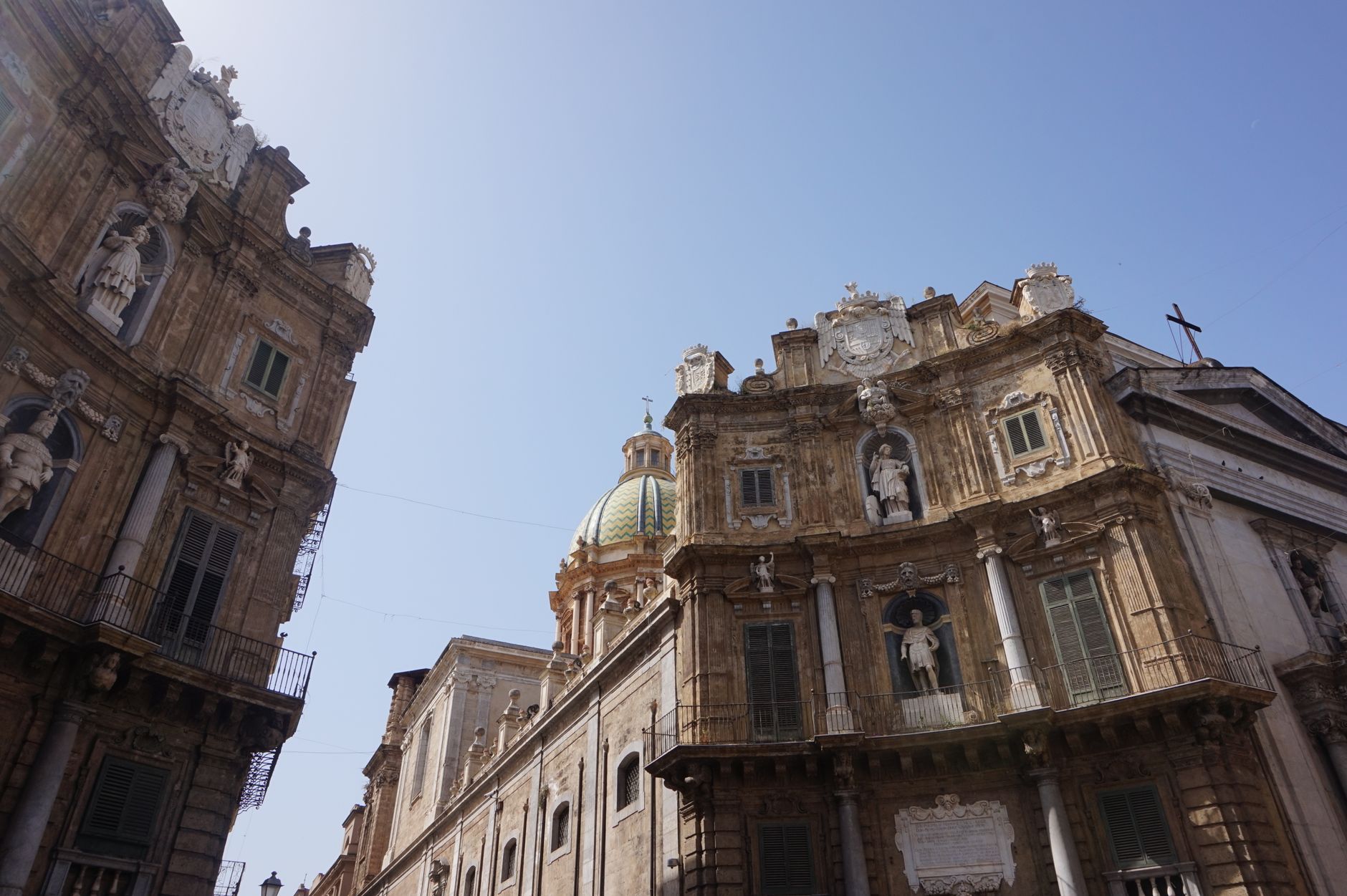
From the Palazzo, walk east to Quattro Canti — the octagonal Baroque piazza at the intersection of Via Maqueda and Corso Vittorio Emanuele, with four sculpted corner façades representing the seasons and the city's patron saints. Think of it as Palermo's navigational center rather than a destination in itself. Every direction in the historic core runs relative to this crossroads. Each façade stacks a fountain, a Spanish king, and a patron saint in tiers — four-way symmetry that took two decades to build. It reads best in morning light before the foot traffic fills the intersection.
Walk south from Quattro Canti into the Kalsa neighborhood — Palermo's oldest Arab-era quarter, now a slower mix of faded Baroque churches, small piazzas, and the seafront promenade at the Foro Italico. The 14th-century Palazzo Steri stands near the waterfront; its pointed arched windows gave Chiaramonte Gothic (a Sicilian regional variant of Gothic architecture, with Arabic-inflected geometric tracery) its name. The churches of Santa Teresa alla Kalsa and Santa Maria della Pietà are concentrated in a few blocks; most open mornings and late afternoons. Kalsa is where the pace drops. Allow an hour minimum and resist the urge to power through it.
Late afternoon, walk northwest to Teatro Massimo — Italy's largest opera house, the third largest in Europe, opened in 1897. The building fills its piazza in the Capo neighborhood with a Neoclassical facade you see from half a block away. Take the guided tour — 40 minutes — to see the red-and-gold auditorium, the royal box, and the stage from the boards up. The Godfather Part III filmed its finale on the front steps; worth a glance, but the auditorium is the reason to come.
Day 1 evening: the streets around Piazza Olivella, just north of the Quattro Canti axis, come alive between 6 and 8pm with the passeggiata — Palermitani moving slowly, stopping to talk, buying gelato. Eat in this neighborhood rather than on Via Maqueda or Corso Vittorio Emanuele, where restaurant staff solicit from the street and tourist pricing is the norm.
Quick reference — Day 1
- Cappella Palatina / Palazzo dei Normanni: ~€12–15 adults, chapel included in palace ticket. Opens approximately 8:30–9am (verify seasonally). Allow 1–1.5 hours. Arrive near opening. UNESCO WHC listing 1487, 2015.
- Quattro Canti: Free, outdoors. Best in morning light. ZTL zone — walkable.
- Kalsa neighborhood: Free to wander. Churches open mornings and late afternoons (hours vary). Allow 1 hour minimum.
- Teatro Massimo: Guided tour ~€8–17 depending on combo option (Italia.it, 2025; Viator/GetYourGuide, 2026); opera tickets from €15. Tours typically Tue–Sun 9:30am–5pm — verify at teatromassimo.it.
- Dinner area: Piazza Olivella and surroundings — skip the main tourist drags.
Day 2: Markets, street food, and Monte Pellegrino
Day 2 moves from monuments to the city's working face: Ballarò market in the morning, the two dishes that define Palermitan street food, and an afternoon at Monte Pellegrino above the city.
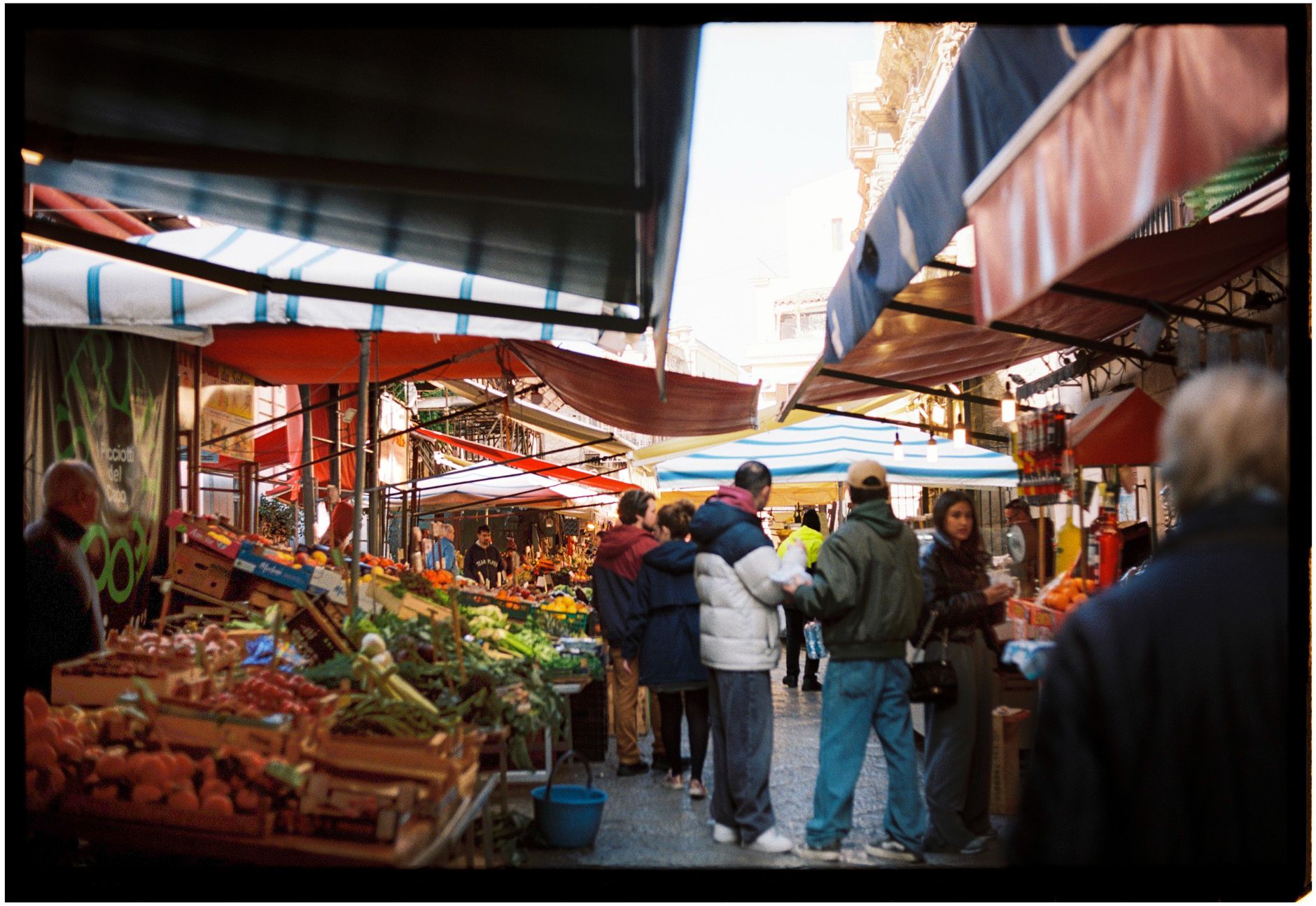
Arrive at Ballarò Market by 9am and plan to leave before noon. The market sprawls through the Albergheria neighborhood — stalls of produce, hanging dried peppers, seafood vendors calling prices in Sicilian dialect (a language with Arabic and Spanish roots, linguistically distinct from Italian, which you'll hear more clearly once you're listening for it). By 10am the market alley smells of fry oil and citrus together. Two things to eat here.
The first is arancina — Palermo's fried rice ball. It's called arancina here (feminine, round like a small orange), not arancino, which is the Catanian form and a point of genuine local feeling. At a market stall in Ballarò, a vendor works a deep fryer that's been going since before you arrived. Pull one from the tray while it's still hot enough to burn your fingers slightly. The ragù version is the standard; the cheese-and-peas version is for people who already understand what they're choosing. Eat it standing in the alley. That is the correct way to eat an arancina in Palermo.
The second is pani ca meusa (literally "bread with spleen") — veal spleen boiled, fried, and stuffed into a sesame roll. Order the married version, maritata: caciocavallo cheese melted over the spleen before the roll closes. The meusaro (spleen vendor) at a Ballarò stall wraps it in paper and hands it over without ceremony. It costs around €2.50 and tastes unlike anything in the rest of Italian cuisine — funky, rich, deeply specific to this city and its particular history of using every part of the animal because for a long time you had to.
After Ballarò, take the afternoon to Monte Pellegrino — the limestone promontory rising 600m above the city's northwest. Bus 812 from Piazza Politeama runs roughly every 30 minutes and takes about 25 minutes to reach the top. Walk into the Santuario di Santa Rosalia. The shrine is literally carved into the cliff face: water trickles through the stone walls, silver ex-votos and photographs cover every surface, candles burn in clusters. This is where Palermitani come when they need to. Santa Rosalia is the city's patron saint — credited with ending the plague of 1624, honored every July with Sicily's largest annual festival, the Festino di Santa Rosalia. The sanctuary's atmosphere is one of genuine ongoing devotion: people arrive, light candles, say something quietly, leave. After the gold splendor of the Palatine Chapel yesterday, this carved cave in the rock is the other end of the city's spiritual register — stripped of ornament, entirely human. After, walk out to the Belvedere and look south over the Conca d'Oro (the Golden Shell plain, the agricultural basin that surrounds Palermo) to the city's rooftops and Mondello bay.
Optional late afternoon: Viale della Libertà, Palermo's northern boulevard, lined with art nouveau buildings and boutiques, leads to the Piersanti Mattarella Park — 15 acres of old trees and quiet paths, the composed, un-chaotic face of a city that earns its chaos in other neighborhoods. Worth 45 minutes if you want to decompress before dinner.
Day 2 evening: Vucciria (the market district near Piazza Caracciolo) is worth knowing about accurately. During the day it is nearly empty — sparse stalls, graffiti-covered shutters, not the working market it once was. After 9pm it transforms into a loud outdoor drinking scene: young, drinks-focused, genuinely chaotic. If that sounds like your evening, go. If it doesn't, skip it (DoEatBetterExperience.com, 2026; WeArePalermo.com, 2025).
Quick reference — Day 2
- Ballarò Market: Free to browse. Most active before noon. Street food €1.50–€5. Watch crossbody bags — pickpockets are active here (DoEatBetterExperience.com, 2026).
- Arancina: €2–3.50 at market stalls. Available from early morning.
- Pani ca meusa: ~€2.50 at meusaro stalls in Ballarò. Open approximately 11am–3pm (AuthenticFoodQuest.com, 2026).
- Monte Pellegrino (bus 812): From Piazza Politeama, €1.40 AMAT ticket (contactless accepted), ~25 minutes. Santuario di Santa Rosalia: free, open daily. Allow 2–3 hours total including transit.
- Vucciria at night: After 9pm only. Drinks-focused outdoor scene — not a food market at any hour (WeArePalermo.com, 2025).
Day 3: Monreale, then pointing south
Day 3 takes the Arab-Norman synthesis to its final, largest expression — Monreale Cathedral, where the same civilization that built the Palatine Chapel produced its grandest statement — then returns to Palermo for lunch and sets up the afternoon drive south.
Go to Monreale early. Bus 389 runs from Piazza dell'Indipendenza in Palermo every 30 minutes or so; the ride is about 30 minutes and costs €1.40 each way. Entry to the cathedral is approximately €4–5 adults. Allow 1.5–2 hours inside.
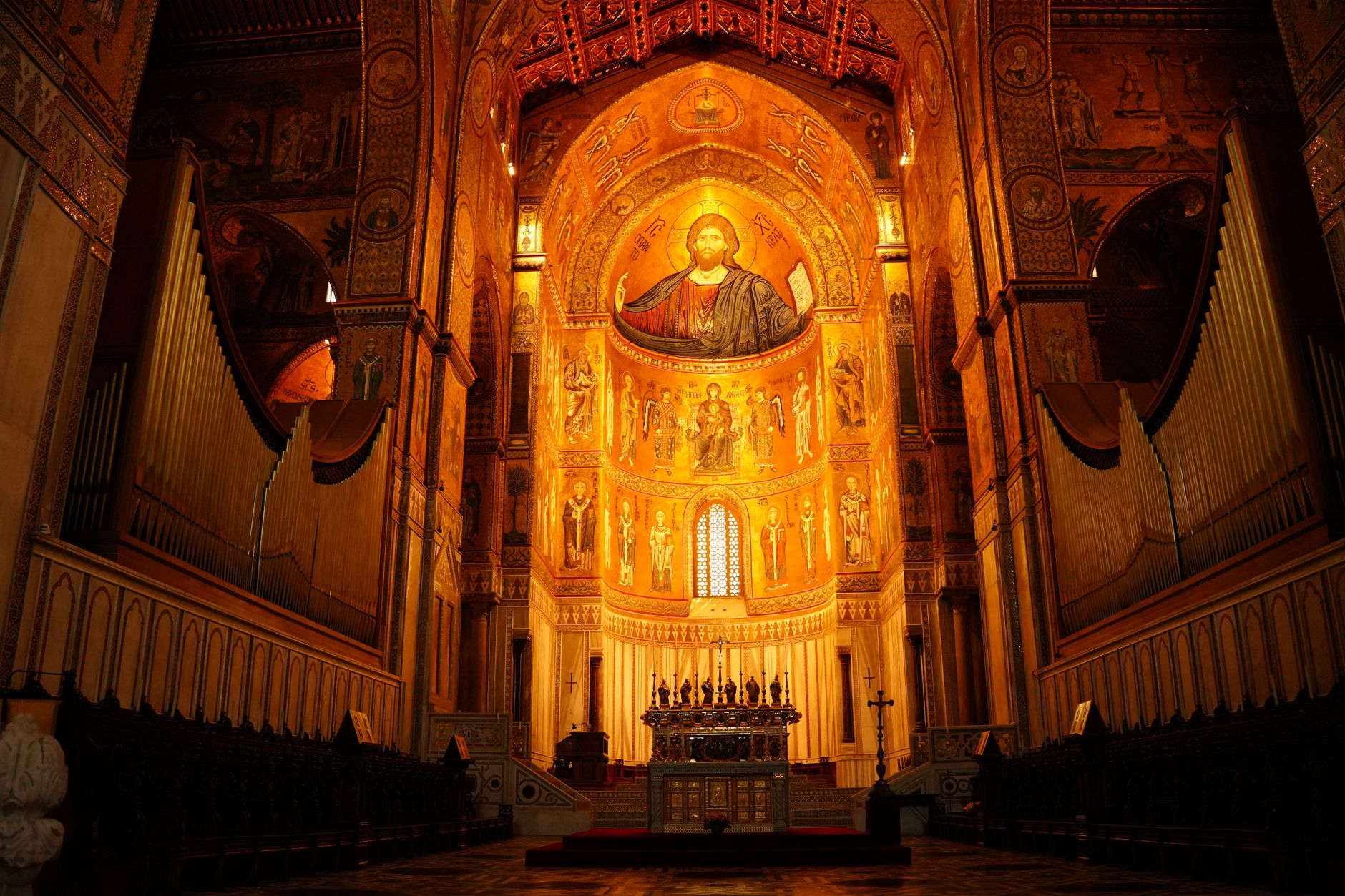
Walk slowly down the nave. The Palatine Chapel gave you the jewel-box version of the Arab-Norman synthesis — a room you could cross in thirty steps, every inch of it covered. Monreale gives you the spatial sweep. Six thousand three hundred and forty square meters of Byzantine gold mosaics line the walls and vault: the Old Testament along the nave, the New Testament filling the transept and choir, the Christ Pantocrator dominating the apse above everything. Adam and Eve, Noah, the binding of Isaac — the full procession unfolds as you walk. The same craftsmen's tradition produced both buildings, under the same Norman kings, within a generation of each other. The Palatine Chapel is the synthesis at its most concentrated; Monreale is the civilization making its most ambitious bid. Forty years later, that world was gone. What remains is the largest medieval mosaic program in existence.
Return to Palermo by midday. Lunch in the city, then pick up the rental car in the afternoon.
Quick reference — Day 3
- Bus 389 to Monreale: From Piazza dell'Indipendenza, approximately every 30 minutes, €1.40 each way. Journey ~30 minutes.
- Monreale Cathedral: Entry ~€4–5 adults. UNESCO WHC listing 1487, 2015. Open mornings; verify current hours before going. Allow 1.5–2 hours (Rome2Rio, 2026).
- Timing: Take an early bus to beat mid-morning tour groups.
Onward: the drive south to Agrigento
The western Sicily circuit leaves Palermo heading south — through Segesta, down to Agrigento, east through Ragusa and Syracuse to Catania — and a rental car from Palermo Airport is what lets you run the whole route without backtracking. Fly into PMO, drive south through Segesta to Agrigento, continue east through Ragusa and Syracuse, exit via Catania (CTA) — one direction, no retracing.
Rental cars are available from Palermo Falcone Borsellino Airport through all major operators. Don't drive into the historic center during your three days in Palermo. The ZTL zone (Zona a Traffico Limitato — pedestrian-restricted area) carries real fines for unauthorized entry, streets in the core are narrow and often blocked, and there is essentially no parking. Pick the car up on Day 3 afternoon when you're ready to leave.
Segesta sits on the A29 autostrada toward Agrigento, approximately 70km southwest of Palermo — about 45 minutes by car. The site is a 5th-century BC Greek temple on a hilltop, one of the best-preserved Doric temples in the world: the columns stand complete, the countryside around it is open and undeveloped, and there are no souvenir stalls at the gate. The adjacent amphitheater hosts seasonal performances. Allow 1–1.5 hours, then continue south. This is what the no-backtracking circuit earns you: a place that would take most of a day to visit independently becomes a stop on the way out. Entry approximately €8–10 adults (TourOfSicily.com, 2025).
Agrigento and the Valley of the Temples is about 130km southeast of Palermo, roughly 2 hours by car from the Segesta turnoff. The Valley of the Temples — a UNESCO site, one of the finest collections of ancient Greek architecture outside Greece — is where you spend your first night south of Palermo. Arrive in late afternoon for the temples in golden light; you'll have them again in the morning before tour groups arrive.
If you're not driving: Cuffaro buses run from Palermo's bus terminal to Agrigento every four hours (€11–14, 2 hours). Trenitalia regional trains run every two hours from Palermo Centrale to Agrigento Centrale (€10–15, approximately 2h03m — Rome2Rio, Omio, June 2026). Note: Agrigento station is not near the Valley of the Temples; add €5–10 and about 15 minutes for a taxi or local bus from Agrigento Bassa.
Practical notes
Palermo's historic core runs from Quattro Canti to Teatro Massimo to the cathedral — walkable in 25 minutes and inside the ZTL pedestrian zone, so there is no reason to drive in it. For wider city travel, AMAT buses (90 routes) and trams (4 lines, more reliable than buses) cost €1.40 per trip, valid 90 minutes, with contactless payment accepted on both (AMAT Palermo / tour.palermo.it, 2026). Bus 812 from Piazza Politeama to Monte Pellegrino is the route you'll use most.
Money and tipping. Italy is not a high-tipping culture. Check your bill at sit-down restaurants for a coperto (cover charge, €1–3) or servizio (service charge, 10–15%). If either appears, additional tipping is not expected. Without either, rounding up or leaving €2–5 is appreciated. At cafés, small change from a coffee is the counter norm. Markets and street food stalls are predominantly cash — carry small bills. Taxis in Palermo have a reputation for overcharging tourists; agree on or verify the metered fare before you get in (TravelSafe-Abroad, 2026).
Safety. Keep crossbody bags closed and phones pocketed at Ballarò, Capo, and Vucciria markets and on crowded buses. Scippatori (bag snatchers on scooters) operate near isolated side streets, particularly around bus stops — keep bags on your sidewalk-facing side. The main tourist drags on Via Maqueda and Corso Vittorio Emanuele have a high concentration of restaurants that aggressively solicit from the street and price accordingly; avoid them for sit-down meals. The ZTL historic core is well-lit and well-trafficked at night.
Outside the tourist core. Palermo's restored historic center is well-maintained. Step a few blocks outside it and the picture changes — irregular rubbish collection, broken footpaths, and abandoned furniture on some residential streets are real and ongoing (LearnItalianWithLarry.com, March 2026). This itinerary stays within the historic core and its immediate surroundings, so it won't affect your three days; worth knowing in advance so the contrast doesn't catch you off-guard.
Best time to visit. April–June and September–October are the considered windows: mild temperatures (18–24°C), manageable crowds, and the best conditions for outdoor sites (ThetopVillas, 2025; WhenToVisit, 2025). July–August is hot (30–38°C or higher), crowded, and expensive. The Festino di Santa Rosalia (Palermo's largest annual celebration, July 14–15) brings enormous crowds to the city center; if you're there for it, it's genuinely memorable — if you're not prepared for it, it will be overwhelming. Mondello beach (Palermo's seaside suburb) is only worthwhile outside July–August; in peak season it becomes overwhelmed and the infrastructure around it degrades.
Entry requirements for US travelers. US passport holders enter Italy visa-free for stays up to 90 days within any 180-day period under Schengen rules (US State Department, 2025). Passport must be valid at least 3 months beyond your planned departure date. As of October 2025, US citizens entering the Schengen area have fingerprints and facial images captured at border entry under the EU's Entry/Exit System (EES) biometric program (US Embassy Italy, 2025). ETIAS — the European Travel Information and Authorization System — is expected to launch in Q4 2026: €20 fee, valid 3 years, travelers under 18 and over 70 exempt from the fee. ETIAS is not yet in force as of publication — check the official ETIAS website before booking, as the launch timeline may shift.
Language. Italian is the working language. English is reliably spoken at major attraction ticket offices, hotels, and restaurants on the main tourist routes. In markets and neighborhood contexts, a few phrases go a long way: per favore (please), grazie (thank you), quant'è? (how much?), il conto, per favore (the bill, please). In the markets you'll also hear Sicilian dialect — a distinct language with Arabic, Norman French, and Spanish roots, audibly different from standard Italian. You don't need to understand it. It's a useful reminder that you're somewhere with a more layered history than most of the places that call themselves ancient.
Planning Sicily? Two more guides worth a look: the best day trips from Palermo and Catania vs Palermo: which gateway.
Frequently asked questions
Is 3 days enough time to see Palermo?
Three days covers the essential arc: Day 1 for the Arab-Norman monument sequence (Cappella Palatina, Quattro Canti, Kalsa, Teatro Massimo), Day 2 for Ballarò market, street food, and Monte Pellegrino, Day 3 for a morning at Monreale Cathedral before heading south toward Agrigento. It won't cover everything — the city rewards longer stays — but three days is enough to understand what makes Palermo worth the trip.
What is the Arab-Norman heritage in Palermo, and why does it matter?
Between the 9th and 12th centuries, Palermo was ruled by Arab emirs, then Norman kings, whose court brought in Byzantine craftsmen. The artistic synthesis that resulted was unlike anything else in Europe. Nine structures share a single UNESCO World Heritage designation (2015): the Cappella Palatina, La Martorana, the Palazzo della Zisa, and Monreale Cathedral among them. The gold mosaic interior of the Palatine Chapel is the concentrated expression of all three traditions working in one room.
What should I eat in Palermo — and where do I find it?
Start with arancina (Palermo's fried rice ball — feminine, round, distinct from Catania's arancino) at Ballarò market. Then try pani ca meusa (spleen sandwich, best in the married version with caciocavallo cheese melted over it) from a market stall for around €2.50. Both are available from morning through early afternoon for under €5. Skip the sit-down restaurants on Via Maqueda and Corso Vittorio Emanuele — they solicit from the street and price accordingly.
Do I need a car to explore western Sicily from Palermo?
For Palermo itself, no — the historic core is walkable and sits inside a ZTL (Zona a Traffico Limitato — a pedestrian-restricted zone), so driving in is both impractical and ticketable. For the wider circuit — Segesta, Agrigento, onward toward Ragusa — a rental car from Palermo Airport is the right choice. It lets you stop at Segesta on the drive south without backtracking, and reach Agrigento's Valley of the Temples without depending on infrequent buses.
How do I get from Palermo to Agrigento and the Valley of the Temples?
By car: around 2 hours via the A19, with an optional stop at Segesta en route. By bus: the Cuffaro service runs from Palermo's bus terminal roughly every four hours (€11–14, 2 hours). By train: Trenitalia regional runs every two hours from Palermo Centrale (€10–15, approximately 2h03m). Agrigento station is not near the Valley of the Temples — add a taxi or local bus from Agrigento Bassa, around €5–10 and 15 minutes (Rome2Rio, Omio, June 2026).
Is Palermo safe for tourists?
Palermo's primary concern is petty theft, not violent crime — broadly comparable to Rome or Naples. Pickpockets are active at Ballarò, Capo, and Vucciria markets and on crowded buses. Scippatori (bag snatchers on scooters) operate near isolated side streets — keep bags on your sidewalk-facing side. Restaurant overcharging concentrates on Via Maqueda and Corso Vittorio Emanuele. The Mafia-danger narrative is mostly decades-old folklore; organized crime in Sicily operates in business and construction, not tourist spaces (TravelSafe-Abroad, 2026).
What is ETIAS and do I need it to visit Sicily?
ETIAS — the European Travel Information and Authorization System — is expected to launch in Q4 2026. Once active, US travelers will need an online authorization before visiting: €20 fee, valid 3 years, covering 30 European countries. Travelers under 18 and over 70 are exempt from the fee. A 6-month grace period follows launch. ETIAS is not yet in force as of publication — check the official ETIAS website before booking, as the timeline may shift (EEAS, 2025; etias.com, 2026).