
Catania vs. Palermo: Which Sicily Gateway Fits Your Trip?
Sicily has two international airports, and the one you choose is the opening decision that shapes every other day of your trip. Fly into Catania (CTA) and you land on the eastern side of the island — close to Etna, Taormina, and Syracuse, the three-node circuit most first-time visitors build their trip around. Fly into Palermo (PMO) and you land in the west: Arab-Norman monuments that have no equivalent in Europe, the Valley of the Temples at Agrigento, the Greek ruins at Segesta. Neither is the wrong gateway. They serve different trips.
The Catania vs Palermo choice maps cleanly to geography: what each airport unlocks, how connectivity and city-center access compare, and what the fare picture actually shows. At the end is a concrete recommendation keyed to your itinerary. If you have 7 or more days, there is a third option: an open-jaw ticket — flying into one airport and home from another, so you don't retrace your ground. It eliminates the long cross-island backtrack.
Catania (CTA): the eastern gateway
Catania is Sicily's busiest airport and the sharper entry point for the island's eastern corridor — Etna, Taormina, and Syracuse are all train-accessible from the city center, no rental car required, with multiple departures per day.
The airport's formal name — Catania–Fontanarossa "Vincenzo Bellini" Airport — signals how thoroughly Bellini's presence runs through this city. Vincenzo Bellini (1801–1835), the bel canto (lyric opera, literally "beautiful singing") composer of Norma and La Sonnambula, was born here. His name is on the airport, the opera house, the city's main public garden, and the city's signature dish. Sit down at a trattoria near the fish market and order pasta alla Norma — rigatoni with tomato sauce, fried eggplant, and grated ricotta salata, named for Bellini's most celebrated opera. It is a dish that belongs to this city in a way it belongs nowhere else. Eat it in Catania and it lands differently. Eat it in Palermo and it is just pasta.
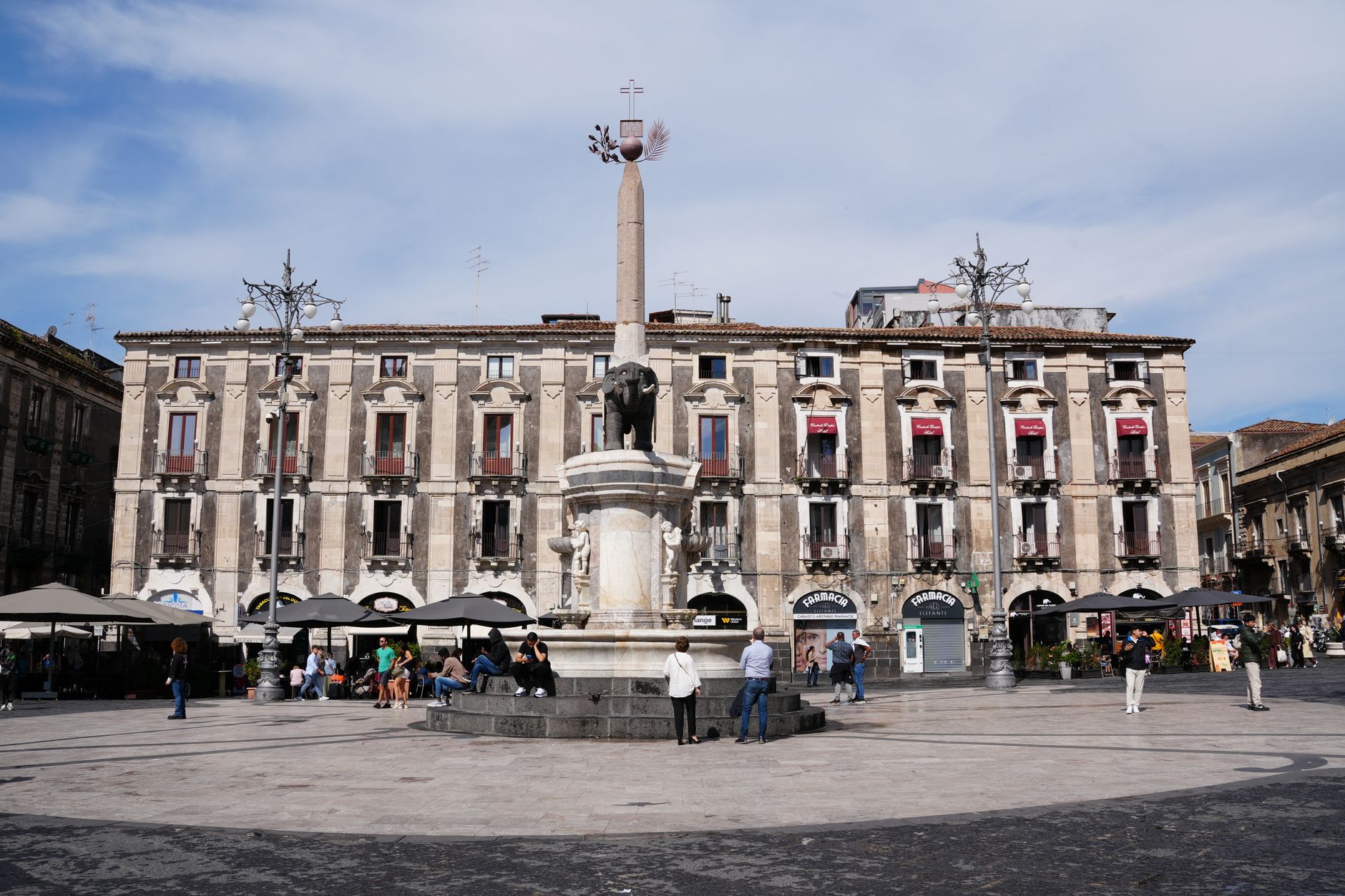
The city anchors around Piazza del Duomo and the Fontana dell'Elefante — the city's emblem, a Roman-era elephant carved from Etna's black lava, set on a Baroque pedestal and ringed by palazzi built after the 1693 earthquake. Both are part of the Val di Noto UNESCO World Heritage Site. Arrive before 9 AM. The adjacent Pescheria (La Piscaria) is Catania's morning fish market — sardines, octopus, swordfish, vendors calling prices in Sicilian dialect while buyers push in from every direction. It operates in the sunken square next door from roughly 7 AM until midday. A vendor in white rubber boots drags a whole swordfish across the marble slab, flips it, calls a price nobody else can quite hear. Missing it — arriving after 11 AM when the stalls are half-dismantled — is the most frequently cited regret of first-time Catania visitors. Plan accordingly.
The rice ball at the frittola cart outside is called arancino here — cone-shaped, masculine, Catanian. In Palermo it is round, feminine, and called arancina. The difference is not a spelling curiosity; it is the island in miniature.
What Catania unlocks geographically
| Destination | Transport | Journey time | Approx. one-way fare |
|---|---|---|---|
| Taormina | Trenitalia regional | 36–51 min | From €6.67 (TheTrainline.com, 2026) |
| Syracuse (Siracusa) | Trenitalia regional | ~1h 15min | ~€8.95–10 (TheTrainline.com, 2026) |
| Noto (from Syracuse) | Trenitalia | ~30–40 min | ~€5.82–5.86 (TheTrainline.com, 2026) |
| Etna / Rifugio Sapienza | AST public bus | ~90 min | ~€3–4 each way (AST Sicilia) |
| Etna (guided tour) | Tour operator | Day trip | From ~€60/person (GetYourGuide, 2026) |
| Palermo | Trenitalia intercity | ~3–4h | From ~€21 (TheTrainline.com, 2026) |
Quick reference — CTA
- Airport: 97 non-stop destinations, 46 airlines, ~3,948 departures per month (AirportInformation.com, June 2026)
- Airport to center: Alibus €4, 20–28 min; free metro shuttle to station, then €1 metro ticket
- Fare context: recent search lows ~$218–$464 one-way from New York area; ~$308 recent KAYAK low (KAYAK, June 2026)
- Rail caveat: Storm Harry (January 2026) damaged the Messina–Syracuse line; Giardini-Taormina to Messina section suspended at time of research — verify current status at trenitalia.com before booking train legs to Taormina or Syracuse (TrasportoEuropa, 2026)
Palermo (PMO): the western gateway
Palermo is the right entry point for western Sicily — the Arab-Norman monuments, Agrigento's Valley of the Temples, Segesta, and Cefalù are all within reach, and the city warrants two to three days before you leave the center.
PMO's defining draw is Arab-Norman heritage — a style that emerged in 12th-century Sicily when the Norman kings drew simultaneously on Byzantine, Arab, and Latin craftsmen. The Cappella Palatina, Monreale Cathedral, and several Palermo churches were collectively designated a UNESCO World Heritage Site in 2015 — nine structures in all, listed as "Arab-Norman Palermo and the Cathedral Churches of Cefalù and Monreale." Nothing like this synthesis exists anywhere else in Europe.
The most concentrated expression is inside the Cappella Palatina — every surface of the royal chapel covered in gold mosaic tesserae, the vault and apse alive with Byzantine-Arab-Norman synthesis — mosaics commissioned under Roger II from 1132 and continued under his successors through the 1140s–1170s. A meusaro (spleen-sandwich vendor — a distinct professional class in Palermo's food culture) works a stall in Ballarò market a ten-minute walk away. Palermo has its own food identity, as specific to this city as pasta alla Norma is to Catania. Pani ca meusa is veal spleen, boiled and fried, stuffed into a sesame roll — served plain with lemon or married with a sliver of caciocavallo cheese. It is Palermo's most specific street food. A meusaro will prepare it in front of you for about €2.50. Order the married version (maritata — with the caciocavallo) and eat it standing at the stall. It is cheap, fast, and unlike anything in standard Italian tourism.
Palermo's rice ball is round, called arancina (feminine, like the orange it resembles). In Catania it is cone-shaped and called arancino (masculine). The debate between the two cities over which is correct is genuine, local, and contested — both claim historical precedence, neither will concede.
What Palermo unlocks geographically
| Destination | Transport | Journey time | Approx. one-way fare |
|---|---|---|---|
| Monreale Cathedral | Bus 389 from Piazza dell'Indipendenza | ~30 min | €1.40 (Rome2Rio, 2026); entry ~€4–5 |
| Agrigento / Valley of Temples | Cuffaro bus or Trenitalia | ~2h | ~€10–14 (Rome2Rio, Omio, June 2026) |
| Segesta | Car (~1.5h) or train to Calatafimi-Segesta + taxi | ~1.5–2h | Entry ~€8–10 (TourOfSicily.com, 2025) |
| Cefalù | Trenitalia regional | ~1h | ~€5–8 one-way |
| Catania | Trenitalia intercity | ~3–4h | From ~€21 |
Quick reference — PMO
- Airport: strong intra-European coverage (Ryanair, Vueling); fewer total routes than CTA; airport 35km from city center
- Airport to center: Prestia e Comandè bus €6.50, ~50 min; Trinacria Express train €6.90, 45–55 min (Palermo Airport official, 2026)
- Fare context: recent search lows ~$331–$498 one-way from JFK/EWR; ~$699 round-trip low seen in recent searches (Expedia, Momondo, June 2026)
- Infrastructure note: Palermo outside the ZTL (Zona a Traffico Limitato — pedestrian-priority zone) is visibly uneven in sanitation and road maintenance; the tourist core is well-maintained, the blocks immediately beyond it often are not (LearnItalianWithLarry.com, March 2026)
- Cappella Palatina: mosaics commissioned under Roger II from 1132, continued under his successors through the 1140s–1170s (Smarthistory; Wikipedia, Cappella Palatina)

The direct comparison
CTA and PMO differ on five axes that actually matter for a Sicily trip: airport connectivity, city-center distance, geographic reach, the fare picture, and whether you need a rental car.
| Catania (CTA) | Palermo (PMO) | |
|---|---|---|
| Airport connectivity | Sicily's busiest: 97 non-stops, 46 airlines (AirportInformation.com, June 2026) | Strong intra-EU coverage; fewer total routes |
| Airport to city center | 4 km; €4 Alibus, 20–28 min (CataniaGuide.com, 2026) | 35 km; €6.50 bus or €6.90 train, 45–55 min (Palermo Airport, 2026) |
| Eastern circuit | Catania → Taormina → Syracuse → Noto, all by Trenitalia | Long cross-island transit required |
| Western circuit | Long cross-island transit required | Palermo → Monreale → Agrigento → Segesta → Cefalù |
| Fare snapshot (US origin) | From ~$218–$464 one-way JFK/EWR, recent low ~$308 (KAYAK, June 2026) | From ~$331–$498 one-way JFK/EWR (Expedia/Momondo, June 2026) |
| Rental car needed? | No — eastern circuit works entirely by Trenitalia | Segesta requires a car or guided day tour; Agrigento and Monreale doable without |
On the fare picture: On many aggregator snapshots in June 2026, CTA averaged lower from US origins. Use the gap as a tiebreaker — it is real in some windows but corridor- and season-dependent, narrowing in peak summer. The geographic argument is more durable.
Fare data: BudgetYourTrip's June 2026 comparison showed average airfare to CTA at approximately $464 vs. PMO at approximately $665 (BudgetYourTrip, 2026). Both are aggregator-average figures from recent searches — not what is bookable right now.
What we recommend
The right Sicily airport is determined by your itinerary, not the fare chart — fly into the airport closest to where you actually want to spend your first two days.
Fly into Catania (CTA) if your trip centers on Etna, Taormina, and Syracuse. All three are train-accessible from Catania Centrale — no rental car required. You can eat pasta alla Norma in the Pescheria district on arrival night, take the 8:15 AM AST bus up to Etna the next morning, and still have time for Taormina before dinner. This is the right structure for a 4–6 day eastern Sicily itinerary, and it takes advantage of CTA's pricing edge in most booking windows. One caveat before you book train legs: verify Trenitalia's current status at trenitalia.com. The Messina–Syracuse line disruption from Storm Harry (January 2026) was unresolved at the time of this research, and replacement bus service adds journey time.
Fly into Palermo (PMO) if your itinerary centers on Arab-Norman Palermo, Agrigento's Valley of the Temples, Segesta, and Cefalù. PMO puts you at the right end of the island for all four. Arrive in the morning, find a meusaro in Ballarò for a pani ca meusa at lunch, and spend the afternoon inside the Cappella Palatina. By sunset you will have understood something about Palermo that two days in Catania would not give you. Budget a rental car for Segesta if you want to visit independently. The case for PMO is geography, not the fare chart.
Book an open jaw if you have 7 or more days and want to see both halves of the island. Fly into Catania, travel west through Taormina, Syracuse, Ragusa, and Agrigento, then exit from Palermo. This eliminates the long cross-island backtrack — the CTA-in/PMO-out direction is the routing experienced Sicily travelers consistently recommend. Open-jaw bookings are not automatically more expensive than a round-trip to one airport; search both structures before committing. For a full explanation of how open-jaw tickets work and when they save money, see our planned guide to open-jaw flying.
Wherever you enter, let your itinerary make the gateway decision. The arancino/arancina debate — one city making its rice balls cone-shaped, the other round, and neither willing to call the other correct — is a useful reminder that Sicily's east and west are genuinely distinct. So are the airports. Pick the one that puts you where your trip actually starts.
Practical notes
Both airports connect their terminals to city centers by public bus or train for under €7, both historic cores are compact enough to navigate on foot, and the logistical differences between CTA and PMO are smaller than the geographic ones. The details below apply whether you are flying into CTA, PMO, or both.
Getting to city centers.
- CTA: Alibus to Piazza Stesicoro, €4, 20–28 minutes, running every 20–25 minutes (CataniaGuide.com, 2026). A free metro shuttle also runs from the terminal to the Aeroporto Fontanarossa metro station every 15–20 minutes; a metro ticket costs €1 and is valid 90 minutes.
- PMO: Prestia e Comandè bus, €6.50, approximately 50 minutes, running to Palermo Centrale and Via Libertà. Trinacria Express train, €6.90, 45–55 minutes, departing from approximately 5:45 AM to 10 PM (Palermo Airport official, 2026).
Getting around.
- Catania: The historic center is compact and walkable — Piazza del Duomo to Castello Ursino to Villa Bellini to Piazza Stesicoro are all within a 20-minute walk. For day trips: Trenitalia from Catania Centrale for Taormina and Syracuse; AST public bus from Piazza Papa Giovanni XXIII for Etna (8:15 AM departure). Rental cars are well-stocked at CTA for travelers doing the island circuit.
- Palermo: The historic core (Quattro Canti to Teatro Massimo) is walkable in about 25 minutes and sits inside the ZTL, making it straightforwardly pedestrian. AMAT buses and trams run city-wide at €1.40 per trip, 90-minute validity, with contactless payment accepted (AMAT Palermo, 2026). Bus 812 from Piazza Politeama reaches Monte Pellegrino in 25 minutes. A rental car is useful for Segesta.
Money and tipping. Tipping is not strongly expected in Sicily. Check the bill for a coperto (cover charge, typically €1–2 per person for bread and table service — not a tip) or a servizio charge. If neither appears, rounding up or leaving €2–3 is appreciated. Markets and street food stalls are predominantly cash-only; carry €20–30 for the Pescheria in Catania or Ballarò in Palermo (ExpatFocus.com; RoadTripEuroGuide.com, 2025).
Best time to visit. April–June and September–October are the most-cited optimal windows for both cities — comfortable temperatures, manageable crowds, the sea accessible through early October (Weather2Travel.com; ClimatestoTravel.com, 2026). July–August brings peak heat (high 30s°C), severely crowded conditions at Taormina, and peak accommodation prices. Catania's Festa di Sant'Agata (February 3–5) draws up to one million visitors and requires months-ahead accommodation booking. Palermo's Festino di Santa Rosalia — the annual celebration honoring the patron saint credited with ending Palermo's 1624 plague — runs July 10–15, with main processions July 14–15.
ETIAS. The European Travel Information and Authorization System is expected to launch Q4 2026. Once active, US passport holders will need an ETIAS authorization before travel — €20 fee, valid 3 years, covering 30 European countries; exempt under 18 and over 70; 6-month grace period follows launch. ETIAS is not a visa — it is an electronic pre-screening similar to the US ESTA (EEAS, 2025; ETIAS.com, 2026). Verify ETIAS launch status before booking if this post is published after the expected Q4 2026 launch date.
Safety. Petty theft — pickpockets at markets, bag snatchers near busy stops — is the primary concern in both cities. At Catania's Pescheria, keep bags closed and wallets in front pockets. In Palermo, use crossbody bags at Ballarò and Capo; agree on or verify the metered taxi fare before departure. Serious crime against tourists is not the relevant risk in either city (ItiMaker.com, 2026; TravelSafe-Abroad, 2026).
Planning Sicily? Two more guides worth a look: 3 days in Catania and 3 days in Palermo.
Frequently asked questions
Is Catania or Palermo cheaper to fly into from the US?
On many aggregator snapshots, Catania (CTA) runs lower — around $308–$464 one-way from New York area airports in recent June 2026 searches, vs. approximately $331–$498 for Palermo (PMO) from the same markets. The gap narrows in peak summer and shifts by booking window. Use fare difference as a tiebreaker; the geographic argument — which airport puts you at the right end of the island — is more reliable for making this decision.
Which Sicily airport is closer to Taormina and Mount Etna?
Catania (CTA) is the right airport for both. Taormina is 36–51 minutes by Trenitalia regional train from Catania Centrale (from €6.67 one-way, up to 30 departures per day). The AST public bus to Etna's Rifugio Sapienza departs Catania at 8:15 AM daily for around €3–4 each way. No other Sicilian airport comes close to either destination in time or cost.
Which airport should I use for Agrigento and Segesta?
Fly into Palermo (PMO) for both. Agrigento is about 2 hours by bus (Cuffaro) or train from Palermo Centrale, around €10–14 each way. Segesta is roughly 1.5 hours by car from Palermo, or reachable by train to Calatafimi-Segesta plus a short taxi. From Catania, both require crossing the island — adding a half-day of transit each way.
Can I fly into one Sicily airport and out of the other?
Yes — this is an open-jaw ticket (flying into one city and home from another, so you don't retrace ground). For trips of 7 or more days, it is the most efficient structure for a full Sicily circuit. The CTA-in/PMO-out direction — entering in the east and moving west — is what most experienced Sicily travelers recommend. Open-jaw bookings are not inherently more expensive than a round-trip to one airport.
How far is it from Catania to Palermo, and should I base in one city?
Catania to Palermo is roughly 3–4 hours by Trenitalia intercity train (from about €21 one-way) or somewhat faster by car. For a trip under 7 days, picking one airport and basing nearby is more efficient than crossing the island mid-trip. For 7 or more days, using an open-jaw routing — fly CTA in, PMO out — makes the island circuit work without a long backtrack.
What is the best airport for a first-time Sicily trip?
It depends on what you want to see. For Etna, Taormina, and Syracuse, Catania is the right choice — no car needed, all three are train-accessible. For Arab-Norman Palermo, Agrigento, and Segesta, Palermo is right. If it is your first Sicily trip and you have 7 or more days, the open-jaw routing — fly into one airport, home from the other — is what most experienced Sicily travelers recommend.
Is Palermo worth visiting on the way to eastern Sicily?
Yes — Palermo earns 2–3 days even if your main targets are Taormina, Etna, or Syracuse. The Arab-Norman monuments (Cappella Palatina, Monreale Cathedral), Ballarò market, and the city's specific street food are not detours; they are a distinct half of what Sicily is. The practical routing: fly into PMO, spend 2 days in Palermo, then take the Trenitalia intercity to Catania for the east. It adds transit but removes the end-of-trip backtrack.