
5 Days in Eastern Sicily: Etna, Taormina, Ortigia
Catania is where you land for eastern Sicily. The airport bears the name of Vincenzo Bellini — the bel canto composer born here in 1801, whose name also runs through the opera house down the road, the city's main public garden, and its signature pasta. From CTA, Trenitalia regional trains connect every major stop on the eastern circuit: Etna to the northwest, Taormina 50 minutes up the coast, Syracuse an hour south. This is the 5 days in Sicily structure that earns all three without a rental car and without retracing a single leg. Two nights in Catania, two nights in Taormina, a day trip to Syracuse on Day 5, and a final night back in Catania before your flight. Three nodes. One airport. No car.
Why Catania as the gateway for eastern Sicily
Catania's airport (CTA) is the right opening move for eastern Sicily because the three things most travelers come here for — Etna, Taormina, and the Greek city of Syracuse — radiate outward from it along a single rail line. The five-day structure in this post covers all three without a car and without doubling back. CTA is Sicily's busiest airport: 97 non-stop destinations, 46 airlines, with Ryanair, Wizz Air, and easyJet covering the major European hubs (AirportInformation.com, June 2026). From US-origin aggregator search summaries, one-way fares from New York-area airports have ranged from around $218 to $464, with $308 appearing as a KAYAK search-summary low (KAYAK, June 2026).
These are aggregator figures from June 2026, not cached fares — actual prices depend on booking window and season. The geographic argument is more reliable than the fare one: Catania sits in the middle of Sicily's eastern coast, and the circuit flows naturally north to Taormina, south to Syracuse, and back, without crossing the island.
The Alibus from the terminal to Piazza Stesicoro takes 20–28 minutes and costs €4 — buy the ticket at the AMTS counter inside, not from individuals at the stop.
One honest caveat before you book: the Trenitalia Messina–Syracuse line took a serious hit from Storm Harry in January 2026. As of June 2026, the section between Giardini-Taormina and Messina remained suspended, with bus replacement running. The Catania–Taormina and Catania–Syracuse legs this circuit depends on had partial restoration, but the situation is live. Verify current status at Trenitalia.com before booking any leg. The bus alternatives (Interbus, Etna Trasporti) work and they cover the same routes — but you should know which you're booking before you leave home.

Day 1: Arrive, find the city's center, and settle in for the evening
Day 1 is an arrival day with no fixed anchors until mid-afternoon — flight variability makes anything earlier unreliable, so the shape is a slow walk inward from the Alibus stop through the historic center, ending on the aperitivo strip where the city actually spends its evenings. Overnight: Catania.
Walk south from Piazza Stesicoro. On the left, sunken behind iron railings, you'll pass the Anfiteatro Romano — Catania's Roman amphitheater, buried by centuries of eruptions and rebuilding until only a fraction of it remains accessible, visible from the street through the railings. It's worth noting for what it is (a second-century structure surfacing between the apartment blocks) but it's not an anchor; keep walking.
Piazza del Duomo opens wide, and at its center sits the thing that makes Catania's history immediately readable: the Fontana dell'Elefante, a Roman-era lava elephant — carved from Etna's black basalt — balancing an Egyptian obelisk on its back. The elephant predates the square by centuries; the piazza itself was rebuilt in golden Baroque stone after the catastrophic 1693 earthquake that flattened the city, and the historic ensemble was later inscribed as a UNESCO World Heritage Site. The contrast of the dark volcanic stone against the lighter cathedral facade is the city's visual signature. As the cathedral bells ring the hour, a granita vendor pushes a cart across the colonnade. Granita is Sicily's semi-frozen flavored drink — water, sugar, and fresh ingredients, usually almond or lemon — typically eaten with a spoon or spooned into a brioche bun.
The Cattedrale di Sant'Agata at the eastern edge of the square carries the same layering: its facade columns were salvaged from the Roman amphitheater you passed on the way in. Roman, Norman, and Baroque in a single elevation. The nave is free; the rooftop cupola and the Museo Diocesano beneath (where Roman bath remnants are accessible) are ticketed.
In the early evening, walk north to Piazza Vincenzo Bellini and the Teatro Massimo Bellini — the city's opera house, inaugurated in 1890, its ceiling frescoed with scenes from Bellini's major works including Norma. The building sits five minutes from Piazza del Duomo. It makes the geography of Catania legible: this is a city that names its airport, its garden, its pasta, and its main civic theater after one composer. If there's an evening performance, the foyer is worth the ticket. If not, the exterior is enough for now — you'll return to the Bellini thread on Day 3.
From the theater, the aperitivo strip on Via Landolina and Via Gemmellaro is a ten-minute walk. This is Catania's actual evening: university students and working residents, not tourists, at small outdoor bars from 19:00 onward, cocktails at €5–9 with small plates of snacks included. Pull up a stool, order something cold, and eat whatever arrives with the drinks. Arrive by 19:30 on weekdays to find a table.
Quick reference — Day 1
- Alibus (CTA → Piazza Stesicoro): €4. 20–28 min. Runs every 20–25 min. Buy at AMTS counter inside terminal — not from individuals at the stop. (CataniaGuide.com, 2026)
- Piazza del Duomo and Fontana dell'Elefante: Free, all hours. UNESCO World Heritage Site (UNESCO World Heritage Centre, 2002).
- Cattedrale di Sant'Agata: Nave free; cupola and Museo Diocesano ticketed — check locally. Modest dress required.
- Teatro Massimo Bellini: Check teatromassimobellini.it for guided tour and performance schedule.
- Via Landolina aperitivo: Bars from ~19:00; cocktails €5–9 with snacks. Arrive by 19:30 weekdays.
Day 2: Mount Etna
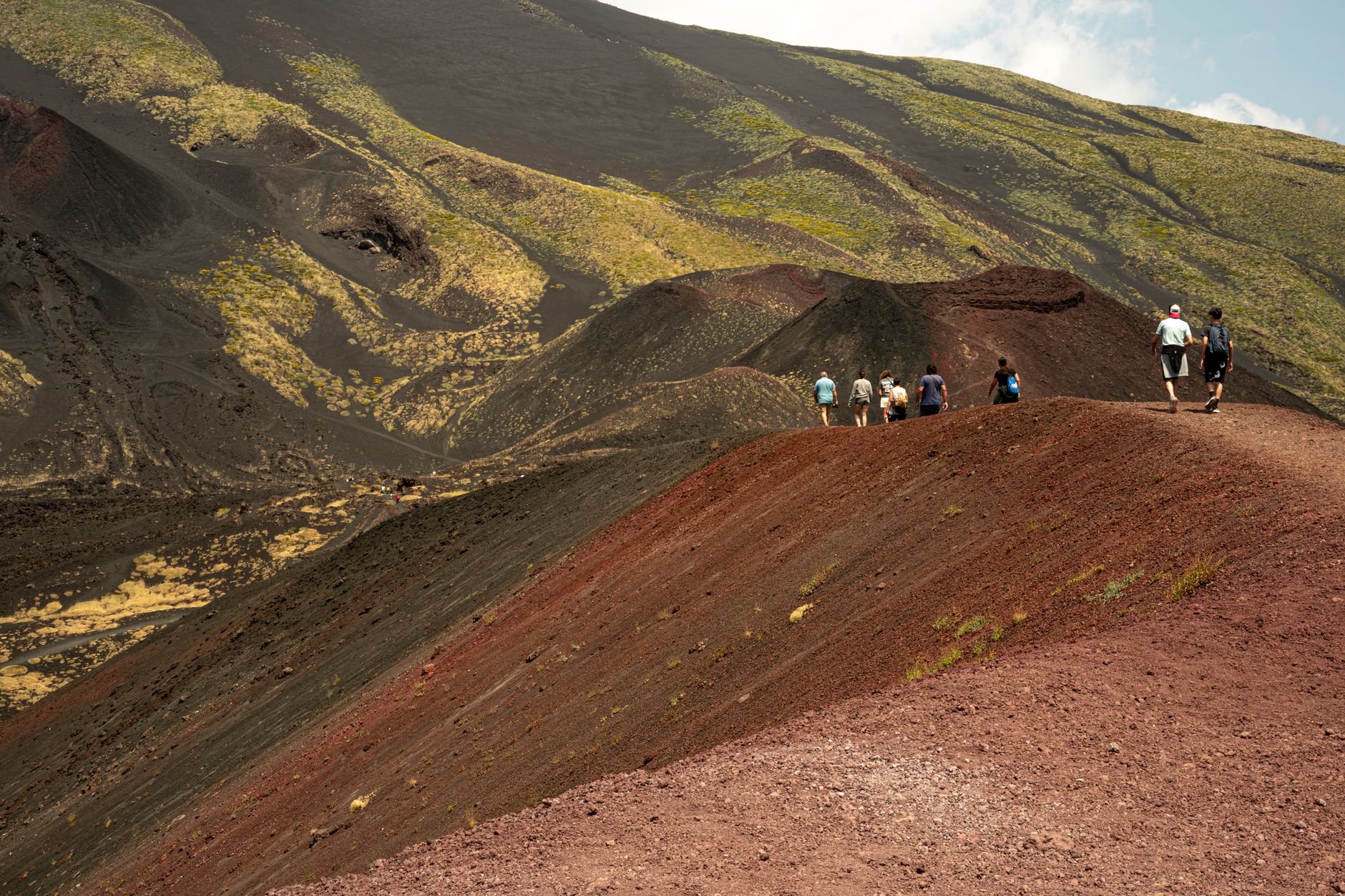
Day 2 is the Etna day — the defining geographic fact of Catania, visible from the square where you drank your granita yesterday, now close enough to walk on its lava fields. Two approaches exist and they deliver different experiences: the budget-independent bus route and the guided group tour. Overnight: Catania.
The AST bus (AST Sicilia — the regional public transport operator) departs from Piazza Papa Giovanni XXIII, just outside Catania Centrale station, at 8:15 AM. It reaches Rifugio Sapienza — a mountain refuge and lower cable car station at about 1,900 metres — in roughly 90 minutes. From there, marked trails cross the lava fields around the base craters; or take the Funivia dell'Etna (the cable car) to 2,500 metres. The summit crater rim at 3,357 metres is accessible only with a licensed guide, appropriate gear, and conditions permitted by INGV (Istituto Nazionale di Geofisica e Vulcanologia — Italy's national volcanic monitoring body). Check INGV's activity alerts before you leave: ingv.it/en. The AST bus returns from Rifugio Sapienza at 4:30 PM.
If you want to go higher than 2,500 metres, or if the landscape walk feels thin without context, guided group tours solve the access and orientation simultaneously. They include transport from Catania, a licensed guide for the summit zone, and typically a stop at an Etna DOC winery. Etna DOC — Denominazione di Origine Controllata, Italy's controlled wine appellation — is the vine zone between 600 and 1,000 metres, where Nerello Mascalese grows in volcanic soil and produces one of Italy's fastest-developing reds. Ask to taste in the cellar; most operators who stop at a winery include a sit-down tasting if you request it when booking.
Quick reference — Day 2
- AST bus (Catania → Rifugio Sapienza, ~1,900m): departs Piazza Papa Giovanni XXIII at 8:15 AM daily (some holiday exceptions), ~€3–4 each way. Returns 4:30 PM. Walk-up.
- Funivia dell'Etna (cable car to 2,500m): Verify current pricing at funivia-etna.com — last cited rate €52 round trip (Trails of Sicily, March 2025; may have changed).
- Guided group tours: from ~€60 per person; include transport, guide, often lunch/wine tasting. Advance booking recommended in peak season (April–October). (GetYourGuide, 2026)
- INGV volcanic activity alerts: ingv.it/en — check before departing.
- Crater rim above 3,000m: licensed guide required.
Day 3: Catania's working morning, then Taormina
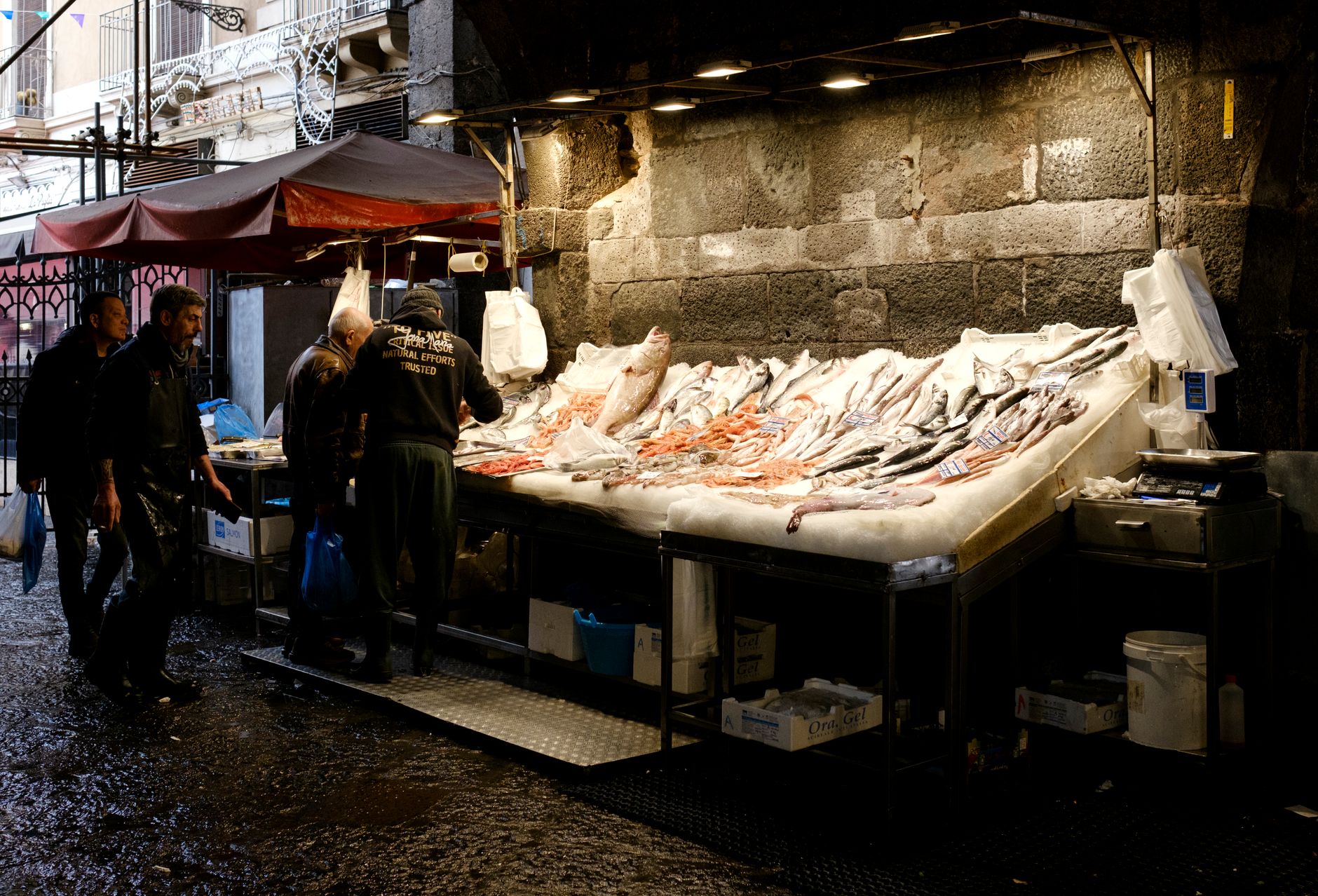
Day 3 front-loads the Catania anchors you haven't hit yet — the fish market and Castello Ursino in the morning, a pasta alla Norma lunch, the San Berillo street art district after — then takes the afternoon train north to Taormina. The sequencing matters: the Pescheria closes by noon and must come first. Overnight: Taormina.
The Pescheria (La Piscaria, the fish market) opens at 7:00 AM in the sunken square directly behind Piazza del Duomo, and it is already in full noise by the time you arrive. A fishmonger in white rubber boots slaps a swordfish flat on the marble counter and shouts a price in Sicilian dialect. The catch — sardines, anchovies, octopus, squid, whole swordfish — arrived from the harbor hours ago and sits on crushed ice under bare bulbs. This market has operated in essentially this form since the 1800s. It is not a food hall; it is the morning infrastructure of a working coastal city. Keep bags zipped and against your body — the market is specifically flagged as a pickpocket area. Arancini (fried rice balls — cone-shaped in Catania, distinct from the round form you'll find in Palermo) from a street vendor at the edge are the right follow-on, eaten standing before the morning cools.
From the Pescheria, walk southwest 15 minutes to Castello Ursino. Frederick II built the fortress in the 13th century as a coastal fortification. Then Etna's 1669 eruption extended the shoreline outward so dramatically that it stranded the castle inland, surrounded by new land. The sea it once overlooked is now several blocks away. The Museo Civico inside covers Greek, Roman, and Norman collections; allow an hour.
Lunch is the moment the Bellini thread lands. The destination: Trattoria del Cavaliere (open since 1922) or Trattoria de Fiore (no written menu — the waiter tells you what came in today; order what the table beside you ordered). The dish: pasta alla Norma — rigatoni with fried eggplant, tomato sauce, and grated ricotta salata, a firm, salted dried ricotta that shaves over the pasta like aged cheese. The dish is named for Bellini's opera Norma. The opera was composed by a man born two blocks from where you're sitting. His name is on the airport where you landed. This is not decorative local color — the thread runs all the way through.
After lunch, ten minutes north of Piazza del Duomo, is San Berillo. The neighborhood operated as Catania's red-light district until the 1950s and has since become a large-scale street art and urban regeneration zone through the Trame di Quartiere initiative. The murals run the full height of building facades; CityMapSicilia compares the district's scale and quality to Berlin's East Side Gallery. It's a specific and honest picture of what Catania does with its rougher edges. Visit in daylight. Download the self-guided tour from CityMapSicilia.it before you go.
Collect your bag and take the afternoon train north. If service is running: Trenitalia regional, Catania Centrale → Taormina-Giardini, 36–51 minutes. The station sits at the base of Taormina's hill; the local Interbus line or a taxi takes 10 minutes to reach town. If the Messina–Syracuse disruption is still ongoing: Interbus or Etna Trasporti buses from Catania to Taormina bus station run approximately 1.5–2 hours. See the Quick reference for both options and verify at Trenitalia.com before you book.
Quick reference — Day 3
- La Pescheria: Free. Mon–Sat, 7:00 AM–noon (often earlier if the catch sells through). Keep bags zipped; pickpocket area. (FreeTourCommunity.com, 2025)
- Castello Ursino / Museo Civico: Entry fee — check locally for current pricing.
- Pasta alla Norma lunch: Budget €8–€15 full lunch. Trattoria del Cavaliere: ~€6.50 for the pasta (GamberoRossoInternational.com). Trattoria de Fiore: verbal service, no written menu.
- San Berillo street art: Free. Daytime only. Self-guided map: CityMapSicilia.it. (CityMapSicilia.it, 2025)
- Train Catania Centrale → Taormina-Giardini: from €6.67 one-way, 36–51 min (Trainline.com, 2026). Verify Trenitalia.com — Giardini-Taormina to Messina section suspended as of June 2026 (Storm Harry); partial restoration ongoing. Bus alternative: Interbus/Etna Trasporti Catania → Taormina bus station, ~1.5–2 hours.
- Taormina hill climb from station: Interbus local line or taxi, ~10 min.
Day 4: A full day in Taormina

The overnight allocation in Taormina is what separates this circuit from a day trip, giving you the early mornings and late evenings that visitors commuting up from Catania never reach. You arrive after the day-trippers have settled in for dinner. You leave the next morning before they bus in. The town's quiet hours — early morning and late evening — are yours. Overnight: Taormina.
Start at the Teatro Antico di Taormina (Greek theater, 3rd century BC, rebuilt by the Romans) before 9:00 AM. The theater sits on a clifftop at the northern end of town. You walk through the entrance and the seating tiers open outward: sea behind the performance space, Mount Etna on the horizon above the stage house. The scale of it — two thousand years of continuous use in a space that makes the Ionian Sea and a live volcano the permanent backdrop — is the thing photographs can't prepare you for. Find a row midway up and sit for a few minutes. Performances still run in summer; if an evening show coincides with your stay, book it.
Corso Umberto I, the pedestrianized east–west spine of the town, runs past ceramics shops, cafés, and medieval fortifications. Taormina is genuinely expensive and genuinely crowded in peak season — this is what it is, and there's no framing that changes it. The honest version: walk the Corso, have a coffee, and spend the bulk of your time at the theater and at the cove below rather than trying to find a quieter version of this town that doesn't exist in July.
In the afternoon, take the cable car down to Mazzarò and the Isola Bella (Beautiful Island) nature reserve. It's a small island connected to the shore by a narrow sand bar, accessible by a short walk across the spit at low water. The cove is the most reliably swimmable stretch of Ionian coast on this circuit without a car. If the water is calm, rent a pedalo or kayak from the beach vendors; the island is best seen from the water. Late afternoon light on the bay, with Etna on the horizon, is worth the descent. Check the cable car schedule and fare locally.
Evening dinner on or near Piazza IX Aprile — the main belvedere terrace, where the view over the Ionian at dusk earns its reputation. Order the house wine, eat slowly, and watch the light go. Side streets off Corso Umberto I have somewhat better value than the main-strip restaurants if the terrace prices are too steep.
Quick reference — Day 4
- Teatro Antico di Taormina: Check current entry fee locally; allow at least 1.5 hours. Evening performances in summer — check Taormina Arte for schedule.
- Corso Umberto I: Free, pedestrianized. Busy from mid-morning in peak season.
- Cable car (Taormina → Mazzarò / Isola Bella): Check schedule and fare locally.
- Piazza IX Aprile: Free to walk; restaurants on and near the terrace, side streets slightly cheaper.
Day 5: Syracuse and Ortigia from Taormina, then back to Catania

Syracuse is the strongest single day in eastern Sicily and the structural reason this circuit earns a fifth day rather than stopping at four — two thousand years of layered city packed into a compact area you cover entirely on foot. The overnight return to Catania is the circuit completing itself: you came in through CTA, you close through CTA, and the city of Bellini gets the final evening. Overnight: Catania.
Leave Taormina-Giardini station by 9:00 AM to put 5–6 hours in Syracuse before the return. If trains are running, the route skirts the coast south through Catania and continues to the mainland edge of Ortigia; it's one of the better scenic rail segments in Sicily. If not, Interbus runs Taormina to Syracuse directly — verify and check current schedules before you leave.
Start at the Neapolis Archaeological Park — the ancient civic zone of Syracuse — on the western hill. The Greek theater carved from the limestone hillside in the 5th century BC is the anchor: 67 rows of seats cut directly from rock, still used for summer performances every other year. Below it, the Ear of Dionysius is a 65-metre cave whose acoustic properties are so pronounced that a whisper carries from the far end to the entrance. Stand near the back and speak at normal volume to test it; the cave still works. The legend attached — that Dionysius I imprisoned his enemies here and eavesdropped on their conversations through the acoustics — has been told since the painter Caravaggio named the cave on a visit in 1608. Probably apocryphal. The cave is worth the walk in regardless.
Cross the two short bridges to Ortigia — the ancient island that forms the historic core of Syracuse, continuously inhabited since the 8th century BC. At the near end, the Temple of Apollo has two original Doric columns intact from the 6th century BC, embedded in later construction. The columns surfacing from the wall of a medieval building tells you everything about how long this island has been in use. At the center, the baroque Piazza del Duomo holds a cathedral built onto the original shell of a Greek temple; the ancient column drums are still visible inside the nave. Walk south to the Spring of Arethusa — a freshwater spring that surfaces at sea level at the island's southern tip, surrounded by papyrus plants. The spring opens onto the harbor, and the geographic improbability of it (freshwater appearing at the sea's edge) is the reason the Greeks explained it with a myth about a river god pursuing a nymph under the Ionian from Greece. Pause for a few minutes; the continuity of the place is available if you let it be.
For lunch, sit at one of the seafood restaurants on or near Ortigia's central piazza and order whatever came in that morning. The fish is the same quality as the Pescheria in Catania, just plated.
Late afternoon: train or bus back to Catania Centrale. Check into your accommodation. The city is the right place to spend the night before a morning flight — better transport to CTA, lower prices than Taormina, and the Alibus in the morning with no hill to negotiate first.
Quick reference — Day 5
- Train Taormina-Giardini → Siracusa: ~1.5–2.5 hours; varies by service and disruption status. Verify Trenitalia.com — service between Syracuse and Giardini-Taormina reportedly resumed January 24, 2026, but confirm before booking. Bus alternative: Interbus Taormina → Siracusa — check current schedule at Interbus.
- Neapolis Archaeological Park (Greek theater + Ear of Dionysius): Ticketed; check current pricing locally. Allow 2 hours. Greek theater: 5th century BC, 67 rows of seats cut from the limestone hillside (Wikipedia, Greek Theatre of Syracuse). Ear of Dionysius: 65-metre cave; named by the painter Caravaggio on a visit in 1608 (Wikipedia, Ear of Dionysius).
- Ortigia island: Free to walk. Continuously inhabited since the 8th century BC, when Corinthian settlers founded Syracuse here in 734 BC (Sicily-visitor.com). Temple of Apollo: free (exterior); 6th century BC, two original Doric columns still visible (Wikipedia, Temple of Apollo, Syracuse). Piazza del Duomo cathedral: check locally; built over the 5th century BC Temple of Athena — ancient column drums still visible inside the nave (italythisway.com). Spring of Arethusa: free.
- Train/bus Siracusa → Catania Centrale: ~1 hour 15 min by train from ~€8.95–€10 one-way (Trainline.com, 2026); last train ~23:10.
The circuit close
The five-day structure closes where it opened: Catania Centrale, the Alibus, the same airport named for the same composer whose pasta you ate on Day 3 — no backtracking, no rental car to return in a different city. The circuit is self-contained.
For travelers with seven or more days, there is a second trip worth knowing about. An open-jaw ticket — flying into one city and home from another, so you never retrace the same ground — makes the full island circuit possible. Fly in CTA and exit from Palermo (PMO), moving west through the Baroque southeast (Ragusa, Noto, Agrigento's Valley of the Temples) before landing in Palermo. Travel forums consistently recommend the CTA-in, PMO-out direction as slightly easier to price and book than the reverse. That's a different trip. This one ends with coffee in Piazza del Duomo and a 20-minute bus ride to the terminal.
Practical notes
This circuit runs best in April through June and September through October: temperatures are manageable, the sea is warm from late May, and Taormina's streets are navigable outside the July–August peak. If you travel in July or August, expect Taormina at full capacity — tour-group buses arrive from Catania by mid-morning, and overnight stays only partially buffer the density. The honest note on high-season Taormina: it's still worth it for the theater and the views; it's just not a quiet experience.
The Trenitalia Messina–Syracuse line disruption from Storm Harry (January 2026) was live and ongoing as of June 2026. The section between Giardini-Taormina and Messina remained suspended with bus replacement. The Catania–Taormina and Catania–Syracuse legs had partial restoration. Verify current status at Trenitalia.com before booking. If buses are your only option for Day 3 and Day 5, budget an extra 45–60 minutes per leg and check current Interbus schedules.
Money: tipping is not expected in Sicily. Locals round up or leave small change; 10% is generous by local standards. Restaurant bills typically include a coperto (a cover charge of €1–2 per person for bread and table service — this is standard, not a tip). Cards work at hotels and most restaurants; carry €20–30 cash for the fish market, street food, and smaller trattorias.
Language: Italian is the operating language; Sicilian dialect in the markets. English coverage is moderate in tourist areas — functional at hotels and main-strip restaurants, sparser at the Pescheria and at local trattorias without menus. A few words go a long way: Quanto costa? (How much?), Il conto, per favore (The bill, please).
The fish market closes earlier than any guide will tell you. Plan to arrive by 8:00 AM on Day 3 and you'll be fine; arrive at 11:30 and you'll find ice and a few stragglers.
ETIAS (Electronic Travel Information and Authorization System) is expected to launch for US citizens Q4 2026. If active when you travel, US citizens need a pre-travel ETIAS authorization (€20; exempt under 18 and over 70). It's not a visa, but it must be obtained before departure. Verify current status closer to your travel date.
- ETIAS launch timeline: expected Q4 2026 for US citizens; €20 fee; under-18 and over-70 exempt. (Kiplinger, 2026)
Aci Trezza and the Cyclops Riviera: if you have a spare morning on Day 1 or a slow morning on the Day 5 return, the fishing village of Aci Trezza sits 14 km north of Catania. Eight basalt sea stacks (Faraglioni) rise from the bay — the rocks Polyphemus supposedly threw at Odysseus in the Odyssey, though they are volcanic, not limestone, unlike the famous stacks off Capri. Interbus runs there in about 30 minutes. Boat tours around the stacks run roughly €15–25 per person. It's a half-morning, not a full day — best combined with an easy launch into the city rather than as a standalone excursion.
- Aci Trezza boat tours: roughly €15–25 per person. (SavoringSicily.com, 2025)
Planning Sicily? Two more guides worth a look: the best day trips from Catania and Catania vs Palermo: which gateway.
Frequently asked questions
Is 5 days enough to see eastern Sicily?
Five days covers the full eastern circuit: two nights in Catania for Etna and the city, two nights in Taormina for the clifftop theater and the beach cove, and a fifth day as a full day trip to Syracuse before returning to Catania that evening. The pace is full but not frantic, and no rental car is required if trains are running.
Do I need a rental car for the Catania–Taormina–Syracuse circuit?
No. Trenitalia regional trains connect Catania to Taormina-Giardini (36–51 minutes, from €6.67 one-way) and Catania to Syracuse (about 1 hour 15 minutes, from around €8.95). If the Messina–Syracuse line disruption from Storm Harry is still ongoing when you travel, Interbus and Etna Trasporti buses cover both legs with roughly similar journey times. Verify status at Trenitalia.com before booking.
How do I get from Catania to Taormina by train?
Take a Trenitalia regional from Catania Centrale to Taormina-Giardini — 36–51 minutes, from €6.67 one-way (Trainline.com, 2026). The station sits at the base of Taormina's hill; the local Interbus line or a taxi takes 10 minutes to reach town. Note: as of June 2026 the Giardini-Taormina to Messina section of the line remained suspended from Storm Harry, with Trenitalia bus replacement — verify Trenitalia.com before booking.
How do I get from Catania to Syracuse (Siracusa)?
Take a Trenitalia regional from Catania Centrale to Siracusa — about 1 hour 15 minutes, from around €8.95–€10 one-way (Trainline.com, 2026). The line runs south along the coast and deposits you a short walk from Ortigia. If trains are disrupted, Interbus operates Catania to Syracuse directly — check current schedule at interbus.it. Always verify at Trenitalia.com before booking.
Is the Trenitalia line to Taormina and Syracuse currently running?
As of June 2026, the section between Giardini-Taormina and Messina remained suspended following Storm Harry (January 2026), with Trenitalia bus replacement operating. Service between Syracuse and Giardini-Taormina resumed January 24, 2026. The situation is live — always verify current status directly at Trenitalia.com before booking any leg of this circuit.
What is pasta alla Norma?
Pasta alla Norma is Catania's signature dish: rigatoni with tomato sauce, fried eggplant, and grated ricotta salata, named after Bellini's opera Norma. Vincenzo Bellini was born in Catania in 1801, and the dish is a local tribute — the name ties the food to the opera to the city in one thread. Trattoria del Cavaliere (open since 1922) is a reliable benchmark, with pasta alla Norma around €6.50 (GamberoRossoInternational.com).
When is the best time to do the eastern Sicily circuit?
April through June and September through October are the strongest windows: warm weather, sea swimmable from late May, and Taormina's streets are manageable before the July–August peak. July and August are very hot (high 30s°C) and Taormina fills with tour groups by mid-morning even with overnight stays. The Sant'Agata festival (February 3–5) draws up to one million visitors to Catania — spectacular if you plan for it, but accommodation books months in advance.
Should I base myself in Catania or Taormina for eastern Sicily?
This circuit's answer is both: two nights in Catania (airport arrivals, Etna base), two nights in Taormina (early mornings before day-trippers arrive, evening after they leave), and one final night in Catania as a flight buffer. Catania is grittier, more affordable, and better connected; Taormina has the views and the theater. One Rick Steves Forum contributor described it as Taormina being Miami and Catania being Philadelphia — both worth your time, entirely different experiences.