
Sant Sadurní d'Anoia in a Day from Barcelona
Sant Sadurní d'Anoia is a Catalan town of 12,000 people, roughly 47 km southwest of Barcelona, where approximately 95% of all Spanish cava (the sparkling wine made by the same méthode traditionnelle — second fermentation in the bottle — as Champagne) is born. You're flying into Barcelona, and Sant Sadurní d'Anoia earns a day trip out of that city for a reason that has nothing to do with brand names. The cava in every Barcelona bar comes from here, and the only way to watch it made is to come to the source. Underground, you can ride through 30 kilometres of tunnels at Codorníu's Modernista (Catalan Art Nouveau, roughly 1888–1920) estate, or stand in front of the riddling racks at Freixenet's caves while a guide turns the bottles a quarter-twist by hand, the way it has been done since the méthode crossed the Pyrenees. The R4 train from Barcelona Sants takes 65 minutes. And because everyone rides, everyone in your group can drink.
Why Sant Sadurní d'Anoia from Barcelona
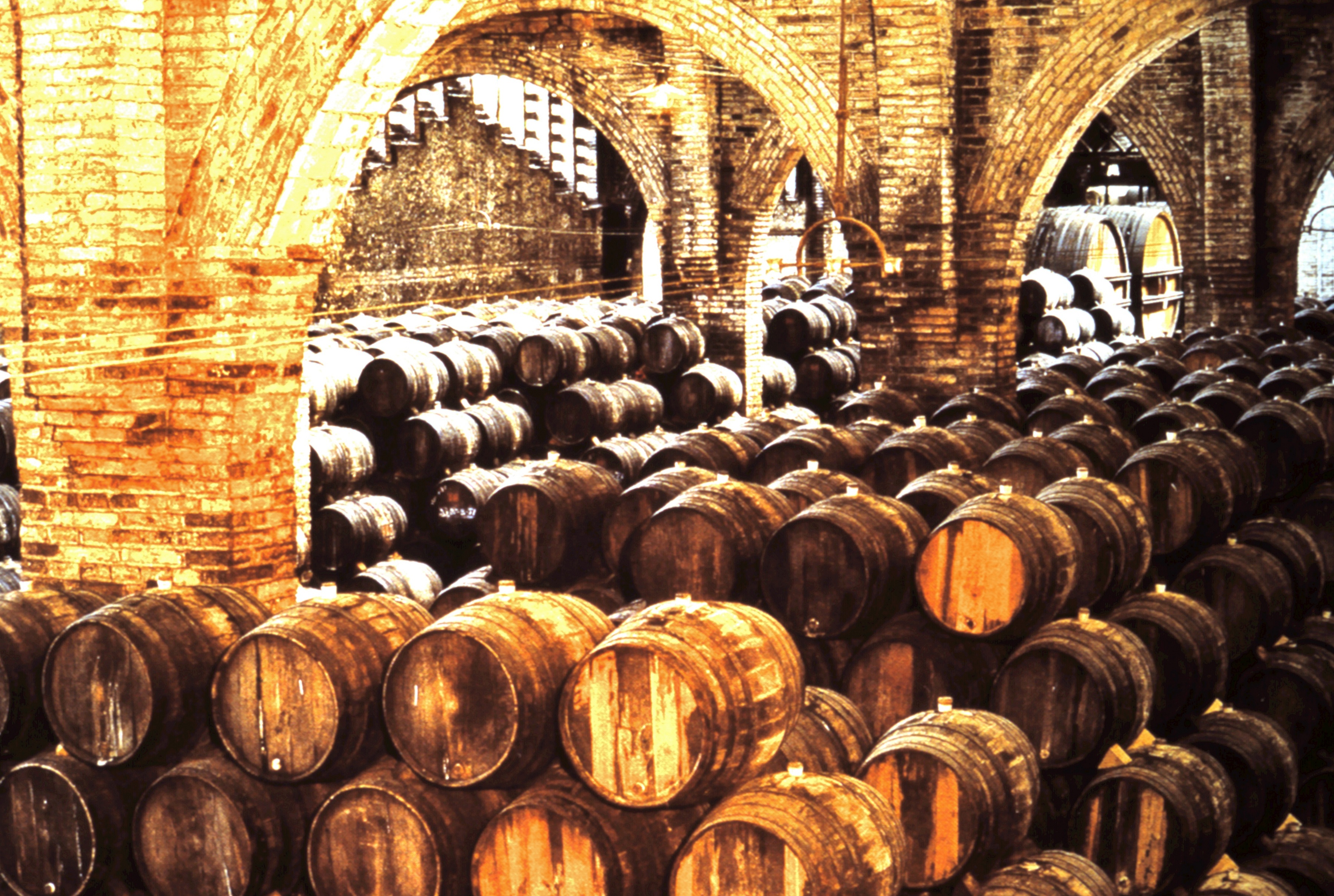
Sant Sadurní earns the trip on three things Barcelona cannot give you: a cellar visit at production scale, a Modernista estate that is a national heritage monument, and small-producer cava that never reaches the city's shelves. The first is the cellar itself. Freixenet's guided cellar-train moves through tunnels dug in the early twentieth century, and the scale is theatrical — millions of bottles aging in the dark, turned and tilted on their long second fermentation. This is the part of the wine that happens out of sight, and you only see it here.
The second is the architecture. Josep Puig i Cadafalch designed the Codorníu estate, a Modernista cellar of parabolic arches and ornate brick that frames the vineyards it draws from. Barcelona has his townhouses; it does not have a working winery built in his hand. The third is the wine that stays local. Small producers like Gramona, working under the stricter Corpinnat appellation (a breakaway group of cava houses that imposed tighter provenance and aging rules than the standard ones), make runs too small for Barcelona retail. You drink them at the source or not at all.
Barcelona has excellent cava bars — Can Paixano near the Barceloneta is a genuine institution, a wall of bottles and a crush of people ordering by the glass. But the production visit, the Puig i Cadafalch architecture at estate scale, and the boutique Corpinnat range are not in the city. That combination — not the brand names — is what makes the trip worth the train ride.
Getting there from Barcelona
The Rodalies R4 from Barcelona Sants to Sant Sadurní d'Anoia is the way to make this trip work, for a logistical reason and an honest one both: this is a tasting day, and rail is the only mode that lets everyone drink. Cellar visits at Freixenet and Codorníu pour two or three glasses across a 90-minute tour. The town has no Uber or Bolt, and local taxis are not abundant. Drive, and one person in your group is the designated driver from the first pour. Take the train, and that problem disappears — the ethical and the logistical case land on the same answer.
The R4 runs direct from Barcelona Sants — you can also board at Plaça de Catalunya and Arc de Triomf — to Sant Sadurní d'Anoia, no seat reservation needed. Buy tickets at station machines, on the Rodalies site, or through Omio, the only official third-party seller for this route; Trainline and RailEurope do not sell Rodalies tickets. Walk-up is fine and there's no advance-booking premium. Driving is possible only with a strict designated-driver arrangement, and it buys you nothing on a tasting day.
Quick reference
- R4 journey: approx. 65 min, direct; roughly every 30 min at peak, approximately hourly off-peak (Rodalies de Catalunya R4 timetable, June 2026).
- Round-trip fare: approximately €8–€12 per person, zone fare (Omio / Rodalies de Catalunya, June 2026) — confirm current zone pricing at rodalies.gencat.cat before travel.
- Drive alternative: Barcelona to Sant Sadurní approximately 47 km via AP-7/C-15 (ViaMichelin, June 2026) — incompatible with full tasting participation unless one person abstains.
Freixenet is a 2-minute walk from the station exit. Turn left out of the station and the complex is immediately in front of you. No taxi, no logistics.
Codorníu is not walkable from the station — 2–3 km along a road with no safe pedestrian path. From the station, take a local taxi from the taxi rank (approximately €5–€8, around 5 minutes). The SSDA L1 bus is an alternative but runs on a limited schedule — check times at penedesturisme.cat before relying on it. If you want Codorníu transport included in the price, an organised day tour from Barcelona (Viator, GetYourGuide, Civitatis, Runner Bean Tours) handles the transfer, typically from approximately €55 for a half-day Codorníu-only option (operator listings, June 2026).

A day in Sant Sadurní d'Anoia
A single day here covers the whole arc of cava — the Cava Centre's orientation, Freixenet's underground spectacle, a Catalan lunch, Codorníu's Modernista estate, and a closing pour at a small producer. The spine is fixed by geography: Freixenet in the morning, lunch in town, Codorníu in the early afternoon. The Cava Centre, the town walk, and Gramona are the flexible stops you fit around it. Leave Barcelona by 09:00 to catch Freixenet's first tour and still reach Codorníu before its last afternoon slot.
Cava Centre — production context before the cellars
The Cava Centre is a 60-minute orientation that pays for itself across the rest of the day, set inside the former La Fassina de Can Guineu building a short walk from the station. The exhibition walks you through the grapes, the chalky soil, the méthode traditionnelle, and the DO Cava denominación de origen rules — so by the time you stand in Freixenet's tunnels, you already understand what you are looking at. Come here first and the cellars stop being a blur of dark corridors and become a process you can follow bottle by bottle. If the morning runs tight and you go straight to Freixenet instead, the Centre also works as an afternoon wind-down between Codorníu and the town walk.
Quick reference
- Cava Centre: approximately €6 per adult; guided visits Tuesday–Sunday (Cava Centre official / santsadurni.cat, June 2026). Combined tickets with Freixenet available — worth checking at booking.
- Walk from station: approximately 5–10 minutes.
Freixenet Caves — the cellar-train at industrial scale
Freixenet sits two minutes on foot from the station exit — the most frictionless cellar visit in the cava region, and the one that shows you the second fermentation up close. The 90-minute tour rides a small tourist train through the 1920s underground cellars, and somewhere in the dark a guide stops at the riddling racks and turns a bottle a quarter-twist, the remuage (the gradual rotating and tilting that walks the sediment down into the neck before disgorgement) that every méthode-traditionnelle wine passes through. The tour ends with a tasting of two cavas. Book ahead — Freixenet does not take walk-ins.
The draw here is not the Freixenet brand. You can buy their black-bottle Cordon Negro in any Barcelona supermarket. What you cannot do in the city is ride through a quarter-kilometre of century-old cellar tunnels and watch sediment hand-coaxed out of bottles at the scale of a house that makes roughly 250 million of them a year. It is industrial heritage, and it is genuinely impressive in the way large infrastructure tends to be — the same way a working dock or a grain elevator is, except it ends in a glass.
Quick reference
- Standard tour: 90 min, multilingual (English, Catalan, Spanish, others); ends with a 2-cava tasting. Adult approximately €19.50; concessions for ages 65+, students, children (Freixenet official / Penedès Turisme, June 2026).
- Booking: required, no walk-ins. Book at freixenet.com or via Barcelona Turisme's shop.

Catalan lunch in the town centre
A long lunch in the town centre is the right break between two tours, a five-to-ten-minute walk from Freixenet along Carrer del Dr. Zamenhof toward the Plaça de la Vila. Sant Sadurní's restaurant scene is solid and honest — a cluster of Catalan tables fills the centre, and the menu del día (the fixed lunch menu standard across Catalonia) is the midday move. You have had one 90-minute tour; you are about to have another. A proper meal rather than a snack is part of what keeps a two-cellar day feeling spacious instead of crammed.
The kitchen here runs on chargrilled meats, escalivada (roasted aubergine and peppers), bread rubbed with tomato and olive oil, and whatever the Penedès plains are growing that week. Order a cava by the glass from a house you have never heard of — the town's restaurants pour small-producer ranges that never make it onto a Barcelona wine list, and the waiter will tell you which field it came from if you ask.
Codorníu Caves — architecture and underground scale
Codorníu is the place where Spanish sparkling wine begins — the country's oldest winery, founded in 1551, and the cellar where Josep Raventós made the first Spanish cava in 1872 after a trip to Champagne convinced him the method would travel. The estate you walk through was built later, between 1902 and 1915, when Josep Puig i Cadafalch raised a Modernista cellar of parabolic arches, ornate brick, stained glass, and sculpted facades — declared a national heritage monument in 1976. Below it, the cellars run for kilometres across three storeys, holding bottles by the hundred million in the cool and the dark.
The visit's second draw is that architecture. Barcelona has Puig i Cadafalch's Casa Quadras and his Palau del Baró de Quadras — civic buildings now repurposed as cultural centres. What the city does not have is his vocabulary applied to a working production facility, the parabolic arches framing vineyard views with the cellars running directly beneath the historic rooms. It reads as something you do not expect to find attached to a cava brand: a cathedral built for wine.
Quick reference
- Iconic Tour: approximately 75 min — cellar train, walk through the historic estate buildings and gardens, tasting of three premium cavas with a small snack. Adult approximately €16–€25 by tour tier (Codorníu official, codorniu.com/en/visits, June 2026 — verify current pricing before booking, as tiers vary). Multilingual; advance booking strongly recommended.
- Getting there: taxi from the station approximately €5–€8 (5 min); from Freixenet directly approximately €8–€10 (10 min).
- History/scale: founded 1551; first Spanish cava made here by Josep Raventós, 1872; estate by Josep Puig i Cadafalch, 1902–1915, national heritage monument 1976; cellars approximately 30 km across three storeys, over 100 million bottles.
Modernista town walk — wine-industry architecture in a working town
The town walk is worth the time because it shows you what cava money built when it stayed home: thirteen Modernista buildings raised by the cava families who funded Sant Sadurní's expansion around the turn of the twentieth century. The Plaça de la Vila, the Town Hall, the facades along Raval Street, and smaller houses like Cal Rigol and the home of Lluís Mestres make a loop you can walk at an unhurried pace; the Agricultural Athenaeum is part of the circuit too. Entry is free.
This is not Gaudí-scale spectacle, and that is the point. These are working-town buildings, lived in rather than cordoned off, and the reward is the concentration — all thirteen reflect the same span of wine wealth, on streets where people still hang laundry. Walk it after Codorníu and the context is already loaded; the modest brick towers read differently once you have spent the morning inside the grand version of the same vocabulary.
Quick reference
- Town walk: 13 Modernista buildings; Town Hall (1896–1900), Cal Rigol (1903), Lluís Mestres house (1909) among them. Approximately 45–60 min at an unhurried pace. Entry free.

Gramona — boutique producer for the wine-serious visitor
Gramona is the close to make if you want to taste what the big houses can't bottle: a small, family-run producer working under the Corpinnat appellation, where a handful of cava houses left the DO Cava system over provenance and aging rules and now hold themselves to stricter sourcing and longer aging than the denominación de origen demands. The wines that come out of that discipline are made in runs too small to travel broadly, which is exactly why you drink them here. Ranked among the world's fifty best vineyards to visit, Gramona pours in small groups, often with an English-language guide who can tell you how many extra months these bottles spent on their lees.
This stop suits the visitor who has already done one of the big cellars and wants the contrast of a small house. Solà Raventós is next door and worth adding to the booking for a second small-producer pour. On price, ask Gramona directly when you book — regional estimates float around, but the real number should come from the winery. If you are wine-curious rather than wine-serious, Codorníu already answers the curiosity and Gramona is optional.
Quick reference
- Gramona: Corpinnat producer; ranked among the world's 50 best vineyards (World's 50 Best Vineyards, accessed June 2026). Small-group guided visits, English available; booking required via gramona.com or penedesturisme.cat. Walkable approximately 10–15 min from the station. Confirm tasting price with the winery directly. Solà Raventós next door for a paired booking.
Back to Barcelona
The last R4 back toward Barcelona Sants leaves Sant Sadurní in the late evening, around 23:00–23:25 — a generous buffer that lets you sit down to a full dinner in town and still make the train without rushing. You came to Barcelona, but the wine in every bar there was made in this valley, and that is the case for the day: you spent it watching how, where everyone could drink.
The real constraint is not the last train but the cellars. Most guided tours run their final slots in the late afternoon, around 16:00–17:00, so plan backwards from there. A 09:00 departure from Barcelona, a 10:00 arrival, then Cava Centre, Freixenet, lunch, and Codorníu fills the day cleanly and leaves the late afternoon for the town walk or Gramona.
Quick reference
- Last R4 return: approximately 23:00–23:25 (Rodalies de Catalunya R4 timetable, June 2026 — confirm exact timing at rodalies.gencat.cat before travel, as schedules update periodically).
- Last tour slots: most cellars run their final guided tours around 16:00–17:00.
Practical notes
A Sant Sadurní d'Anoia day trip rests on two steps taken before you leave Barcelona, and skipping either is what turns a good day into a wasted one: book the cellar tours in advance, and confirm the R4 timetable for your travel date. Book the tours at freixenet.com and codorniu.com/en/visits; check the line at rodalies.gencat.cat on the day, because the R4 has had infrastructure disruptions historically and schedules update — confirm the service is running normally, especially on weekends and public holidays (Diari de Catalunya, June 2026).
Cellar booking lead times: a few days ahead is usually enough for weekdays; one to two weeks ahead for weekend slots at Freixenet and Codorníu; four to six weeks ahead for the Cavatast weekend (first weekend of October; 2026 dates: October 2–4). Turn up without reservations on a Saturday in September or October and you may find the main tours sold out.
Languages: Freixenet and Codorníu both run multilingual tours including English. For smaller producers like Gramona, English tours exist but confirm when booking. The town is Catalan-speaking; Spanish and basic English carry you through restaurants and shops.
The Simón Coll chocolate option: the Espai Xocolata Simón Coll (approximately €23.50 per adult as of 2026, espaixocolata.simoncoll.com) is a 50-minute guided tour of an artisan chocolate factory — a fair secondary draw if chocolate interests your group. Cava and artisan chocolate is a recognised local pairing, and Penedès Turisme runs a combined itinerary. It does not displace Gramona on a wine day, but if one person in your group does not drink, this is the right stop for them while the others taste.
Seasons: late August through September is the verema (grape harvest) season, when some cellars open vineyard access and the wine-tourism experience is at its fullest. The Cavatast festival (first weekend of October) brings 30-plus producers into the town centre — the best single chance to taste across the breadth of the Penedès range, but plan accommodation well ahead. If you stay overnight for Cavatast, hotel stock in town is limited; book three to six weeks ahead.
What to expect on return to Barcelona: the R4 drops you back at Barcelona Sants, Arc de Triomf, and Plaça de Catalunya in reverse order. The late-return schedule gives you every option — a quiet walk back to your hotel, or one more glass of cava at any of the city's wine bars, now with something specific to say about where it came from.
Making a longer trip of it? Two more easy escapes from Barcelona: a weekend in Girona and Roman Tarragona.
Frequently asked questions
Can I do Sant Sadurní d'Anoia as a day trip from Barcelona?
Yes. The Rodalies R4 runs direct from Barcelona Sants to Sant Sadurní d'Anoia in approximately 65 minutes, roughly every 30 minutes during peak hours. Freixenet is a 2-minute walk from the station. With advance booking for cellar tours, a full day covering two cellars, the Cava Centre, and a Catalan lunch is a comfortable itinerary with a late evening return train.
Do I need to book cava cellar tours in advance?
Yes — and this is the one thing that will derail the day if you skip it. Freixenet requires advance booking and does not accept walk-ins. Codorníu strongly recommends booking ahead; weekend and harvest-season slots fill. Book a few days ahead for weekdays, one to two weeks ahead for weekends, and four to six weeks ahead for the Cavatast festival weekend in early October.
How do I get from the Sant Sadurní train station to Codorníu — is it walkable?
No. Codorníu is 2–3 km from the station along a road with no safe pedestrian path. Take a local taxi from the station taxi rank — approximately €5–€8 for a 5-minute ride. The SSDA L1 bus is an alternative but runs on a limited schedule; check times before relying on it. Organised tours from Barcelona handle the transfer entirely, which is a reasonable reason to book one.
Freixenet or Codorníu: which cellar should I visit?
They offer different experiences. Freixenet is the lower-friction choice — adjacent to the station, a well-run 90-minute cellar-train tour, and impressive at industrial scale. Codorníu adds a genuine architectural draw: the Puig i Cadafalch Modernista estate (1902–1915) is a national heritage monument, and the 30 km of underground tunnels make for a more dramatic production experience. If you have time for both and want the architectural element, Codorníu is worth the taxi ride.
Can I visit both Freixenet and Codorníu in one day?
Yes, with planning. Book Freixenet for mid-morning (90-minute tour) and Codorníu for early afternoon. A taxi between the two runs approximately €8–€10 and takes about 10 minutes. Factor in lunch and the return taxi from Codorníu to the station. A departure from Barcelona by 09:00 leaves enough time for both tours, a sit-down lunch, and a comfortable late-afternoon or early-evening return.
What is cava, and how is it different from Champagne?
Cava is a Spanish sparkling wine made by the méthode traditionnelle — the same method as Champagne, with secondary fermentation in the bottle — but uses indigenous Catalan grape varieties: Macabeu, Xarel·lo, and Parellada, grown in the chalky limestone soils of the Alt Penedès. Around 95% of all cava comes from the Penedès region around Sant Sadurní d'Anoia. The result is a drier, slightly more mineral sparkling wine than most entry-level Prosecco, at a lower price point than most Champagne.
What is the best time of year to visit Sant Sadurní d'Anoia?
April through June is the quietest and most pleasant period for a standard cellar visit — comfortable weather and no crowd pressure. Late August through September is harvest season (verema — the grape harvest), when some cellars open vineyard access and the wine-tourism experience is richest, though booking a week or more ahead is advisable. The first weekend of October is Cavatast, with 30-plus producers in the town centre — excellent for variety, but book accommodation and trains well in advance.